



 TV · 2021
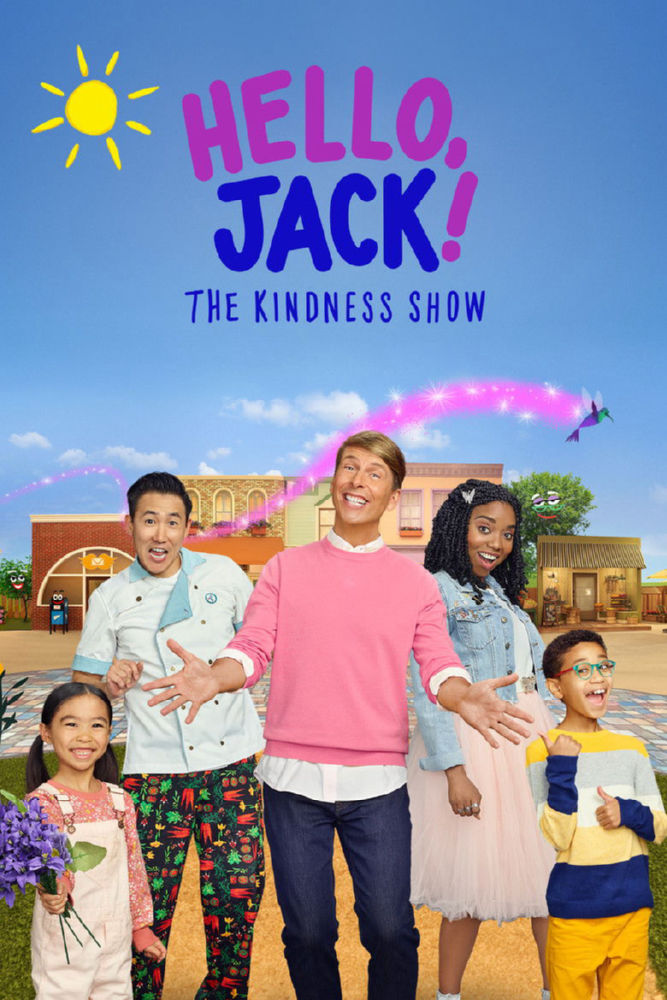
Hello, Jack! The Kindness Show
Jack greets the neighbors of Clover Grove with humor and heart, turning ordinary days into chances to share compassion, creativity, and imagination. His example invites the whole town to practice small acts of kindness.
Hello, Jack! The Kindness Show follows Jack, one of Clover Grove’s most thoughtful residents, as he opens each day with a cheerful hello and a ready laugh. He notices when a neighbor needs a hand, a listening ear, or a spark of imagination, and he answers with simple, concrete help rather than speeches. Songs, playful sketches, and make-believe games become his tools for showing how a kind word or shared idea can lift someone’s mood. Friends around town join his errands and experiments, learning patience, gratitude, and creative problem-solving beside him. Episodes stay rooted in ordinary street-level moments—greetings, small favors, and lighthearted mix-ups—so young viewers can copy the habits at home. Jack’s warmth sets the tone for the whole community without turning the stories into lectures.
As the series moves forward, Jack’s ties to the people of Clover Grove grow through repeated visits, joint projects, and gentle mishaps that still end in understanding. He steers tense moments back toward cooperation with humor and invites shy neighbors to take part so no one has to be kind alone. Musical numbers and imaginative play stretch each lesson so children can sing along and try the same ideas themselves. Townsfolk who once kept to themselves begin trading hellos, sharing chores, and celebrating small wins together. Jack never pretends to fix every trouble single-handed; he keeps drawing the group in until kindness feels like a shared habit. By the end of each outing the street feels a little warmer, and he is already ready for the next hello.
Oops! Is this show WOKE?
Only an account holder or member can file. Cite a scene, a line, or a pattern. Other account holders +1 or −1 that argument, once each. The show is not WOKE until enough of them have given a +1. Enough −1s remove the write-up, and it is no longer shown.
Sign in to file a woke label. One of each criterion per member.
Comments and reviews
Report a mistake
Same rule as woke labels: one report, a written reason, and the community +1 or −1 it — once per member. A net +5 applies the change. Editors can hold it for review, or apply it immediately.
No mistake reports yet.
Sign in to report a mistake. One report per field, per member.
Member review
Omar Quill Member
Oct 20, 2026
★★★★★★★★★★Hello, Jack! The Kindness Show is the kind of thing I ended up putting on in the background during long grinding sessions when I needed something low-stakes that wouldn’t pull my full attention away from a boss fight or a build tweak. I’m seventeen, I game a lot, and some nights the soundtrack of controller clicks needs a softer counterweight. This 2021 show filled that slot for a stretch. It never tried to be clever in a way that demanded focus, and that worked for me more than it probably should have.
Jack is the kid who starts every day like the map just loaded and he’s ready to clear every side quest the neighborhood has. He walks around Clover Grove saying hello, noticing when someone looks stuck, and offering a hand or a dumb little game or a song instead of a speech. The episodes stay small on purpose—someone drops groceries, a friend can’t decide what to draw, a mix-up with a borrowed tool turns into a shared afternoon. No big villains, no world-ending stakes. Just ordinary street-level moments that get stretched into half-hour lessons about patience and gratitude. I can see why that formula exists. When I’m deep into a multi-hour raid or trying to theory-craft a new loadout, I don’t always want plot density. I want something that moves at walking speed and doesn’t punish me for missing a line while I’m checking DPS numbers.
What kept me from rating it higher is how thin the texture gets after a few episodes. The kindness is real and consistent, which is fine, but the creative sparks feel recycled. Same pattern of noticing a need, inventing a playful fix, then the whole street joins in with a song or a make-believe game. It works the first couple times because Jack’s energy is genuine and the friends around him actually seem to learn something instead of just nodding. After that it starts feeling like the same side quest loop with different NPCs. In games I bounce off content that pads the same loop without new mechanics; here the “mechanics” are songs and sketches, and they don’t evolve much. I still finished a decent chunk of it because the tone never turned mean or preachy. It just stayed gentle. Gentle is rare enough that I didn’t hate the repetition the way I hate filler arcs in longer series.
I caught myself comparing the show’s problem-solving to how I approach tough builds. Jack doesn’t overthink. He picks a simple tool—shared idea, kind word, silly game—and applies it until the mood lifts. That’s closer to the way I finally beat certain bosses after hours of overcomplicating rotations: strip it back, do the obvious thing cleanly, and stop trying to look fancy. The show never says that out loud, but the pattern is there if you’re watching while half-focused on something else. Friends on the show pick up the same habit. They stop waiting for a perfect plan and just help. That part felt useful even if the packaging stayed childish.
There are stretches where the humor lands because it’s not trying hard. Jack’s laugh is ready without being forced, and the lighthearted mix-ups don’t rely on anyone being stupid for the punchline. When a neighbor needs a listening ear, the show actually lets the quiet sit for a beat instead of rushing to the next song. Those quieter beats are the ones I noticed most while my screen was full of health bars and cooldown timers. They give the kindness room to feel concrete instead of abstract. At the same time, the imagination games can tip into pure padding. Once you’ve seen three versions of “let’s pretend the sidewalk is a river,” the fourth one doesn’t teach anything new. I started skipping ahead a little, which is something I almost never do with shows I actually care about. That tells me the ceiling is lower than the floor is solid.
I’m not the target audience and I know it. The whole thing is built for younger kids who need the lesson repeated in bright colors. Still, I gave it 3.5 because it does what it claims without pretending to be deeper than it is. No lectures disguised as plot. No sudden left turns into heavier themes. Just a kid who treats ordinary days as chances to share a little compassion and creativity, and a town that slowly copies him. In a week full of high-stress matches and late-night farming, that simplicity was weirdly restful. I wouldn’t queue it up as my main entertainment, but I also wouldn’t turn it off if it was already playing. That’s an honest middle score. It earned the half-star above average by staying kind without getting sticky or fake about it, and it lost the rest by running the same friendly loop until the edges blurred.
If you’re looking for something that asks almost nothing of you while still modeling decent behavior, this fits. If you want characters who grow in complicated ways or stories that surprise you past the first few greetings, you’ll bounce off it the same way I started to. For me it sat comfortably in that background-TV zone next to chill playlist hours—present, pleasant, and easy to put down when the next raid invite popped. That’s enough for 3.5. Not special enough to recommend hard, not empty enough to dismiss. Just a steady little show that knows its lane and stays in it.