



 MOVIE · 2008
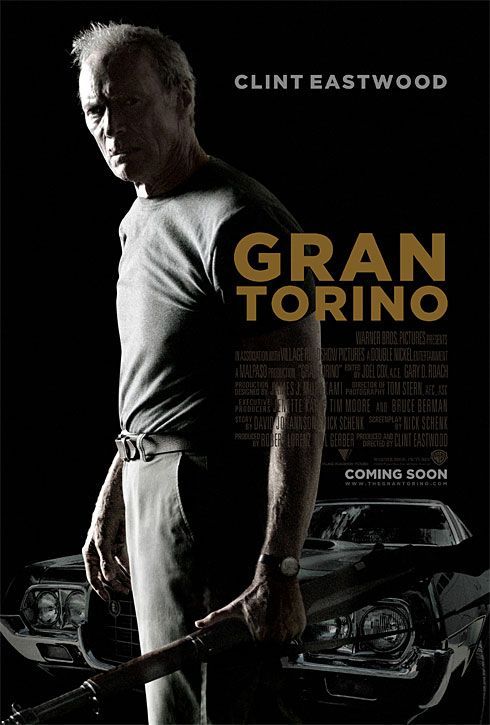
Gran Torino
A widowed Korean War veteran confronts his own bigotry when he takes a Hmong teenager under his wing after the boy tries to steal his classic car, then faces the gang that threatens the family.
Gran Torino follows Walt Kowalski, a recently widowed Korean War veteran and retired Detroit autoworker who lives alone with his dog and his meticulously kept 1972 Gran Torino. Surrounded by a changing neighborhood now filled with Hmong immigrant families, the gruff, foul-mouthed Walt openly resents his new neighbors and rebuffs the young priest who keeps trying to draw him back to church. When shy teenager Thao Lor is pressured by a local Hmong gang into attempting to steal the Gran Torino as an initiation, Walt catches him and drives the gang off his lawn with a rifle. Thao’s sister Sue later approaches Walt, explaining the family’s situation and gradually pulling the reluctant old man into their orbit. Walt begins assigning Thao odd jobs as repayment, teaching him how to work, talk to employers, and carry himself, while his own hard-edged views start to crack under the family’s everyday kindness.
As Walt’s bond with Thao and Sue deepens, the same gang that tried to recruit Thao escalates its harassment, assaulting Sue and later attacking Thao. Walt responds with the only tools he knows—intimidation, a show of force, and the lingering authority of a man who has seen combat—while still trying to keep Thao on a straight path toward a job and a future. Family tensions with Walt’s own distant adult children surface alongside the neighborhood conflict, underscoring how isolated he has become. The pressure culminates in Walt making a final, deliberate choice that protects the Lor family and settles the gang threat without turning Thao into another shooter. In the aftermath the Gran Torino itself becomes a quiet symbol of the unlikely friendship that rewrote the end of Walt’s life.
Oops! Is this show WOKE?
Only an account holder or member can file. Cite a scene, a line, or a pattern. Other account holders +1 or −1 that argument, once each. The show is not WOKE until enough of them have given a +1. Enough −1s remove the write-up, and it is no longer shown.
Sign in to file a woke label. One of each criterion per member.
Comments and reviews
Report a mistake
Same rule as woke labels: one report, a written reason, and the community +1 or −1 it — once per member. A net +5 applies the change. Editors can hold it for review, or apply it immediately.
No mistake reports yet.
Sign in to report a mistake. One report per field, per member.
Member review
Becky Soto Member
Oct 6, 2026
★★★★★★★★★★Gran Torino settled in with me longer than I expected after I finished it. I went in mostly for Clint Eastwood doing what he does best, that weathered stare and the low growl that can clear a room, and I got that in spades. Walt Kowalski lives alone in his Highland Park house after his wife dies, keeps his lawn neat, and treats the 1972 Ford Torino in the garage like the last good thing left from a life he mostly keeps locked away. He is not warm. He is not interested in the Hmong families who moved onto the block. He is especially not interested in anyone touching that car.
The moment that lodged itself in my head is the night Thao tries to take the Torino as a gang initiation. Walt stops it cold, rifle in hand, and the whole neighborhood freezes for a second. What follows is not a sudden conversion. Walt stays blunt, still mutters the old slurs, still acts like every interaction is an imposition. Yet little by little he starts pulling Thao into chores and errands. He shows the kid how to use tools, how to fix a loose step, how to stand up straight when he talks to someone. Those scenes feel plain and useful rather than staged for a lesson. Walt is handing over a kind of practical self-respect he never managed to give his own grown kids, who treat him like an inconvenience they would rather move into a retirement place.
Sue, Thao’s sister, is the one who really gets under Walt’s skin in the best way. She talks back, calls him out, and somehow ends up riding along on his errands while he grumbles the whole time. Their exchanges gave the movie its lighter stretch without turning soft. I kept thinking about how the family next door is dealing with real pressure from the local gang, and how Walt’s old soldier instincts slowly shift from protecting only his porch and his car to looking out for people he once wanted nothing to do with. The priest keeps stopping by after the funeral, trying to get Walt to talk, and Walt brushes him off with pure irritation until the visits start meaning something different. Everyday stuff like that builds the change instead of a big speech.
Eastwood directed it himself, and you can feel him letting the neighborhood breathe. The house, the street, the gatherings next door with food and relatives all feel lived-in. Daisy the dog is just there, quiet company on the porch while Walt drinks his beer and watches the world he no longer recognizes. The gang trouble escalates in a way that feels personal rather than cartoonish. Walt handles the threat the only way a man like him knows how, and the final choices he makes carried weight for me. I will not lay them out, but they fit the character he has been the whole time: stubborn, blunt, and finally willing to put himself between the people he has come to care about and the mess coming for them.
What I liked most is that the movie lets Walt be wrong without turning him into a pure villain or a sudden saint. His prejudices sit right on the surface, ugly and specific to his generation and his war, yet the story shows them cracking through repeated contact and shared work rather than through anyone delivering a monologue. Thao starts awkward and unsure, then slowly picks up the habits Walt drills into him. Their bond stays uneasy the whole way, which made it feel honest. Walt never becomes the gentle grandpa; he just decides these kids are worth the trouble.
I gave it four stars because the core relationship works and the performances hold it up. Eastwood is locked in as Walt, all gravel and reluctance with something raw underneath. Bee Vang grows into Thao without forcing it, and Ahney Her keeps Sue sharp in every scene opposite the old man. Some of the side family members stay thinner than I wanted, and the pace is steady enough that it might not grab someone looking for constant heat. Still, the quiet stretches on the porch, the hardware-store runs, the reluctant mentoring, those are the parts I carried away with me. It left me thinking about how isolation hardens a person and how one stubborn connection can start to loosen it. The Torino itself sits there as more than a car; it is the piece of the past Walt refuses to surrender until he finds something else worth guarding. I would sit through it again just for the way the small, ordinary moments accumulate into something that matters.