



 MOVIE · 1999
Girl, Interrupted
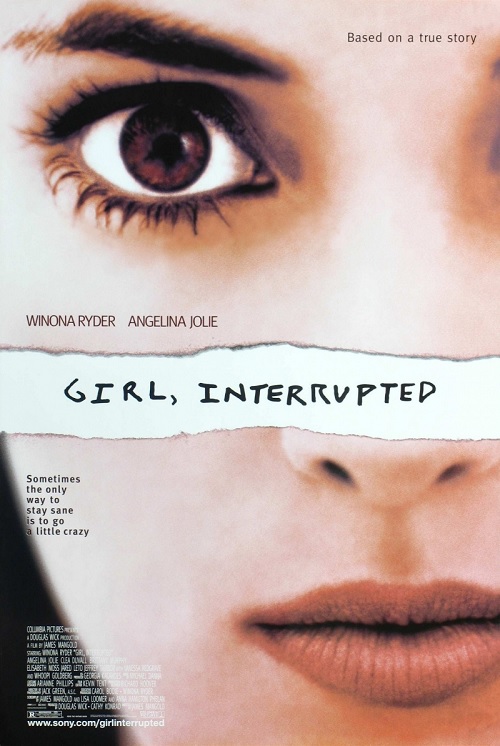
It's 1967, and 17-year-old Susanna Kaysen (Winona Ryder) is like a lot of teenagers: confused, insecure, struggling to make sense of the rapidly changing world around her. The psychiatrist she meets with (courtesy of her parents), however, gives this behavior a name, Borderline Personality Disorder, and whisks her away to Claymoore Hospital. Here, Susanna joins a shadow world of eccentric young women, among them charming sociopath Lisa (Angelina Jolie), pampered "Daddy's girl" Daisy (Brittany Murphy), and burn victim Polly (Elisabeth Moss). Guided by no-nonsense ward nurse Valerie (Whoopi Goldberg) and the hospital's head psychiatrist, Dr. Wick (Vanessa Redgrave), Susanna must choose between the worlds of those who belong on the inside of the institution and the often difficult world of reality on the outside.
Oops! Is this show WOKE?
Only an account holder or member can file. Cite a scene, a line, or a pattern. Other account holders +1 or −1 that argument, once each. The show is not WOKE until enough of them have given a +1. Enough −1s remove the write-up, and it is no longer shown.
Sign in to file a woke label. One of each criterion per member.
Comments and reviews
Report a mistake
Same rule as woke labels: one report, a written reason, and the community +1 or −1 it — once per member. A net +5 applies the change. Editors can hold it for review, or apply it immediately.
No mistake reports yet.
Sign in to report a mistake. One report per field, per member.
Member review
Lila Marsh Member
Oct 6, 2026
★★★★★★★★★★I sat down with Girl, Interrupted again the other night because it had been years and I wanted to see if it still landed the same way. It mostly does, in that half-satisfying way where the performances carry more than the story itself ever quite manages. It’s 1967, a teenager gets labeled and locked into Claymoore, and the rest is her trying to figure out whether she belongs with the other women on the ward or back in the ordinary mess outside. I don’t need a full run-through of every beat; you either know the shape of it or you don’t. What stays with me is how the movie treats that in-between space without turning it into pure soap or pure lecture.
Winona Ryder plays Susanna with this quiet, slightly stubborn confusion that feels right for someone who’s seventeen and suddenly told her whole personality is a disorder. She’s not overplaying the fragility. You get the sense she’s observing as much as she’s suffering, which matches the way the character keeps one foot in the writer’s seat even when she’s supposed to be the patient. Angelina Jolie as Lisa is the one who actually pulls the oxygen out of the room every time she appears. Charming, cruel, restless, and completely unwilling to pretend the hospital rules mean anything. That performance still works because it never softens into simple villainy or simple free-spirit fantasy. Lisa is fun until she isn’t, and the movie is honest enough to let both sides sit there.
The supporting women hold their own without turning into a checklist of diagnoses. Brittany Murphy’s Daisy has that brittle pampered edge that makes her scenes tense rather than just pitiful. Elisabeth Moss as Polly is quieter and more heartbreaking in the way burn scars and institutional time flatten a person. Whoopi Goldberg’s nurse Valerie is the one adult who refuses to talk down to them or romanticize the place, and Vanessa Redgrave’s Dr. Wick has that cool professional distance that feels period-accurate. The hospital itself becomes a kind of weather system: routines, cigarettes, locked doors, the low hum of people who have been told they are broken and are still trying to live inside that sentence.
What keeps it from going higher for me is the way the script sometimes flattens the real difficulty of borderline personality disorder into a set of dramatic set pieces. I’m not a clinician, and I’m not going to pretend the 1960s language around mental health was perfect or even coherent. But the movie wants the diagnosis to function as both a trap and a kind of membership card, and it never fully decides which one matters more. Susanna’s parents and the outside world feel sketched rather than lived-in. The late-sixties backdrop is mostly atmosphere instead of pressure. You get the clothes and the music cues, but not enough of the specific social machinery that would make a family choose institutionalization so quickly. When the film leans on the contrast between “inside” eccentricity and “outside” conformity, it can feel a little tidy, like the lesson arrived before the characters finished arguing.
I still like how it handles friendship and rivalry on the ward. These women are not automatically sisters just because they share a hallway. They trade secrets, they sabotage each other, they form temporary alliances that collapse the second someone gets a privilege or a visitor. That feels truer than the usual uplift version of institutional bonding. Lisa’s pull on Susanna is especially well played: part admiration, part contamination, part the relief of finally meeting someone who refuses to perform recovery on schedule. The movie understands that charisma can be a form of control without needing to announce it in monologue form.
There are stretches that drag. A few group scenes wander. Some of the more theatrical moments (the escapes, the confrontations) play bigger than the quieter observation the film does best. And the ending wraps things with a neatness that the middle never quite earned. Susanna’s choice between the shadow world and ordinary reality is the point, but it arrives with a clarity that real recovery rarely has. I don’t need every story to end in permanent wreckage; I just wanted a little more friction in the final steps.
Even with those soft spots, I keep coming back to the cast and the texture of the place. It’s a character piece more than a thesis, and when it stays in that lane it works. Jolie’s work is still the sharpest thing in it, but Ryder’s steadiness keeps the whole thing from tipping into pure spectacle. The movie doesn’t solve mental illness or the 1960s or the question of who gets to decide you’re well enough to leave. It just sits with a group of young women who have been sorted into a category and are still trying to figure out how much of that category is real. That is enough for me to stay interested, even when the script loses its nerve.
I landed at 3.5 because the performances and the atmosphere outweigh the occasional neatness and the thinness around the edges. It’s worth watching if you care about that particular kind of institutional character study and you’re willing to accept that not every beat hits with the same force. I wouldn’t call it essential, and I wouldn’t call it a miss. It’s a solid middle-weight film that still has a few scenes I can picture clearly days later, mostly because of what the actors do with the space between the lines rather than the lines themselves. That’s my take: good company for a night when you want something heavier than fluff but lighter than pure despair, and honest enough in the middle that the softer ending doesn’t erase what came before.