



 TV · 2017
Genesis - The Psychological Significance of the Biblical Stories
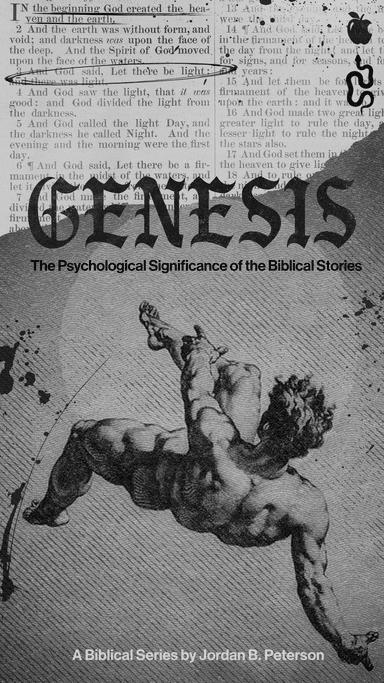
This Biblical series by Dr. Jordan B Peterson explores the psychological significance of the biblical stories from the book of Genesis.
In this lecture, world renowned speaker and clinical psychologist Jordon B. Peterson describes what he considers to be the idea of God, which is at least partly the notion of sovereignty and power, divorced from any concrete sovereign or particular, individual person of power.
He also suggests that God, as Father, is something akin to the spirit or pattern inherent in the human hierarchy of authority, which is based in turn on the dominance hierarchies characterizing animals.
Oops! Is this show WOKE?
Only an account holder or member can file. Cite a scene, a line, or a pattern. Other account holders +1 or −1 that argument, once each. The show is not WOKE until enough of them have given a +1. Enough −1s remove the write-up, and it is no longer shown.
Sign in to file a woke label. One of each criterion per member.
Comments and reviews
Report a mistake
Same rule as woke labels: one report, a written reason, and the community +1 or −1 it — once per member. A net +5 applies the change. Editors can hold it for review, or apply it immediately.
No mistake reports yet.
Sign in to report a mistake. One report per field, per member.
Member review
Toni Briggs Member
Oct 19, 2026
★★★★★★★★★★Jordan Peterson’s Genesis lecture series sits in a strange middle ground for me. I came in already knowing the broad strokes of how he reads the early chapters—order out of chaos, the naming of things as the first human act, the garden as the place where self-consciousness crashes into moral knowledge—and I left with respect for the ambition and a handful of real sticking points that kept it from landing higher.
He treats the text like a set of psychological maps rather than a history lesson or a Sunday-school morality play. That choice is the whole point. When he walks through the separation of light from darkness, he is not doing apologetics. He is talking about the mind’s need to carve structure out of undifferentiated potential, and how that same move shows up every time you try to get your own life in order. The Adam and Eve material hits harder. The serpent, the fruit, the sudden knowledge of nakedness—he frames it as the birth of self-awareness and the weight that comes with it. Work, suffering, and the demand for voluntary responsibility stop being punishments and start looking like the terms of the deal once you can see yourself. I found that useful. It is the kind of reading that makes the old stories feel less like museum pieces and more like descriptions of what still happens inside people.
The strength is the consistency of the through-line. Chaos versus order is not a slogan here; he keeps returning to it with enough variation that it starts to feel like a genuine pattern rather than a hammer he is swinging at every nail. You get Cain and Abel as the first real conflict over sacrifice and resentment, the flood as the collapse that follows when corruption spreads, the tower as the arrogance of trying to build heaven by committee. He is good at showing how these stories keep reappearing in ordinary life—how resentment curdles into violence, how pretending you can skip the hard parts of responsibility just invites the chaos back in. For someone who has spent time around people who treat the Bible as either pure literal history or pure oppressive myth, this middle path is refreshing. It takes the text seriously without requiring you to check your brain at the door.
What holds it at 3.5 is the delivery and the occasional overreach. These are long lectures. Peterson circles. He will land a sharp observation, then spend another ten minutes restating it with new examples that do not always add much. Some nights I stayed locked in; other nights I felt the same point being sanded down until the edge was gone. The psychological reading is powerful, but every so often it starts to feel like the Bible is being used mainly as a prop for the framework he already built in Maps of Meaning and the later self-help material. When that happens the text loses some of its own stubborn particularity. Genesis is not only a guide to the psyche. It is also a story about a people, a covenant, and claims that go beyond what any individual can extract for personal development. I wanted him to sit longer with that tension instead of folding everything back into the order-chaos dyad.
There is also the matter of tone. He is earnest to a fault. That earnestness is part of why people listen—he clearly believes the stakes are high and that meaning is not optional. At the same time it can tip into a kind of relentless seriousness that makes the lighter or stranger moments in the text harder to hear. Humor, irony, the sheer oddness of some of these narratives get flattened. I kept wishing for a little more air in the room.
Still, I am glad I sat through it. The core claim—that these stories remain maps of human experience rather than relics—holds up. Responsibility as the antidote to resentment, the necessity of facing chaos without pretending you can abolish it, the idea that consciousness itself carries a cost: those ideas stick. They are not new, but they are put together here with enough force that they feel newly urgent. In a culture that often treats ancient religious texts as either sacred untouchables or embarrassing leftovers, watching someone take them apart as living psychology is worth the time even when the lectures drag.
I would recommend it with the same caveats I give myself. Watch it when you have patience. Skip around if a particular lecture starts repeating. Take the psychological insights and then go back to the plain text and see what still resists being turned into a self-improvement manual. That friction is part of what makes the series valuable. It does not solve Genesis. It opens it in a direction that is still useful, and for me that is enough to keep the rating honest at three and a half rather than pretending it was either a revelation or a waste. Peterson is better when he is wrestling with the material than when he is polishing the same insight for the third time. When he wrestles, the lectures earn their length. When he does not, you feel every minute. That mix is exactly why I landed where I did.