



 TV · 2024
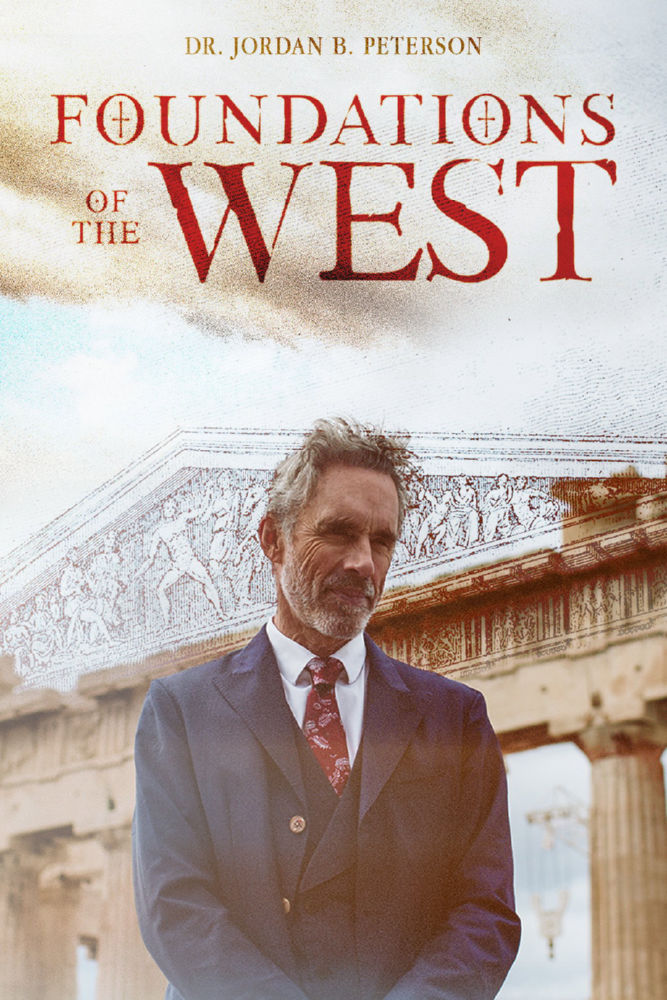
Foundations of the West
Dr. Jordan B. Peterson and colleagues travel to ancient cities that forged the West, unpacking their ideas, ruins, and lasting influence on modern life through on-site discussion.
Foundations of the West follows Dr. Jordan B. Peterson as he joins esteemed colleagues at the ruins and landmarks of civilizations that built the Western tradition. The series moves from city to city, pairing walk-throughs of iconic sites with extended conversations about law, myth, philosophy, and civic order. Peterson and his guests examine how those places produced institutions and stories that still structure politics, education, and daily life. Episodes stay anchored in concrete locations rather than abstract theory alone, letting the physical remains prompt the dialogue. Viewers hear how successive cultures borrowed, contested, and refined earlier foundations. The tone remains educational and historical throughout the runtime.
Later segments widen the map to additional ancient centers whose achievements and failures still echo. Peterson and the scholars compare competing accounts of order, sacrifice, and freedom that emerged from those cities, tracing lines forward into later Western thought. On-camera visits supply the visual spine while the talk digs into texts, architecture, and political experiments tied to each stop. Relationships among the participants stay collegial and inquiry-driven as they test one another’s readings of the record. The series closes its arcs by linking specific legacies—legal, religious, and cultural—to patterns visible in the present without turning the travelogue into a sermon. What remains is a guided tour of origins rather than a campaign for contemporary slogans.
Oops! Is this show WOKE?
Only an account holder or member can file. Cite a scene, a line, or a pattern. Other account holders +1 or −1 that argument, once each. The show is not WOKE until enough of them have given a +1. Enough −1s remove the write-up, and it is no longer shown.
Sign in to file a woke label. One of each criterion per member.
Comments and reviews
Report a mistake
Same rule as woke labels: one report, a written reason, and the community +1 or −1 it — once per member. A net +5 applies the change. Editors can hold it for review, or apply it immediately.
No mistake reports yet.
Sign in to report a mistake. One report per field, per member.
Member review
Peg Harlan Member
Oct 7, 2026
★★★★★★★★★★I put on Foundations of the West expecting something closer to the old educational specials that used to air when networks still trusted an audience to sit with ideas for more than a few minutes. A group of scholars and commentators walking the ground in Jerusalem, Athens, and Rome, tying the physical places to the habits of mind that built what we still call the West. Sacred truth meeting human reason, morality that claims something higher than the mood of the moment, the slow stacking of civic forms. That is the pitch, and on paper it is the kind of series I will usually give a fair shake.
The travel itself is the strongest part. You see the Garden of Gethsemane, the stones of the old civic monuments, the actual streets where people once argued about law and God and what a free man owes his city. It is not tourist fluff. The camera lets the ruins sit there long enough that you feel the weight of them. When the hosts pause and talk about the Axis Mundi or the way Jerusalem, Athens, and Rome each supplied a different pillar—revelation, philosophy, ordered government—you can almost hear the older conversation continuing. They do not rush past the Christian contribution or treat it as an embarrassing footnote. That alone separates this from a lot of current history programming that acts like faith is only ever a costume for the worst people. I appreciated that steadiness.
Where it lands at three stars for me is the uneven rhythm and the talking. Some episodes lean hard into deep-dive panel discussion that circles the same points without sharpening them. You get rotating hosts who know the material, which is good, but the back-and-forth sometimes feels like a seminar that forgot the students need a clear through-line. I found myself wanting tighter editing between the location footage and the commentary. The conceptual core is solid—sacred truth, godly morality, human rationality intersecting to form the architecture we still live inside—but the series does not always trust a single strong voice to carry a stretch of it. Multiple perspectives can be useful; here they occasionally dilute the force.
I kept thinking about how they used to make them like this with fewer people on screen and more patient camera work. A single historian walking a ruined forum and simply speaking for ten minutes could hit harder than a roundtable that keeps restating the thesis. The production connects the milestones well enough, and it never sinks into the usual modern habit of treating Western development as original sin. No lectures about how every achievement must be balanced by a confession. That restraint is welcome. Still, the execution stays workmanlike rather than gripping. Some segments feel like they were shot for a university course rather than for someone who might watch after a long day and still want to stay awake.
The geographical pilgrimage idea is smart. Moving from one legendary city to the next gives the argument a spine. You see how the theological claims made in one place met the philosophical tools forged in another and then got practical shape under Roman administration. Modern society did not appear out of a committee meeting last Tuesday. It grew from people who believed certain things about the soul, about reason, about the limits of power. The series knows that and does not apologize for it. I just wish the storytelling had more lift in places. A few stronger narrative anchors—one recurring figure, one tighter set of questions—would have helped the whole thing cohere instead of feeling like a collection of informed conversations strung along a travel itinerary.
Watching it, I never felt talked down to, which matters. The hosts assume you can handle the vocabulary of theology and classical thought without a cartoon explainer. That is rare enough these days that I give it real credit. At the same time, the series does not quite earn the full stretch of attention it asks for. Pacing sags in the middle of several episodes. You start strong on location, then settle into a discussion that covers ground already covered two cities earlier. I finished the run glad it exists and glad it refuses the usual distortions, yet not eager to rewatch soon. Three stars feels honest: worthwhile subject, decent access to the places that matter, thoughtful people on camera, but not enough craft to turn the pilgrimage into something memorable rather than merely informative.
If you already care about the foundations—how Jerusalem’s moral claim, Athens’ habits of argument, and Rome’s institutional memory still shape courts and universities and the ordinary expectation that truth is not invented every morning—you will find solid material here. If you need the form to match the ambition, you may feel the same middling satisfaction I did. It is the kind of show that reminds you the older framework is still standing, even when the presentation itself could use a firmer hand.