
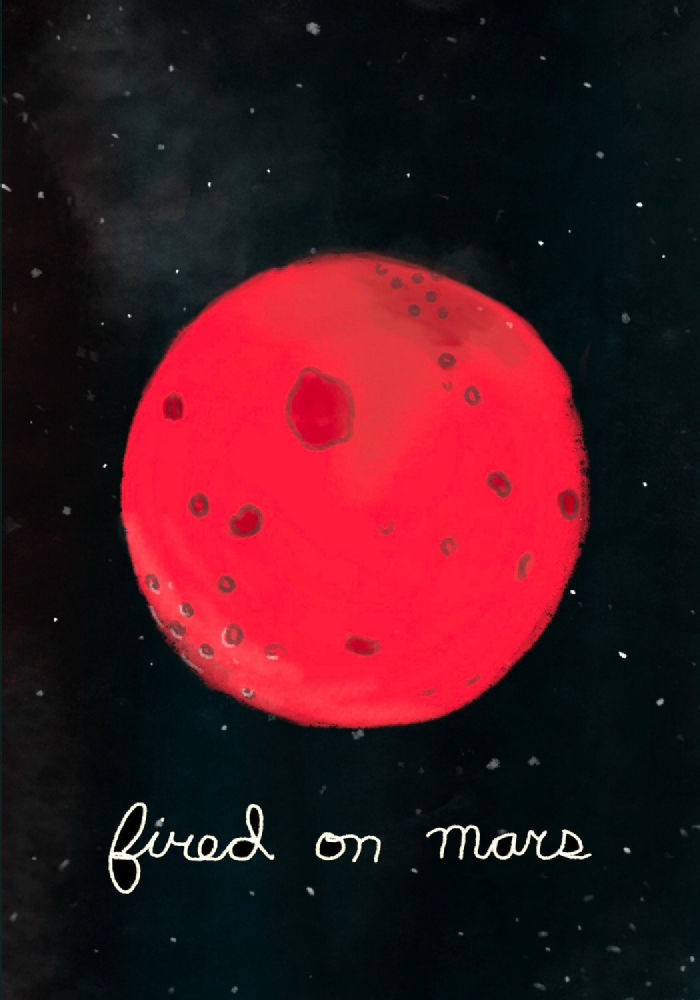



 TV · 2023
Fired on Mars
After moving to Mars for a dream career as a graphic designer for a massive tech conglomerate, a regular guy is abruptly laid off and finds himself stranded on the corporate colony, forcing him to navigate a surreal, existential crisis within a dystopian corporate culture.
The narrative centers on an ordinary, mild-mannered graphic designer who takes a massive leap of faith by relocating to a sprawling corporate colony on Mars to work for a high-profile technology startup. He envisions a bright future filled with creative fulfillment and a stable lifestyle alongside his long-distance girlfriend back on Earth. However, his optimistic assumptions are completely shattered when his specialized department is suddenly eliminated, leaving him completely redundant. Because the company controls all transport back to Earth and refuses to fund his return ticket, he finds himself trapped in a sterile, hyper-corporate Martian habitat with no income, no clear career path, and no easy way home.
As he drifts through a profound existential crisis, the protagonist tries to find his footing within a highly clinical, micro-managed society that measures human worth entirely by productivity. His daily routine dissolves into a series of awkward encounters with oblivious executives, corporate-mandated wellness seminars, and eccentric fellow outcasts who have also fallen through the cracks of the system. Driven by a desperate need to feel useful and find companionship, he takes on bizarre odd jobs and aligns himself with a subterranean counter-culture movement operating beneath the shiny office spaces. The animated series serves as a bleakly funny, dark satire on modern office politics, loneliness, and the hollow nature of corporate loyalty.
Click any of the following icons below to rent or stream it!
Oops! Is this show WOKE?
Only an account holder or member can file. Cite a scene, a line, or a pattern. Other account holders +1 or −1 that argument, once each. The show is not WOKE until enough of them have given a +1. Enough −1s remove the write-up, and it is no longer shown.
Sign in to file a woke label. One of each criterion per member.
Comments and reviews
Report a mistake
Same rule as woke labels: one report, a written reason, and the community +1 or −1 it — once per member. A net +5 applies the change. Editors can hold it for review, or apply it immediately.
No mistake reports yet.
Sign in to report a mistake. One report per field, per member.
Member review
Dan Reilly Member
Oct 19, 2026
★★★★★★★★★★Fired on Mars starts with a premise that should have had more teeth. A regular graphic designer packs up his life, leaves Earth, and takes a job with some giant tech outfit on a corporate colony, only to get laid off almost immediately and find out the company won’t pay for his ride home. That trap is a good setup. What didn’t work for me was how long the show stays in the soft middle of that situation. The guy wanders the colony in a daze, making half-hearted attempts at freelancing or just existing, and the existential fog hangs around longer than it needs to. I kept waiting for the satire of corporate life to cut deeper, but a lot of the early stretches feel like watching someone slowly realize the brochure lied without ever getting truly angry or clever about it.
The long-distance girlfriend back on Earth is another piece that never quite lands. Their calls and messages are meant to underline how stranded he is, yet the relationship itself stays thin. You get the sense the writers needed an Earth anchor more than they needed a real person on the other end of the line. Side characters in the colony fare a little better when they pop up as bureaucratic weirdos or burnt-out lifers, but too many of them exist just to deliver one quirky line and vanish. The show wants to say something about what happens when a company owns every square inch of your sky and your paycheck, yet it often settles for mild awkwardness instead of sustained pressure.
Pacing is uneven in a way that frustrated me. Some episodes stretch quiet despair until it starts to feel padded, while others rush past potentially sharper observations about how a closed corporate ecosystem actually functions when the mission statements stop matching reality. The animation style is clean and a bit sterile, which fits the setting, but it also makes certain emotional beats land flatter than they should. I wanted more visual invention once the guy is stuck—more of the colony’s everyday absurdities turned into something memorable rather than just background. There are stretches where the humor leans on the same “this place is soul-crushing” note without finding new angles, and that repetition is what kept me from locking in harder.
That said, credit where it’s due. Once the show stops circling the initial shock of the layoff and lets the character start improvising a life inside the system, a few things click. The quiet gags about endless HR loops, pointless team-building, and the sheer logistics of being disposable on another planet have a dry accuracy that sneaks up on you. The main performance (or voice work, however you want to call it) stays understated in a way that suits a mild-mannered guy who never signed up to be a rebel. He doesn’t suddenly become a firebrand; he just keeps trying small, practical things while the bigger machine ignores him. That restraint works better than a louder version would have.
World details occasionally shine. Little design choices in the colony—signage that feels like it was approved by twelve committees, living quarters that look temporary forever, the way leisure is still somehow branded—add texture without needing big speeches. When the show trusts those touches instead of explaining them, it gets closer to the surreal tone it keeps aiming for. A couple of later stretches finally let the stranded feeling turn into something closer to dark comedy rather than pure gloom, and those are the parts I remember most clearly. The corporate culture isn’t cartoonishly evil every second; sometimes it’s just indifferent and inefficient, which is funnier and more honest.
I rated it 3.5 because the core idea is strong enough to carry the weaker patches, but the execution never fully trusts its own premise. It circles the same territory of quiet panic and half-hearted reinvention without always finding the next gear. If it had tightened the early episodes and let the satire get meaner or stranger sooner, it might have stuck with me more. As it stands, it’s watchable and occasionally sharp about what happens when your dream job evaporates and the only exit requires a ticket the company controls. Not a disaster, not a revelation—just a show that knows the feeling of being stuck and doesn’t always know what to do with it beyond observing it. The colony itself is the most interesting character, and I wish the writing had explored its rules and loopholes with more consistency. Still, there are enough solid moments of recognition—those days when the job is gone but the place isn’t—to make it worth finishing if the premise already grabbed you. It doesn’t overpromise revolution or pure laughs; it just sits with the awkwardness of being redundant in a place that was sold as the future. That honesty is what scrapes it above average for me, even when the storytelling lags.