




 TV · 2023
Faraway Downs IS WOKE
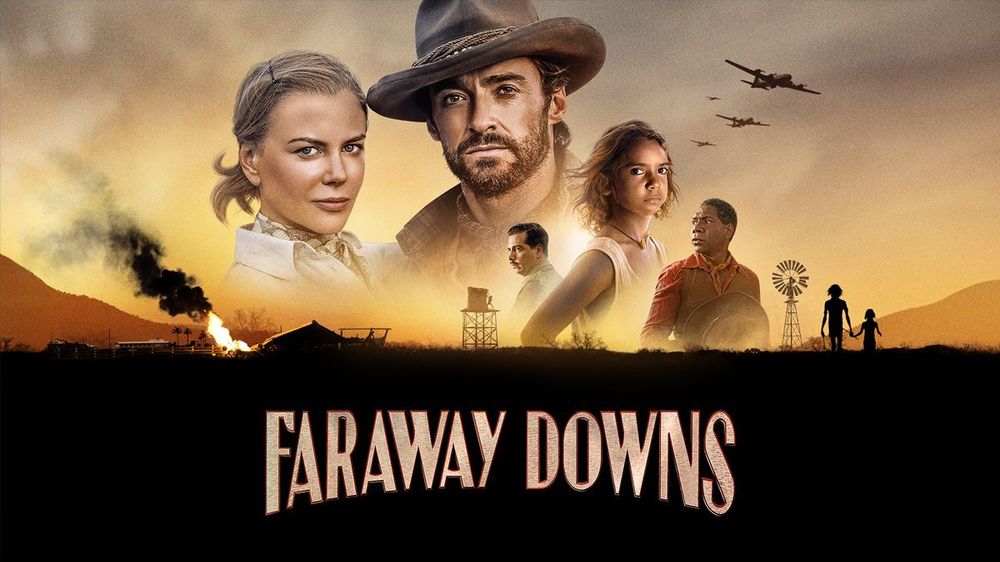
An aristocrat, Sarah has a cattle station in Australia. Following the death of her husband, a baron plots to take her land but she joins forces with cattle drover Jackman to protect her station.
The narrative takes place between 1939 and 1942, beginning as an English aristocrat travels halfway across the world to confront her wayward husband and force the sale of their struggling Australian cattle ranch. Upon her arrival, she discovers her husband has been murdered, leaving her in sole possession of the sprawling property. Reluctant to let a powerful, greedy livestock baron seize the estate to establish a complete regional monopoly, she chooses to run the ranch herself. To drive a massive herd of one thousand cattle across the punishing, treacherous terrain of the desert outback to secure a military contract, she enlists the help of a gruff, independent local stockman and a clever, biracial Indigenous boy.
As the arduous journey progresses, a deep romance blossoms between the noblewoman and the rugged drover, and she forms a profound maternal bond with the young boy. However, their makeshift family unit is constantly threatened by sabotage from corporate lackeys and the country's draconian racial policies that actively target the child's heritage. The personal struggle for survival and identity reaches a volatile breaking point when the catastrophic arrival of World War II brings enemy bomber planes directly over the northern territory. The unfolding devastation forces painful sacrifices, tragic losses, and a deep reexamination of what it truly means to own one's own story amidst the sweeping tides of history.
Click any of the following icons below to rent or stream it!
WHAT CRITERIA MAKES IT WOKE?



Oops! Is this show WOKE?
Only an account holder or member can file. Cite a scene, a line, or a pattern. Other account holders +1 or −1 that argument, once each. The show is not WOKE until enough of them have given a +1. Enough −1s remove the write-up, and it is no longer shown.
Sign in to file a woke label. One of each criterion per member.
Comments and reviews
Report a mistake
Same rule as woke labels: one report, a written reason, and the community +1 or −1 it — once per member. A net +5 applies the change. Editors can hold it for review, or apply it immediately.
No mistake reports yet.
Sign in to report a mistake. One report per field, per member.
Member review
Omar Quill Member
Oct 7, 2026
★★★★★★★★★★Faraway Downs sat in my queue for a bit because the cattle-drive setup looked like one of those long open-world survival runs where you just keep the herd alive across bad terrain. I finally put the hours in. It’s the 2023 six-part streaming cut of that older Baz Luhrmann movie, stretched out so the desert crossings and the military contract feel like multi-stage boss routes instead of one big set piece. Sarah shows up from England, finds her husband dead, and has to hold the station against a baron who wants the whole region locked down. She hooks up with the stockman Jackman and they push a thousand head across the outback. On pure movement and scale it still works. The dust, the water stops, the sheer length of the drive give it that “one more camp” pull I get from big map games when the objective is just keep the caravan going.
What I kept noticing, though, is how hard the rewrite tilts the whole thing. The original spine was the aristocrat and the drover grinding through the land deal and the war years. Here the script keeps yanking the camera and the voice-over over to Nullah, the biracial Indigenous kid, until the adventure is basically told as his story. Every major turn gets filtered through him. It feels less like the plot naturally opened up and more like someone went through the old film with a checklist and decided the white leads had to step aside so the kid could carry the frame. I don’t mind a strong kid character—Nullah’s got presence—but the deliberate swap makes the cattle drive and the station fight feel secondary to making sure we stay inside his viewpoint the entire time.
The pacing takes real hits from it. You’ll be mid-drive or dealing with the baron’s pressure and the episode just stops so someone can spell out the Stolen Generations and the old government policies in pretty modern language. It’s not woven in; it’s planted. The story freezes, the music swells a bit, and we get the lesson before anything else is allowed to move. I sat through those stretches the same way I sit through forced tutorial pop-ups that repeat the same moral point three times. You already got it the first time; keep the herd moving.
The bigger drag is how the town and the power structure are drawn. Almost every white face that isn’t Sarah or Jackman lands as some flavor of cruel or greedy or just plain malicious. The cattle barons, the police, the regular townspeople—they’re all written like extensions of one big machine built to crush the mixed-race and Aboriginal characters. Meanwhile Nullah and the Indigenous side get the pure-heart, deep-wisdom treatment, like they’re walking spirit guides who never once act petty or scared or selfish the way actual people do. It flattens everybody. I kept waiting for one ordinary local to just be tired or conflicted instead of another boot on the neck, and it never really came. That kind of total black-and-white casting makes the stakes feel smaller, not bigger, because you already know who the script has decided is evil before they open their mouths.
Still, the core loop held me. Getting the herd across that country under the contract deadline has real weight. Jackman’s the gruff specialist who knows every shortcut and every way the land can kill you; Sarah’s the outsider learning the build order on the fly. When they stop preaching and just run the drive, it scratches the same itch as a long co-op haul where the environment is the real enemy. The 1939-to-1942 window gives it a ticking clock that works. I never felt lost on the geography or the basic goal.
I landed at 3.5 because the bones of the adventure are solid enough that I finished all six parts and didn’t regret the time, but the constant identity reframing and the sermon breaks and the cartoon version of the local society kept knocking me out of it. It’s the kind of show where you can tell the writers were more worried about hitting every modern box than about letting the cattle and the desert and the contract do the heavy lifting. If they had trusted the trek itself a little more and dialed back the purity-and-villainy split, I’d have sat closer to a four. As it stands I can recommend it for the open-ground stretch and the sheer stubbornness of trying to move a thousand head, just go in knowing the perspective has been rebuilt around the kid and the history lessons will arrive on schedule whether the scene needs them or not. That’s my honest take after watching the whole thing through.