



 TV · 2019
Evil
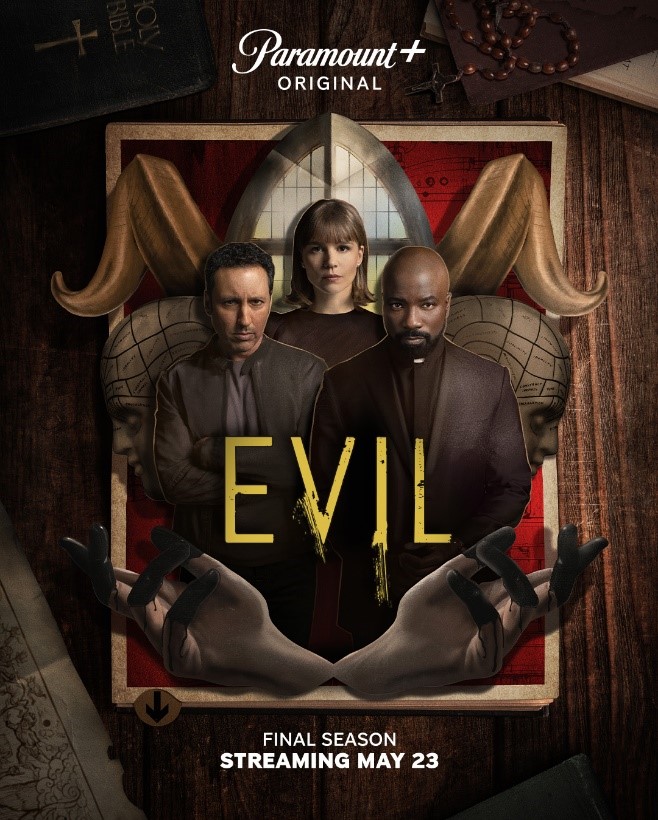
In this captivating TV series, a skeptical psychologist, a former journalist turned seminarian, and a technical expert investigate the blurred line between the supernatural and the human mind.
Evil focuses on a skeptical female clinical psychologist who joins a priest-in-training and a blue-collar contractor as they investigate supposed miracles, demonic possessions, and other extraordinary occurrences to see if there's a scientific explanation or if something truly supernatural is at work.
Oops! Is this show WOKE?
Only an account holder or member can file. Cite a scene, a line, or a pattern. Other account holders +1 or −1 that argument, once each. The show is not WOKE until enough of them have given a +1. Enough −1s remove the write-up, and it is no longer shown.
Sign in to file a woke label. One of each criterion per member.
Comments and reviews
Report a mistake
Same rule as woke labels: one report, a written reason, and the community +1 or −1 it — once per member. A net +5 applies the change. Editors can hold it for review, or apply it immediately.
No mistake reports yet.
Sign in to report a mistake. One report per field, per member.
Member review
Toni Briggs Member
Oct 20, 2026
★★★★★★★★★★What a strange little show. That was my first and pretty much lasting reaction to Evil, and I mean it as a compliment more than a complaint. I still do not know how to neatly define it, and I suspect that is the point. It walks a blurred line between religion and superstition on one side and atheism and hard rationalism on the other, and it refuses to pick a lane for you. Most series in this territory either sneer at faith or treat the supernatural like a guaranteed jump-scare delivery system. This one keeps both possibilities alive episode after episode and lets the tension do the work.
At first the whole thing felt dissonance-inducing. The tone jumps, the humor is dry and a little off-kilter, the cases can pivot from clinical to genuinely unsettling without much warning. Once I got used to those quirks, of which there are plenty, I found I rather liked it. Kristen Bouchard is the forensic psychologist who starts from the position that almost everything has a natural explanation. David Acosta is the priest-in-training who is open to the idea that some things do not. Ben Shakir is the tech guy who can take apart the gadgets and the wiring and the supposed miracles with equal calm. The Catholic Church hires them to assess claims of healings, possessions, and other extraordinary events, and the show is content to let their methods collide without turning any of them into a cartoon.
I have always leaned rationalist myself, so the religiosity amused me more than it converted me. What kept me watching is that the presentation is not lecturing or heavy-handed. You get opposing views in the same room, sometimes in the same scene, and neither side is written as the automatic idiot. Kristen’s skepticism is allowed to be sharp and useful. David’s vocation is allowed to grow without the script rolling its eyes. Ben’s engineering mind keeps both of them honest. That balance is rarer than it should be. Plenty of shows treat Christian faith as a costume for the bigot or the fool; Evil mostly declines the invitation. The hierarchy inside the Church can be bureaucratic, political, even cold, but the faith itself is not framed as the root of every problem. That alone made the series feel fresher than the average network supernatural procedural.
The cases themselves are the real engine. Some look like straightforward psychological breaks or medical oddities until a detail refuses to sit still. Others start with the smell of sulfur and then get explained down to wiring or suggestion or trauma. The show is willing to leave a residue of ambiguity, which is exactly what makes it stick. I never felt spoon-fed a moral. I felt like I had watched three competent people argue over evidence while something larger hovered just outside the frame. That is more interesting to me than another demon-of-the-week that gets banished by the third act.
Performance-wise the three leads carry it. Katja Herbers plays Kristen with a practical toughness that never tips into the unearned superheroine routine; she is smart, stubborn, and often wrong in ways that cost her. Mike Colter gives David a quiet gravity without turning him into a walking sermon. Aasif Mandvi’s Ben is the dry center who keeps the science and the sarcasm in the same toolkit. Supporting players cycle in and out, some memorable, some purely functional, but the core trio is what makes the hour worth sitting through. The writing trusts them enough to let conversations run long and let silences land.
It is not perfect. A few episodes lean harder into the weird for its own sake and lose the forensic thread. The personal lives of the leads sometimes feel like they are being serviced rather than deepened. And the show’s willingness to stay in the gray can occasionally tip into stalling; you want a firmer answer and it withholds. Those are the reasons it sits at four for me rather than higher. Still, the overall effect is more coherent than the early dissonance suggested. Once the rhythm settles, the quirks become part of the personality instead of obstacles.
I keep coming back to that blurred line. Most entertainment today wants you to choose a team and stay there. Evil is more interested in the argument itself. It lets a rationalist walk into a rectory and a man of faith walk into a lab and neither one has to surrender on contact. That is not revolutionary filmmaking, but it is honest storytelling, and honesty is harder to find than another possession sequence. The series respects the audience enough to assume we can hold two ideas at once without needing a speech to tell us which one is correct. I rated it four because it earned the hours I gave it and left me thinking about the cases after the credits. Strange little show, yes. Also one of the more consistently watchable things I have spent time with in this genre. It does not demand belief. It just refuses to make disbelief the only respectable option, and that is enough.