



 MOVIE · 1979
Escape From Alcatraz
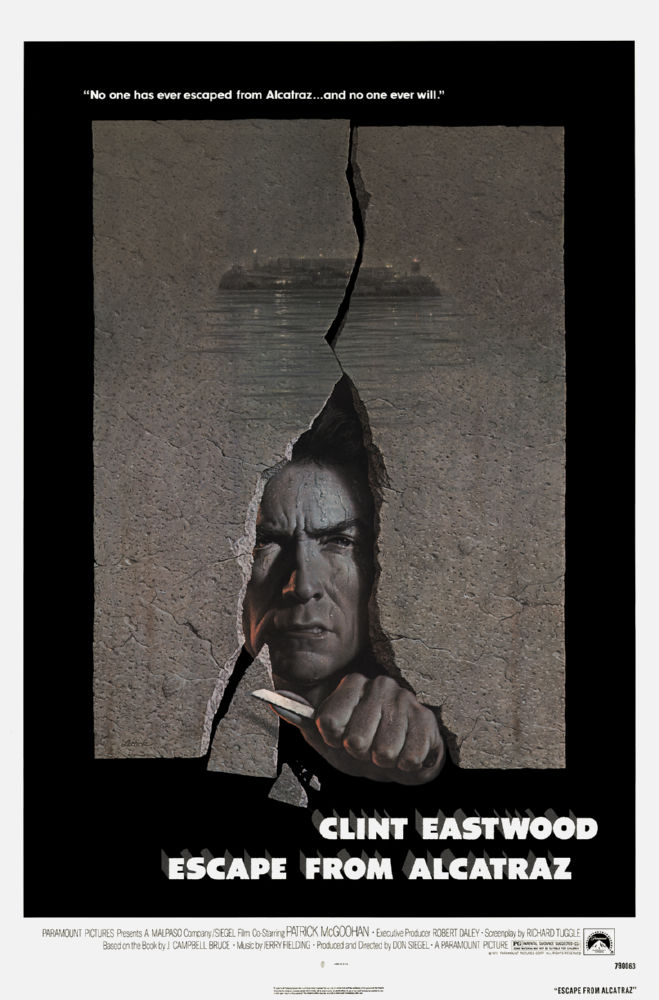
Frank Morris (Clint Eastwood), a hardened con with a history of prison breaks, is sent to serve the rest of his life sentence at Alcatraz -- America's most infamously brutal and inescapable maximum security prison. Morris quickly realizes the prison's dehumanizing effects and clashes with its cruel warden (Patrick McGoohan). Fed up with life at Alcatraz, Morris and two convict brothers (Fred Ward, Jack Thibeau) meticulously plan the unthinkable: an escape from the island.
Oops! Is this show WOKE?
Only an account holder or member can file. Cite a scene, a line, or a pattern. Other account holders +1 or −1 that argument, once each. The show is not WOKE until enough of them have given a +1. Enough −1s remove the write-up, and it is no longer shown.
Sign in to file a woke label. One of each criterion per member.
Comments and reviews
Report a mistake
Same rule as woke labels: one report, a written reason, and the community +1 or −1 it — once per member. A net +5 applies the change. Editors can hold it for review, or apply it immediately.
No mistake reports yet.
Sign in to report a mistake. One report per field, per member.
Member review
Lila Marsh Member
Oct 6, 2026
★★★★★★★★★★I put on Escape From Alcatraz the other night because I wanted something that just gets on with the business of being a solid movie instead of chasing whatever mood the room is in. Clint Eastwood plays Frank Morris like a guy who has already decided the walls are temporary and the only question left is timing. He shows up on the rock, takes the measure of the place in about ten minutes of quiet looking, and then starts working the problem the way a carpenter works a board that won’t sit flush. No speeches. No big declarations about freedom. Just the daily grind of figuring out what the concrete will give up if you stay patient with a spoon and a nail clipper.
What I keep coming back to is how little the film needs to sell you on the stakes. Alcatraz itself does most of the heavy lifting. The cold, the routines, the way every corridor feels watched even when nobody is standing there. You feel the schedule pressing down on everybody, and Morris just finds the seams. He pulls in the Anglin brothers without a lot of talk, and the three of them turn into this quiet little workshop after lights-out. Dummy heads, vents, the raft idea—it all builds the way real work builds, one careful night after another. I sat there thinking about how many movies would have turned each step into a mini-crisis with alarms and close calls. This one mostly lets the process be the suspense. You know what they’re risking, so every scrape of metal on concrete lands harder than another chase sequence would.
Eastwood is perfect for this because he doesn’t ask you to like Morris or root for him in the usual way. He’s competent, private, a little cold around the edges. That fits. A man who has broken out of other places before isn’t going to waste energy charming the audience. The supporting guys feel like actual inmates rather than types—some broken, some still carrying a spark, most just trying to get through another day without drawing the wrong kind of attention. The guards aren’t cartoon monsters either. They’re just doing a job on an island that was built to make the job easy. That balance keeps the whole thing from tipping into pure fantasy or pure misery.
I liked how the movie trusts the audience to follow the plan without a lot of hand-holding. You see the tools, you see the progress, you see the moments when something almost goes sideways and then doesn’t. There’s a kind of respect in that. It assumes you can sit still and pay attention. Modern stuff sometimes forgets that people will lean in if you give them a clean line of work to watch. Here the work is the dig, the silence, the waiting for the right tide. When they finally move, it feels earned because you’ve been living inside the same slow clock they have.
A couple of things kept it from feeling perfect for me. The middle stretch settles into a rhythm that is almost too steady; you know they’re going to keep advancing the hole, so the tension flattens a little until the final stretch tightens everything again. And the ending leaves you with the open question history already left us, which is honest, but it also means the movie doesn’t quite land a full exhale. I wanted one more beat of clarity even while I respected the choice. Still, those are small complaints against a film that mostly knows exactly what it is doing.
Watching it now, what stands out is how little it leans on anything outside the men and the walls. No big messages get plastered on top. Nobody is there to represent a cause. It’s just a story about stubborn skill meeting a place designed to crush that skill, and the place almost wins. Almost. That “almost” is what stays with you. I finished it and sat for a minute thinking about the cold water and the dark and how much nerve it would take to push off from the shore knowing the odds. The movie never has to spell that out. It just puts you there long enough that you carry the weight yourself.
I’ve seen plenty of escape pictures that try harder and end up feeling smaller. This one stays lean. Eastwood’s quiet focus, the methodical digging, the way the island itself becomes the main opponent—those pieces fit without force. It’s the kind of movie you can put on when you want craft over noise, and it still holds up decades later because it never pretended to be anything flashier than a careful job done under impossible conditions. Four stars feels right. It earns the rating by staying true to its own narrow, cold lane and refusing to dress it up. I’d watch it again on a night when I want something that respects my attention instead of begging for it.