




 TV · 2023
Drops of God IS WOKE
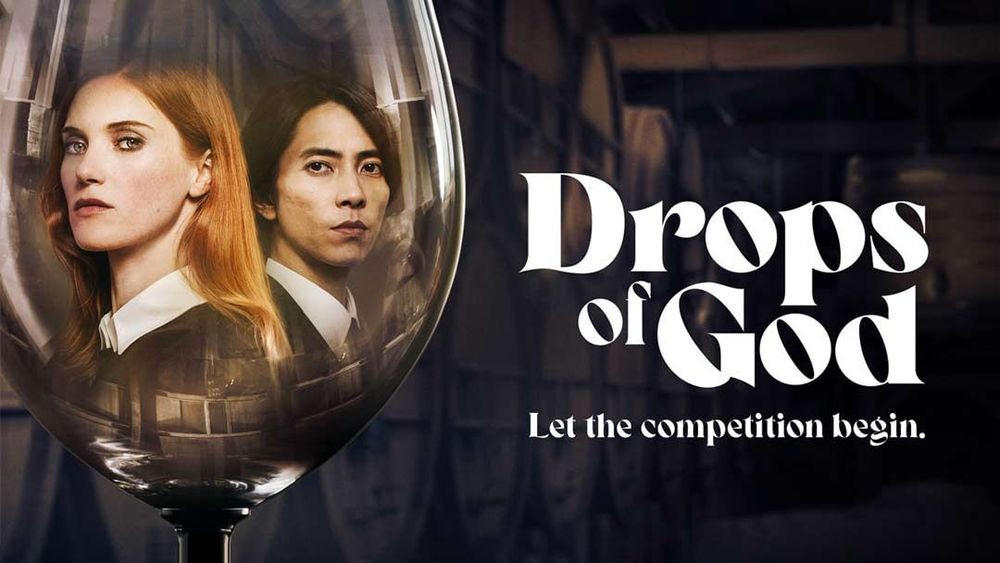
Following the death of a world-renowned wine authority, his estranged daughter must travel to Tokyo to compete in a series of grueling, impossible sensory tests against his brilliant young protégé to claim a record-breaking wine inheritance.
The narrative centers on a dramatic inheritance competition sparked by the passing of a legendary wine critic and creator of a globally influential wine guide. Upon his death, he leaves behind an extraordinary collection of 87,000 bottles valued at nearly $150 million. His adult daughter, who has been estranged from him since her parents separated during her childhood, travels to Tokyo for the reading of the will. She discovers that she does not automatically inherit his life's work; instead, she must face off against her father's "spiritual son," a brilliant young winemaker who was taken under the late critic's wing as a star protégé. To secure the empire, the two must compete in three highly intricate, blind sensory challenges designed to test the absolute limits of their palates and minds.
The intense, continent-spanning contest pushes both rivals to their psychological and physical limits across Tokyo, France, and Italy. The daughter faces a staggering obstacle: a severe childhood trauma related to her father's domineering, intense sensory training has left her with a physical intolerance to alcohol, causing her to violently pass out at a single taste of wine. To stand a chance, she must retrain her extraordinary memory through smell alone, leaning on soil, sun, and nature to decipher the clues. Meanwhile, the protégé must contend with the immense pressure and rigid disapproval of his own wealthy, traditional family, who detest his path in the wine industry. As the rounds progress—involving identifying exact vintages and solving artistic riddles—the escalating rivalry unravels deeply buried family secrets and hidden connections that forever transform their identities.
Click any of the following icons below to rent or stream it!
WHAT CRITERIA MAKES IT WOKE?



Oops! Is this show WOKE?
Only an account holder or member can file. Cite a scene, a line, or a pattern. Other account holders +1 or −1 that argument, once each. The show is not WOKE until enough of them have given a +1. Enough −1s remove the write-up, and it is no longer shown.
Sign in to file a woke label. One of each criterion per member.
Comments and reviews
Report a mistake
Same rule as woke labels: one report, a written reason, and the community +1 or −1 it — once per member. A net +5 applies the change. Editors can hold it for review, or apply it immediately.
No mistake reports yet.
Sign in to report a mistake. One report per field, per member.
Member review
Ray Okonkwo Member
Oct 7, 2026
★★★★★★★★★★I went into Drops of God already knowing the manga pretty well. That original run stretches across something like 44 volumes and it is still easy to find in English if you dig around. It built everything around Shizuku Kanzaki, a young Japanese guy whose whole life gets pulled into the impossible world of elite wine tasting after his father’s death. The Apple series throws that out almost immediately. They rebuild the entire story around Camille Léger, a French woman who shows up in Tokyo after the famous critic Alexandre dies and discovers she has to fight his chosen protégé for the massive cellar and the legacy that comes with it. I noticed the change right away and it never stopped feeling like a deliberate swap rather than a natural adaptation choice.
The competition itself still pulls you in. Those sensory tests are staged with real tension—blind tastings that stretch across days, memory games that force the characters to reconstruct entire landscapes from a single sip, pressure that makes you lean forward even when you already know how these kinds of stories usually resolve. Camille’s outsider status in Japan gives the early episodes a clean fish-out-of-water energy that works better than I expected. You watch her struggle with the language, the etiquette, and the sheer volume of knowledge the other side already possesses, and the show is smart enough to let those moments breathe without constant explanation. The protégé is written sharp and a little cold, which keeps the rivalry from turning soft.
Where it starts to grind is the way the script keeps pausing the actual contest to underline Camille’s personal reclamation. Scenes that should stay locked on the next impossible challenge suddenly open into long stretches about her reclaiming agency, rewriting the terms of her childhood, and turning the inheritance fight into a broader statement about standing up as a woman who was left behind. It is not subtle, and it slows the middle stretch more than once. I kept wanting the show to trust the wine mechanics and the family stakes instead of stopping to make sure we understood the empowerment angle.
The father gets the roughest treatment. Alexandre is drawn as a pure tyrant—obsessive, emotionally frozen, and willing to put a little girl through training that borders on cruelty. There is a specific early memory of him blindfolding young Camille and forcing her to name foods after one bite, then treating any failure as personal weakness. The show frames those methods as the direct cause of lifelong damage, and it never lets up on the idea that traditional paternal authority in this house was basically abuse dressed up as education. That reading sits heavy over every later conversation about legacy. It turns the dead man’s reputation into something the daughter has to exorcise rather than simply surpass.
I still found the family drama entertaining enough to stick with it. The Tokyo locations look lived-in, the supporting cast around the wine world feels specific, and the final rounds of the contest carry real weight even after the messaging has done its work. There is also an older Japanese screen version that stayed closer to the manga’s two male leads and its tighter cultural focus; this new one clearly wanted a broader international cast and a different emotional center. The wine details themselves are where the series gets sloppy compared with the source. The manga treated grape varieties, regions, and tasting notes with almost documentary care. Here you catch shortcuts and outright stumbles that pull you out if you know the subject at all.
None of that erased the hours I spent watching Camille and the protégé circle each other. The core inheritance battle remains a strong hook, the sensory set pieces are staged with confidence, and the personal cost of the contest lands even when the script is busy reshaping the original shape of the story. I gave it four stars because the drama and the tests held my attention longer than the rewrites annoyed me. It is not the version I hoped for after reading the long original run, but it is still a show I finished and thought about afterward. The changes are obvious, the father is written as a monster, and the empowerment beats arrive on schedule, yet the central contest still works on its own terms.