
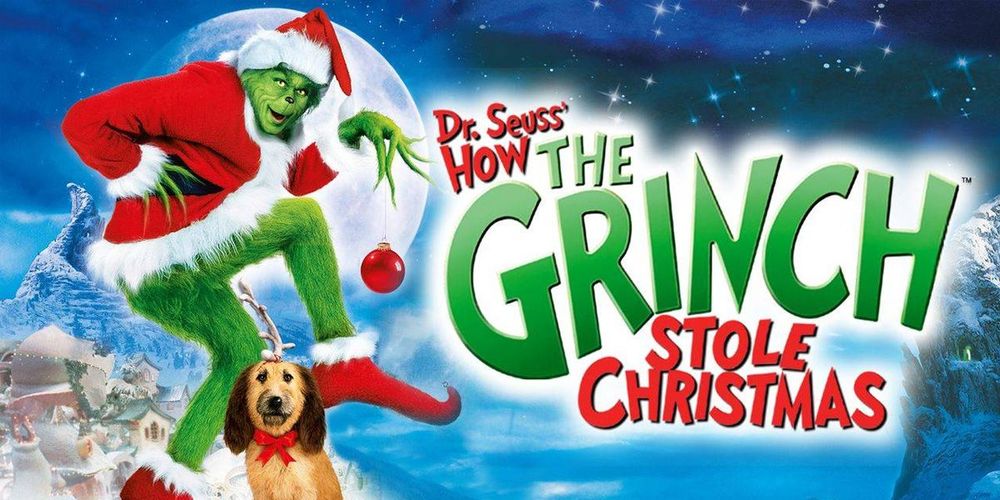



 MOVIE · 2000
Dr. Seuss' How The Grinch Stole Christmas
In this live-action adaptation of the beloved children's tale by Dr. Seuss, the reclusive green Grinch (Jim Carrey) decides to ruin Christmas for the cheery citizens of Whoville. Reluctantly joined by his hapless dog, Max, the Grinch comes down from his mountaintop home and sneaks into town to swipe everything holiday-related from the Whos. However, the bitter grump finds a hitch in his plans when he encounters the endearing Cindy Lou Who (Taylor Momsen).
Oops! Is this show WOKE?
Only an account holder or member can file. Cite a scene, a line, or a pattern. Other account holders +1 or −1 that argument, once each. The show is not WOKE until enough of them have given a +1. Enough −1s remove the write-up, and it is no longer shown.
Sign in to file a woke label. One of each criterion per member.
Comments and reviews
Report a mistake
Same rule as woke labels: one report, a written reason, and the community +1 or −1 it — once per member. A net +5 applies the change. Editors can hold it for review, or apply it immediately.
No mistake reports yet.
Sign in to report a mistake. One report per field, per member.
Member review
Ray Okonkwo Member
Oct 16, 2026
★★★★★★★★★★Jim Carrey’s Grinch still sits in that odd middle space for me. I put it on again last week mostly out of habit, the way you do with holiday movies that used to play on a loop when the channels had nothing else. The green makeup and the yellow eyes do most of the heavy lifting before he even opens his mouth. Carrey leans hard into the physical stuff—the way he folds himself into corners of the cave, the sudden lunges, the little dances of disgust whenever anything wholesome floats up the mountain. Some of those bits land clean. You can see him working the suit like a second skin, and when the camera just lets him thrash around it feels closer to the spirit of the old drawings than a lot of the dialogue does.
Whoville itself is a different story. The production design goes full sugar rush: everything rounded, every surface painted like a cupcake, crowds that never stop bouncing. It looks expensive and busy at the same time. I catch myself watching the background more than the leads sometimes, just to see how many extras they jammed into a single shot of the town square. It works for the first twenty minutes, then the brightness starts to grind. The movie keeps insisting on more volume, more noise, more frantic cutting whenever the Whos throw another celebration. That energy is part of the joke, sure, but it also flattens the quieter moments that the story needs later.
Max the dog is the part I end up rooting for without trying. The animal work is simple and clear. You get the long-suffering looks, the reluctant sled duty, the little victories when he manages to stay upright. Those beats don’t need punch lines. They just sit there and do their job while Carrey does his. Cindy Lou Who, played by Taylor Momsen when she was still a kid, cuts a different path through the noise. She doesn’t play cute for the camera the way a lot of child actors did back then. There’s a steadiness to her that makes the Grinch’s eventual shift feel less like a switch flip and more like someone finally getting under his skin. The scene up at the cave where she just talks to him without the whole town watching is one of the few places the movie remembers to breathe.
I keep noticing how much the film trusts Carrey’s improvisation. Whole stretches feel like they grew in the moment—extra snarls, extra asides, extra ways to contort the face under all that latex. Sometimes it pays off. You get a genuine laugh when he commits to something ridiculous and the rest of the frame just has to keep up. Other times it stretches a sequence past the point where the joke still has shape. The gift-stealing run through town has real momentum for a while, then starts adding layers of slapstick that feel like they were kept because nobody wanted to cut Carrey short. I get why. He was the draw. But the runtime shows it.
The songs sit in the same mixed bag. A couple of them have that big, brassy holiday sound that fills a room. Others feel like they exist mainly to give the Whos something else to bounce to. The score underneath does better work when it stays out of the way and just underlines the mountain wind or the quiet after the theft. I like that the ending still bothers to earn the turn instead of racing to the group hug. The book always had that simple moral engine, and the movie doesn’t completely sand it down even while it piles on the production value.
What keeps it at a three for me is the uneven balance. The commitment is obvious—sets, makeup, Carrey going full tilt—but the movie doesn’t always know when to stop decorating and just let a moment sit. I rewatch pieces of it more than the whole thing. The cave stuff, Max’s silent commentary, that one stretch where the Grinch actually listens instead of performing. Those hold up. The rest of Whoville’s perpetual parade starts to feel like homework after a while. It’s still better than a lot of the louder holiday comedies that came after it, and it has enough craft that I don’t feel like I wasted the evening. I just don’t reach for it the way I reach for leaner versions of the same story. Three stars feels honest: worth having on the shelf, worth half an evening when the mood hits, not something I need to defend or tear down.