



 MOVIE · 1994
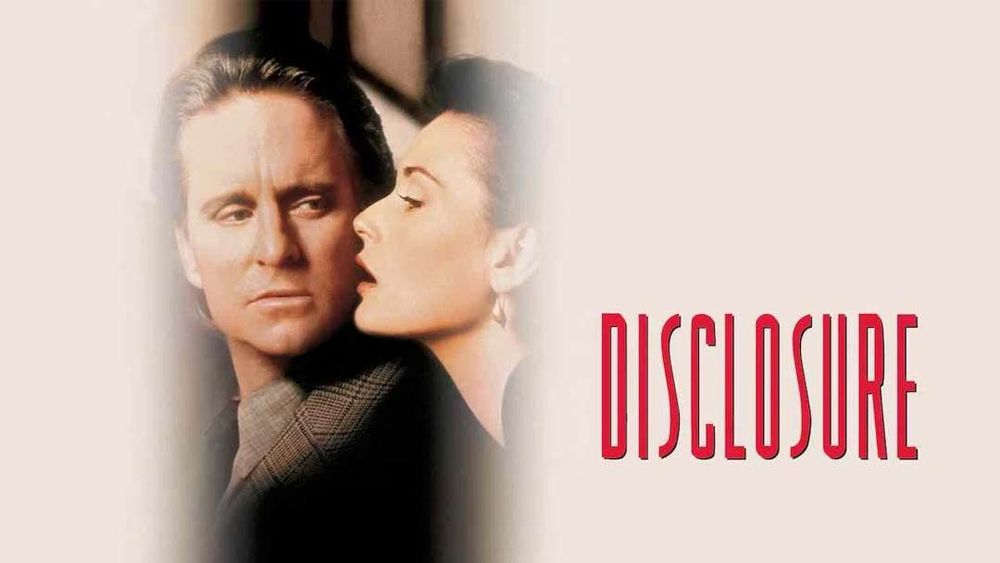
Disclosure (1994)
A computer specialist is sued for sexual harassment by a former lover turned boss who initiated the act forcefully, which threatens both his career and his personal life.
Oscar winners Mike Douglas and Demi Moore played the leading roles in this suspenseful thriller based on a high-tech company that uses sex to play a game of power.
After the married high-tech company executive rejected the romantic temptation of the new female boss, she filed a complaint of sexual harassment against him. In order to save his marriage, career, and reputation, the executive discovered the intertwined deceptions in the company and those who tried their best to destroy him in order to cover up secrets.
Oops! Is this show WOKE?
Only an account holder or member can file. Cite a scene, a line, or a pattern. Other account holders +1 or −1 that argument, once each. The show is not WOKE until enough of them have given a +1. Enough −1s remove the write-up, and it is no longer shown.
Sign in to file a woke label. One of each criterion per member.
Comments and reviews
Report a mistake
Same rule as woke labels: one report, a written reason, and the community +1 or −1 it — once per member. A net +5 applies the change. Editors can hold it for review, or apply it immediately.
No mistake reports yet.
Sign in to report a mistake. One report per field, per member.
Member review
Stu Kline Member
Oct 16, 2026
★★★★★★★★★★Disclosure came out when I was still figuring out office politics for real, and watching it again now still feels like a solid middle-of-the-road thriller that doesn’t pretend to be more than it is. Michael Douglas plays the guy who knows the systems inside the company and gets steamrolled by Demi Moore once she slides into the boss chair. She pushes the encounter, he backs off, and suddenly he’s the one answering for harassment. That flip is the whole engine of the movie, and it still works because nobody softens the edges.
The corporate side is what keeps me watching more than the bedroom tension. High-tech firm, mergers, people covering their tracks with memos and late-night server access. Douglas has to dig through layers of deception just to keep his job and his marriage from blowing up at the same time. You feel the pressure in the small scenes—the hallway conversations, the way his wife starts looking at him different after the complaint lands. It doesn’t need speeches. The script lets the mess pile up on its own.
Moore goes full predator without winking at the camera. She’s cold, calculating, and uses the company’s own rules against him. That choice still lands because it doesn’t turn her into a cartoon. She’s competent at her job and ruthless about getting what she wants. Douglas does the quieter work of a man who thought he had the map and suddenly doesn’t. Their scenes together crackle more from power imbalance than pure heat, which is the right call for this story.
The virtual-reality demo sequences look quaint now, all glowing grids and early-nineties idea of the future. Back then they felt cutting-edge; today they’re just part of the texture. They serve the plot without overstaying. Same with the supporting players—Donald Sutherland as the company elder who plays both sides, the lawyers circling. Nobody is there for comic relief or moral lectures. Everyone has an angle.
What holds it at three stars instead of higher is the pacing in the back half. Once the investigation ramps up, some of the twists telegraph themselves. You see the next betrayal coming a beat early, and the final confrontation in the boardroom resolves a little too cleanly for how messy the setup was. The marriage subplot gets the right amount of strain but never quite digs into how a couple actually rebuilds trust after something this public. Still, the movie never talks down to you about any of it.
I like that it refuses to make the harassment a simple gender checklist. A boss uses sex and authority to box someone in, and the system is set up to believe the complaint first. That dynamic didn’t need updating for modern audiences; it was already clear in 1994. The film just shows the machinery grinding and lets you watch a capable guy scramble to stay upright. No speeches about who is allowed to be the victim. Just consequences.
The tech details hold up better than I expected. File systems, email trails, the way one deleted message can sink a career—those parts feel lived-in rather than invented for drama. Douglas sells the specialist who actually understands the hardware and the people who want him gone. You root for him without the movie begging for it.
Rewatching, I noticed how little the story leans on shock value. The initial encounter is uncomfortable because of the force and the sudden power shift, not because the camera lingers. After that it’s all fallout: reputation, paycheck, home life. That focus keeps it from turning into pure melodrama. It’s a workplace survival story with a sexual weapon at the center, and it treats both pieces with the same straight face.
Three stars feels honest. Good performances, a premise that still has teeth, and enough corporate intrigue to carry the slower stretches. It’s not a classic I’ll push on everyone, but it’s a reliable watch when you want something that doesn’t lecture and doesn’t flinch from how ugly power games get once someone decides the rules only apply one way. The ending leaves a few threads a little neat, yet the overall ride stays tense enough that I didn’t check the clock. Solid piece of mid-nineties craft that knows exactly what kind of story it’s telling and sticks to it.