
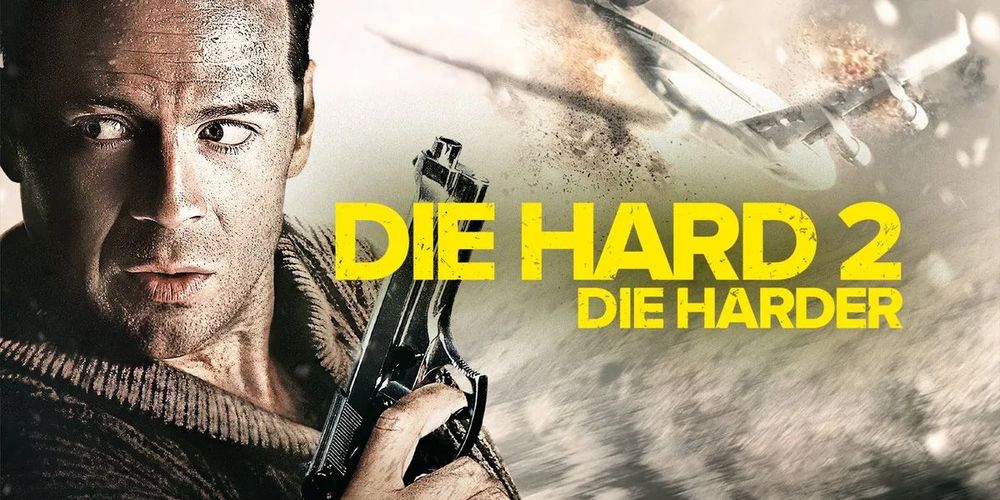



 MOVIE · 1990
Die Hard 2 Die Harder
A year after his heroics in L.A, detective John McClane (Bruce Willis) is mixed up in another terrorist plot, this time at Washington Dulles International Airport, where he is waiting for his wife (Bonnie Bedelia). That same night, South American politico and drug profiteer Ramon Esperanza (Franco Nero) is arriving in U.S. custody. McClane takes action when a treasonous ex-colonel (William Sadler) seizes control of the airport, threatening to crash every inbound flight unless Esperanza is freed.
Oops! Is this show WOKE?
Only an account holder or member can file. Cite a scene, a line, or a pattern. Other account holders +1 or −1 that argument, once each. The show is not WOKE until enough of them have given a +1. Enough −1s remove the write-up, and it is no longer shown.
Sign in to file a woke label. One of each criterion per member.
Comments and reviews
Report a mistake
Same rule as woke labels: one report, a written reason, and the community +1 or −1 it — once per member. A net +5 applies the change. Editors can hold it for review, or apply it immediately.
No mistake reports yet.
Sign in to report a mistake. One report per field, per member.
Member review
Peg Harlan Member
Oct 16, 2026
★★★★★★★★★★Die Hard 2 sits in that middle spot for me where I still put it on when it’s on cable and I don’t change the channel, but I never quite reach for it the way I do the first one. Bruce Willis is still McClane, barefoot or not, mouthy and stubborn and somehow the only guy in a building full of people who can see what’s going on. This time it’s Dulles, snow everywhere, planes circling with nowhere to land, and his wife Holly is up there again waiting to come down. That setup alone gets you most of the way. You already know the kind of night he’s about to have.
What works is the basic stubbornness of the character. McClane doesn’t get smarter or more polished between movies. He’s still the guy who’ll crawl under a plane or shoot out a window because sitting still feels worse. William Sadler’s colonel is cold and methodical in a way that fits the airport setting. The snow and the control tower and the grounded flights give the whole thing a different texture from the skyscraper. It’s bigger and more open, which means some of the tight pressure of the first movie leaks out, but you get those wide shots of planes hanging in the dark and the sense that hundreds of people are just waiting for someone to screw up. That part still lands.
I do miss the simpler geography of Nakatomi Plaza. There you knew the floors and the vents and the elevator shafts. Here the airport sprawls and the action jumps around more, and a few of the set pieces feel like they’re trying to top the last movie instead of just being themselves. The runway stuff is loud and flashy. Sometimes it works, sometimes you can feel the movie straining. Franco Nero as Esperanza has that smooth villain energy, but he doesn’t get enough room to become a real presence. The traitors inside the system are the better threat—people who already know the procedures and just turn the dials the wrong way.
Bonnie Bedelia is stuck on the plane again, which is tough for an actress. She does what she can with the radio and the growing panic, and you feel for her, but the movie keeps her at a distance. The supporting cops and FAA guys are a mixed bag. Some of them feel like real bureaucratic friction, the kind that actually slows a person down when minutes matter. Others just stand around looking confused so McClane can look sharp by comparison. That’s a cheap trick and the movie uses it more than once.
I like that it still treats guns as tools instead of moral statements. McClane picks them up, runs out of ammo, improvises, and keeps moving. Nobody stops to lecture anybody about the hardware. The violence is blunt and a little absurd in places—exactly what you expect from this series—but it doesn’t pretend the weapons have their own agenda. That keeps it honest to the first film’s spirit even when the plot gets busier.
There’s a stretch in the middle where the movie remembers it’s allowed to be funny. Willis muttering to himself, the bad guys underestimating the barefoot cop from New York, the little victories that come from pure irritation rather than grand strategy. Those moments are why I rated it where I did. They’re not as sharp as the original, but they’re still there. When the film leans on spectacle instead, it loses some of that personality. Bigger explosions don’t automatically mean better tension.
I’ve watched it enough times to know where it sags and where it still kicks. The snowbound airport is a solid idea. The circling planes raise the stakes without needing another speech. McClane’s refusal to leave his wife up there is pure character, no speeches required. What keeps it from climbing higher for me is the sense that the writers were already looking over their shoulder at the first movie, trying to match it beat for beat while expanding the canvas. Expansion isn’t always improvement. Sometimes you just get more surface and less grip.
Still, on a winter night when nothing else is on, I’ll sit through it. Willis carries a lot with that half-exhausted, half-pissed energy. Sadler makes a clean, unshowy antagonist. The airport itself becomes a character in the way the tower and the runways and the grounded traffic control all lock together. You used to get movies that trusted a simple premise and a stubborn lead to hold the whole thing. This one mostly does. It just doesn’t hold quite as tight as its older brother. That’s enough for three and a half from me. I’ll put it on again next time it’s snowing and I want something loud that still knows how to move.