



 TV · 2020
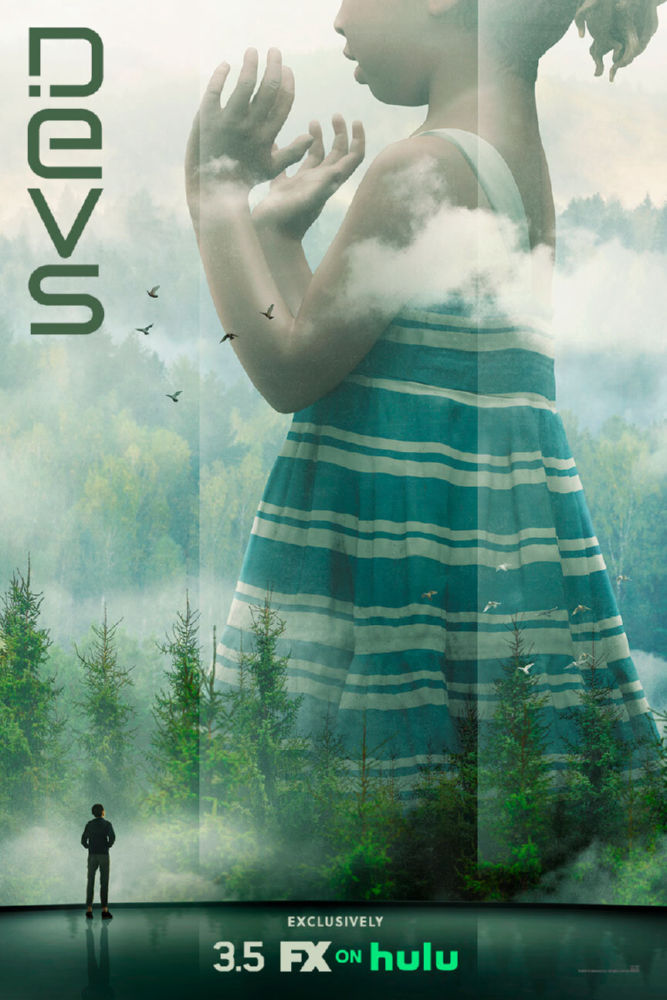
Devs
A Silicon Valley engineer suspects her company's elite quantum lab after her boyfriend dies under murky circumstances. Her probe collides with a project that treats the universe as fully determined and predictable.
Devs follows Lily Chan, a skilled computer engineer at the powerful San Francisco tech firm Amaya. When her boyfriend Sergei is pulled into the company's ultra-secret Devs division and soon turns up dead, Lily rejects the official explanation and starts investigating on her own. She leans on her ex Jamie for technical help while dodging the company's head of security, Kenton, who watches her every move. Inside Devs, founder Forest and project lead Katie oversee a mysterious quantum system built in the shadow of personal tragedy. Lily's search quickly expands from a possible murder cover-up into questions about surveillance, code, and whether human choices are ever free. The early episodes keep her isolated as the lab's calm surface hides something far larger than corporate secrecy.
As Lily pushes deeper she encounters the brilliant but fragile coder Lyndon and begins to grasp what the Devs machine actually does: reconstruct and forecast events with uncanny precision under a fully deterministic model of reality. Forest's obsession with the project is rooted in the loss of his young daughter, and the system becomes both a scientific breakthrough and a private attempt to rewrite grief. Relationships fray under constant monitoring; Jamie risks everything to aid Lily while Kenton enforces the company's will with quiet ruthlessness. Revelations about the simulation-like nature of the universe force Lily to confront whether her own actions were ever hers to choose. The final turns bind the personal stakes of love and revenge to the cold logic of the machine, leaving the characters to live inside the consequences of a world without true chance.
Click any of the following icons below to rent or stream it!
Oops! Is this show WOKE?
Only an account holder or member can file. Cite a scene, a line, or a pattern. Other account holders +1 or −1 that argument, once each. The show is not WOKE until enough of them have given a +1. Enough −1s remove the write-up, and it is no longer shown.
Sign in to file a woke label. One of each criterion per member.
Comments and reviews
Report a mistake
Same rule as woke labels: one report, a written reason, and the community +1 or −1 it — once per member. A net +5 applies the change. Editors can hold it for review, or apply it immediately.
No mistake reports yet.
Sign in to report a mistake. One report per field, per member.
Member review
Lila Marsh Member
Oct 20, 2026
★★★★★★★★★★I came to Devs because the setup felt personal enough to stick. A software engineer loses her boyfriend inside a sealed quantum lab at a powerful San Francisco tech company, rejects the official story, and starts digging into the classified project that got him killed. That grief-and-suspicion engine is what held me, more than any lecture about physics.
The show moves slowly on purpose. Lily Chan keeps pushing against the walls Amaya puts up, while the founder Forest and his collaborator Katie run this golden-cube facility built around a machine that treats the universe as fully determined. You spend a lot of time in the redwoods and in quiet rooms watching people who already know the outcome of almost everything. I get the complaint that if Devs had been a two-hour movie the same material might have hit harder; stretching the investigation and the philosophical weight across a full series does make stretches feel tiring. There are episodes where you are mostly sitting with atmosphere and small gestures of control, and that patience is required.
Still, the early episodes worked on me. I have always liked stories that mess with what we can see of the past, and those grainy projected images—Christ on the cross, Joan of Arc, other distant moments—were quietly effective. They gave the lab a strange reverence without turning it into a sermon. Then the plot drifts harder into speculative physics: the possibility of multiple universes, the claim that every action was already fixed by what came before. I am not qualified to unpack the real science, so I won’t pretend. What I responded to was the human cost of believing that view. Forest’s calm certainty and Katie’s precision feel like people who have traded ordinary mess for a cleaner kind of certainty, and Lily’s refusal to accept it keeps the show from becoming pure lecture.
The performances do a lot of quiet work. Lily’s stubbornness never turns into speeches; she just keeps going because the alternative is accepting a death that does not add up. Jamie, the gifted but unstable ex she turns to, brings a ragged energy that cuts against the lab’s polished fatalism. Kenton, the security chief, is effective in a colder register—he is not cartoonish, just a man whose job is to keep the sealed division sealed. None of them felt like they were carrying a message bigger than the story. The campus itself, the way the redwoods hide something absolute, stays with me more than any single monologue about free will.
Where the show frustrates is that it circles big questions without really settling inside them. Determinism, grief, whether free will can survive inside a machine that can see every moment—these are the bones of the thing. It raises them clearly and then spends most of its runtime splashing around the edges. You keep waiting for a sharper reckoning, and near the end it takes a turn that feels more like a lateral move than an answer. That left me a little unsatisfied. I wanted the concepts to cost the characters more in concrete ways, not just in mood. If you can live with a show that prefers implication and dread over clean resolution, you might still want to check it out, but I would not expect it to hand you a finished philosophy.
What kept my rating at four is the consistency of tone and the way personal loss stays central. The series never forgets that Lily is investigating because someone she loved is gone, and that simple fact stops the high-concept material from floating free. I finished it still thinking about the comfort and the trap of believing everything was already written. The length tests you, the ideas stay somewhat surface-level, and the final shift does not fully pay off the questions it asks. Even so, the mood, the performances, and the specific ache of someone refusing a closed system were enough for me. I would watch it again for the early historical visions and for the way the cube facility feels both beautiful and airtight. It is not a perfect piece of television, but it is a distinctive one that stayed in my head after the credits, which is more than I can say for a lot of tech-adjacent stories that promise depth and then settle for style.