




 TV · 2018
Derry Girls IS WOKE
In 1990s Derry, five Catholic-school teenagers and one English cousin stumble through exams, family chaos, and the Troubles while trying to look cool.
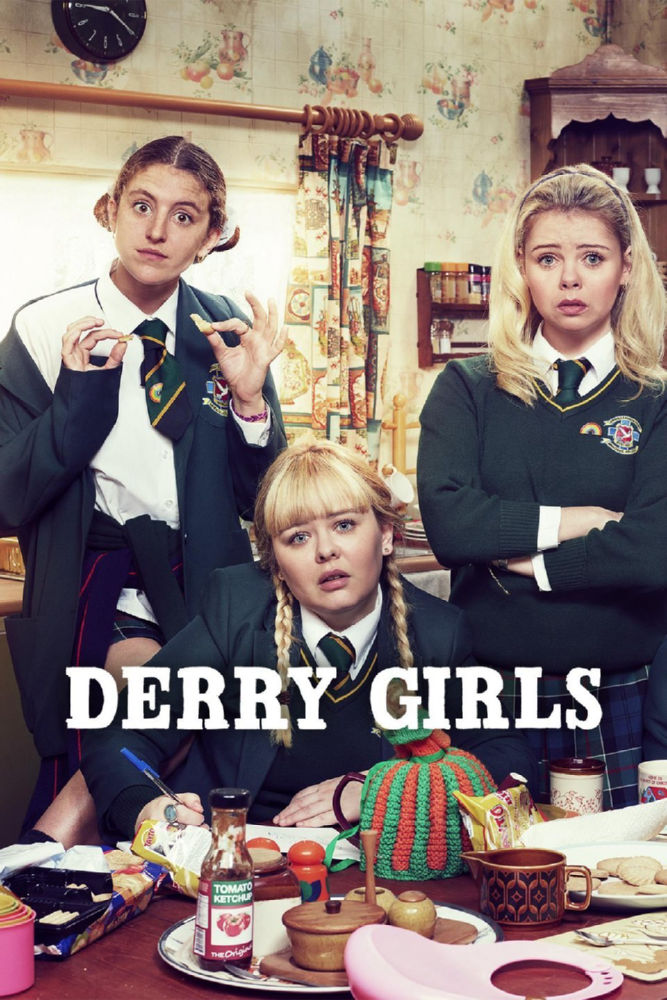
Derry Girls follows Erin Quinn, a dramatic teenager who fills her diary with grand plans while surviving Our Lady Immaculate College alongside cousin Orla McCool, best friend Clare Devlin, sharp-tongued Michelle Mallon, and Michelle’s English cousin James Maguire, the only boy in their year. Erin’s household is a constant circus: her parents Mary and Gerry, flighty Aunt Sarah, and grumpy Granda Joe share one cramped house and endless arguments. The girls skip class, chase bands, botch school projects, and trade insults while soldiers, checkpoints, and bomb scares form the everyday backdrop of the Troubles. James endures relentless teasing for his accent and for being male in an all-girls environment. Orla’s oddball songs and Clare’s anxious rule-following collide with Michelle’s schemes, turning ordinary teen crises into local disasters. Small victories—passing a test, surviving a family wedding, or simply getting home in one piece—feel huge against the political noise outside.
As the series moves forward the same core group keeps colliding with bigger moments: peace-process marches, school trips that go wrong, and the slow approach of exams and adulthood. Erin keeps chasing a writer’s life and repeatedly misreads her own importance; Michelle drags everyone into risky nights out; Orla remains cheerfully oblivious; James keeps trying to fit in. Clare’s private struggles with identity and her eventual openness about liking girls become part of the group’s ongoing story rather than a side note, while the friends still spend most of their energy on boys, parties, and surviving their teachers. Family threads tighten around Joe’s stubbornness, Sarah’s romances, and Gerry’s attempts to keep the peace at home. By the later episodes the teenagers face leaving school and the uncertain ceasefire years, still bound by the same loud, loyal friendship that got them through every ridiculous crisis in Derry.
WHAT CRITERIA MAKES IT WOKE?

Oops! Is this show WOKE?
Only an account holder or member can file. Cite a scene, a line, or a pattern. Other account holders +1 or −1 that argument, once each. The show is not WOKE until enough of them have given a +1. Enough −1s remove the write-up, and it is no longer shown.
Sign in to file a woke label. One of each criterion per member.
Comments and reviews
Report a mistake
Same rule as woke labels: one report, a written reason, and the community +1 or −1 it — once per member. A net +5 applies the change. Editors can hold it for review, or apply it immediately.
No mistake reports yet.
Sign in to report a mistake. One report per field, per member.
Member review
Wes Calder Member
Oct 19, 2026
★★★★★★★★★★Derry Girls sits in that narrow pocket where a sitcom can keep the Troubles as weather rather than plot engine and still feel honest about it. Erin’s diary theatrics, Orla’s sideways songs, Michelle’s sharp mouth, Clare’s careful earnestness, and James stuck as the lone English boy in a Catholic girls’ school all bounce off each other without needing a lesson plan. The household noise—Mary and Gerry, Aunt Sarah, Granda Joe—lands as lived-in irritation more than sitcom furniture. Soldiers and checkpoints drift through the edges the way they would have for kids who still cared more about looking cool and failing exams than about the politics swallowing the place. That balance is why I landed at 4.5 instead of talking myself down.
I did notice the writing keeps circling back to Clare. Among the five main teenage leads she is the lesbian, and her relationships and the slow sorting-out of that get recurring narrative space. It is not a side note; the show returns to it enough that it becomes part of the show’s shape. On a site like this that registers, even when the rest of the comedy stays light and specific. The rest of the group still gets their full share of screentime and stupidity, so it never turns into a single-issue hour, but the focus is there and plain.
The accent wall is real for some people. I have spent enough time with that sound that it clicked fast; others need an episode or two and a little patience. Once it settles, the timing is clean. The jokes do not depend on insider Northern Irish references alone. A couple of us watched it from completely different backgrounds and still ended up laughing at the same stretches—the botched projects, the band chases, James catching endless grief for existing as male and English in that uniform. The comedy travels. It is not locked to one postcode.
What keeps it from feeling precious is how little the show apologizes for the girls being gullible and street-savvy at the same time. They talk a bigger game than they can back up, insult each other constantly, and still form a unit that makes sense. James’s outsider status is used without turning him into a mascot or a punching bag that never punches back. Orla remains gloriously odd without the script winking at the audience every thirty seconds. The first series moves especially cleanly; later stretches repeat some rhythms and the cast is visibly older than the school setting, which can pull you out if you stare too hard, but the core voices stay consistent enough that I did not bail.
The Catholic-school texture and the family circus give the episodes their weight without turning every plot into a statement. Anxiety from the undeclared war touches down here and there—checkpoints, news, the ordinary caution—yet the show mostly lets the teenagers stay teenagers. That choice is what makes the whole thing watchable rather than dutiful. I am not usually drawn to period teen ensembles that lean on big historical backdrops, but the writing here stays small and mean in the right ways. The insults land. The failures are specific. Nobody is rewritten into a better person overnight.
I am not going to pretend the Clare material is invisible or that it does not tilt the ensemble. It does. On NOT WOKE SHOWS that matters, and I am not grading around it. At the same time the surrounding comedy is sharp enough, and the sense of place dry enough, that I still sat through the run without the usual fatigue. The show knows when to stop explaining itself. That restraint, more than any single gag, is why the rating stuck at 4.5 rather than sliding lower once the pattern with Clare became obvious. It is funny, it is local without being sealed off, and it carries one clear modern weighting in the lead group that you can see coming and still choose to live with if the rest of the hour is doing its job. For me it mostly did.