



 TV · 2017
Dark
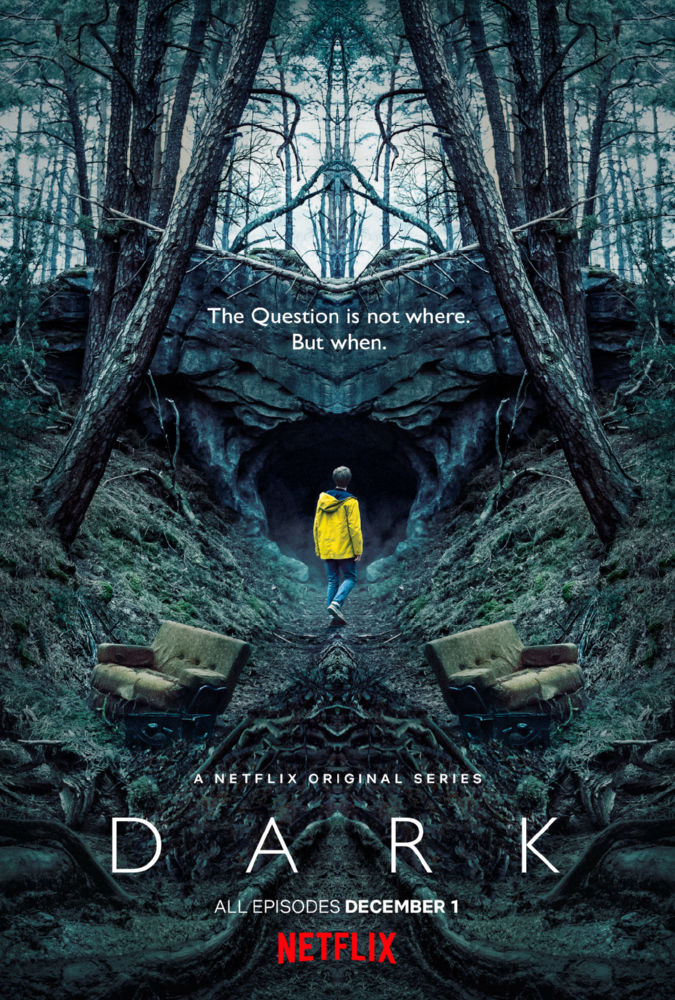
Dark follows the disappearance of two children in the German town of Winden and the resulting investigation that exposes a time-travel conspiracy spanning three generations and four families.
Dark follows Jonas Kahnwald after his friend Mikkel vanishes into a cave near the Winden nuclear power plant. Jonas discovers old photographs and a mysterious note that link the 2019 disappearance to events in 1986 and 1953. His mother Hannah, police chief Charlotte Doppler, and teacher Regina Tiedemann each pursue separate leads that intersect at the same locations and dates. The investigation reveals that several residents are their own ancestors due to repeated time loops.
Jonas learns that his father Michael was actually Mikkel Nielsen transported forward in time. Attempts to break the cycle draw in his love interest Martha, her brother Magnus, and the priest Noah, whose actions sustain the loop. The families confront the consequences of their choices across decades while a larger force tied to the power plant manipulates events to preserve the timeline.
Click any of the following icons below to rent or stream it!
Oops! Is this show WOKE?
Only an account holder or member can file. Cite a scene, a line, or a pattern. Other account holders +1 or −1 that argument, once each. The show is not WOKE until enough of them have given a +1. Enough −1s remove the write-up, and it is no longer shown.
Sign in to file a woke label. One of each criterion per member.
Comments and reviews
Report a mistake
Same rule as woke labels: one report, a written reason, and the community +1 or −1 it — once per member. A net +5 applies the change. Editors can hold it for review, or apply it immediately.
No mistake reports yet.
Sign in to report a mistake. One report per field, per member.
Member review
Wes Calder Member
Oct 19, 2026
★★★★★★★★★★Dark is the kind of show that arrives with a reputation already attached, the sort of thing coworkers hand you like a puzzle they half-solved and then watch your face. I went in knowing it was German, knowing it involved missing kids and a nuclear plant and some kind of loop across decades, and that was enough. What I did not expect was how little it cares about making the first stretch easy. The lights flicker, birds drop, the caves feel wrong, and everyone in Winden is sitting on something they would rather keep buried. That part tracks. The rest is slower and colder than the elevator pitch suggests.
I watched it with subtitles. There is a dubbed version floating around, and I tried a few minutes of it out of curiosity, then went back. The original delivery has a flatness that fits the town. People do not emote for the camera. They withhold. That choice matters more than it sounds. Once you get used to the cadence, the English track feels like it is trying to sell you tension the picture already has.
People reach for Stranger Things when they describe this, and the surface overlap is obvious enough: small town, missing boy, caves, a sense that the 80s never really left. I do not think the comparison holds past the first couple of episodes. Stranger Things wants you to like hanging out. Dark wants you to keep a chart. The families fold into each other across 1953, 1986, and 2019 until you realize half the cast is related in ways that would break a normal dinner table. Jonas starts as the center and then the center keeps moving. His friend Mikkel vanishes near the plant. Old photos and a note pull the investigation backward. Hannah, Charlotte, Regina each pick at different threads and land in the same places on the same dates. None of that is spoiler so much as the basic machinery. The show does not hide that time is the problem. It just refuses to explain the problem on a schedule that would keep a casual viewer comfortable.
I have seen the take that the characters are shallow and the plot is just people hopping decades. That complaint is fair if you want banter and clear motives by episode three. What looks like shallowness is often people locked into roles the loop already wrote for them. They repeat patterns because the structure rewards repetition. Noah is the clearest example of someone who treats the cycle as work rather than tragedy. Martha and Magnus get pulled in once Jonas starts trying to cut the knot. The show is not interested in making any of them charming first. Attachment arrives later, if it arrives, through the weight of what they keep failing to prevent.
The pace is deliberate in a way that will lose people. Season one is long corridors and half-answers. Season two does not suddenly become a sprint. I did not find it uninteresting so much as stubborn. It asks you to sit with confusion instead of resolving it for dopamine. When something finally clicks—an identity, a date, a photograph that now means something else—the satisfaction is quiet. No score swells. Just the sense that the board has fewer empty squares. That is either your idea of a good time or it is not. I am in the first group, with reservations. There are stretches where the show trusts its own mythology a little too much and lets the human temperature drop. A few supporting figures remain outlines longer than they should. The nuclear plant and the caves do a lot of atmospheric work, sometimes more than the dialogue.
What keeps it at 4.5 for me is the follow-through. Time travel stories usually cheat or sentimentalize. Dark mostly refuses both. The loops have rules and the rules hurt. Breaking them is not framed as a clever hack. It is framed as something that costs people you have already spent hours with. The sinister turn is not a twist so much as the logical end of watching the same wounds reopen across generations. Secrets in Winden are not colorful backstory. They are load-bearing. Once you accept that, the missing children stop feeling like a premise and start feeling like a symptom.
I would not call it a delight in the easy sense. It is a supernatural puzzle with a grim streak and almost no interest in comforting you. Mystery and suspense are there, but they sit under a layer of gray weather and bad decisions. If you need episode-to-episode hooks that yank you forward, this will test your patience. If you like a story that treats your attention as something you can spend and then reward carefully, it holds up. I finished it without feeling tricked, which is rarer than it should be for anything that puts a cave and a power plant at the center of three timelines. That is about as high as my praise goes, and for this one it is enough.