
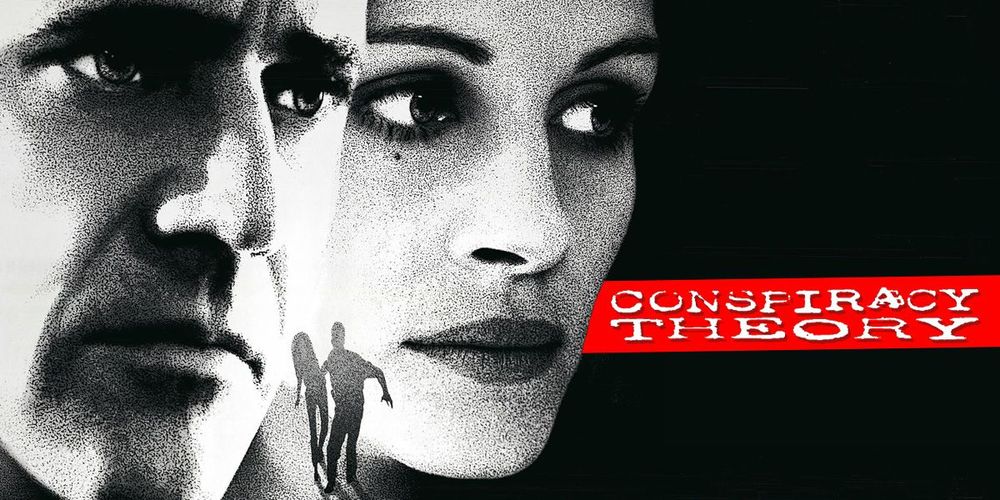



 MOVIE · 1997
Conspiracy Theory (1997)
A New York cab driver obsessed with conspiracy theories becomes a target when one of his wild claims turns out to be true. He must identify which theory is real while protecting the Justice Department attorney he secretly loves.
Conspiracy Theory follows Jerry Fletcher, a New York City taxi driver who fills his nights writing and mailing a newsletter of elaborate government plots. Jerry regularly drops in on Alice Sutton, a Justice Department attorney he has quietly idealized, offering her coffee and the latest theories she mostly treats as harmless eccentricity. After one of his published ideas draws lethal attention, armed operatives snatch him from the street and subject him to chemical interrogation meant to erase what he knows. Jerry escapes in a chaotic scramble and races to Alice, insisting the danger is real. Skeptical yet unsettled by the sudden violence around him, she begins checking his claims against her own files and discovers unsettling overlaps with classified programs.
Alice’s inquiries pull her into the same crosshairs, forcing the pair to go on the run through the city while piecing together which of Jerry’s many theories actually matches the operation hunting them. They uncover links to a black-ops mind-control project and a calculating handler willing to kill anyone who can expose it. Jerry’s fractured memories and Alice’s professional access become their only leverage as assassins close in and trust between them is repeatedly tested. Personal loyalty collides with institutional secrecy, pushing both characters to decide how far they will go to stay alive and to bring the truth into the open. The chase tightens around a final confrontation that settles which conspiracy was never just a theory.
Creator: Richard Donner · IMDb
Oops! Is this show WOKE?
Only an account holder or member can file. Cite a scene, a line, or a pattern. Other account holders +1 or −1 that argument, once each. The show is not WOKE until enough of them have given a +1. Enough −1s remove the write-up, and it is no longer shown.
Sign in to file a woke label. One of each criterion per member.
Comments and reviews
Report a mistake
Same rule as woke labels: one report, a written reason, and the community +1 or −1 it — once per member. A net +5 applies the change. Editors can hold it for review, or apply it immediately.
No mistake reports yet.
Sign in to report a mistake. One report per field, per member.
Member review
Peg Harlan Member
Oct 16, 2026
★★★★★★★★★★I landed on 3.5 for Conspiracy Theory because it still works as a late-nineties thriller even when the gears start grinding against each other. Mel Gibson plays Jerry Fletcher, the cabbie who tapes his monologues and keeps stacks of newspaper clippings like they are sacred texts. One of his wild ideas turns out to have teeth, and suddenly the same people who used to ignore him are hunting him. Julia Roberts is the Justice Department attorney he keeps pestering with his bulletins. She gets dragged in whether she wants it or not. That setup is clean and it hooks you early.
Gibson goes all in. He does not play Jerry as a cartoon. The man is exhausting and lonely and genuinely frightened, and you can feel the years of talking to himself in that cab. The little details land—the way he checks locks twice, the way he offers people free rides just so he can unload another theory. Roberts keeps her footing opposite that energy. She is not asked to match his intensity; she just has to stay sharp and human while the ground keeps shifting under both of them. Their scenes together have a peculiar rhythm that feels lived-in rather than written for cute sparring.
Patrick Stewart shows up as the polished face of whatever agency is cleaning house, and he is calm enough to be unsettling. The movie does not over-explain him, which helps. You get the sense that men like that have been doing this work for decades and have long since stopped needing to raise their voices. The supporting cast fills out the edges without crowding the frame.
Where it starts to lose me is the pile-on. Once Jerry is on the run, the film keeps adding layers—mind-control whispers, old assassinations, institutional cover stories—until you are not entirely sure which thread is the one that actually matters. The chase mechanics are solid enough: tight alleys, sudden reverse, a few well-timed escapes. They used to make them like this, with practical stunts and clear geography so you could track who was gaining on whom. I still enjoy that craft. But the script wants to be a paranoid chase, a reluctant romance, and a sideways look at how much we should trust official stories all at the same time. Those ambitions bump into each other in the middle stretch. Scenes that should tighten instead circle. You start checking your watch a little, wondering when the movie will decide what it is really about.
I first saw it on a weeknight when it was still relatively new, and I remember being more entertained than impressed. That has not changed much. The humor still sneaks through in the right places—Jerry’s absolute conviction that everything connects, even when it clearly does not. Some of the quieter beats between him and Roberts feel honest about two damaged people who keep finding reasons to stay near each other. The film never pretends Jerry is suddenly cured or that the system he fears is suddenly benevolent. It just lets the pressure build and then tries to land the plane.
The landing is serviceable rather than sharp. A few resolutions feel convenient, as if the writers needed to close doors they had left open too long. Character choices that should carry more weight get hurried. I do not mind a thriller that refuses to explain every last detail—mystery is part of the fun—but I do mind when the emotional stakes soften just so the plot can wrap. That is the main reason I sit at 3.5 instead of nudging higher. It is good company for a couple of hours, especially if you like Gibson when he is willing to look unhinged, but it does not stick to the ribs the way the best of that era could.
Still, I will put it on again when the mood hits. There is something stubbornly watchable about a man who has spent his life being dismissed suddenly discovering that the dismissal was the real mistake. The movie never becomes profound about that idea, and it does not need to. It just runs with it long enough to keep you leaning forward. The production design, the city nights, the way information is traded in half-lit offices—those pieces still hold up. You can feel the pre-digital texture of it. People actually had to go places and talk face to face and risk being seen. That alone gives the paranoia a different flavor than the ones we get now.
I am not claiming it is hidden greatness. It is a solid, slightly overstuffed entertainment that knew how to use two movie stars who were both at interesting points in their careers. Gibson’s restless energy and Roberts’s grounded skepticism bounce off each other in ways that feel specific to this picture. When the story stays close to that friction, it works. When it wanders into committee-level complication, it loses altitude. That balance is why 3.5 feels honest. I would rather watch it than half the slicker thrillers that came after, even knowing its soft spots. Sometimes that is enough.