




 TV · 2025
Common Side Effects IS WOKE
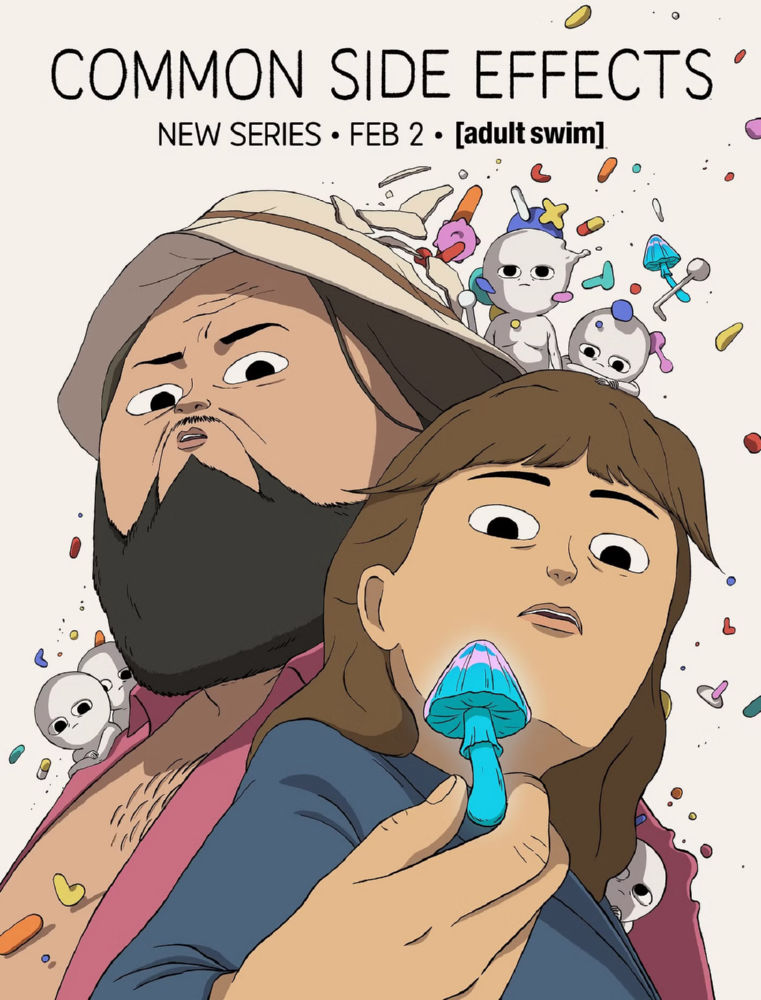
Former high school lab partners Marshall and Frances uncover a rare mushroom that could cure every disease, then collide with a big-pharma and government plot to bury it.
Common Side Effects follows Marshall and Frances, former high school lab partners whose paths cross again when a strange fungus enters their lives. The pair quickly realize the mushroom appears capable of reversing illness on a scale no existing medicine matches. Their early tests and inquiries draw unwanted attention from pharmaceutical interests and federal players who prefer the discovery stay hidden. Marshall brings restless curiosity and a willingness to push boundaries in the lab, while Frances supplies sharper caution and a clearer sense of the institutional walls ahead. Together they chase samples, contacts, and half-buried records, turning a scientific hunch into a widening fight over who controls a potential universal cure. Each new lead tightens the sense that powerful groups will erase the mushroom rather than let it rewrite medicine.
As Marshall and Frances dig deeper, alliances form and fracture around the mushroom’s true reach and the people willing to kill for silence. They move from quiet experiments into riskier fieldwork, dodging surveillance and pressure while trying to keep the organism alive and documented. Old high-school trust is tested by secrets, competing motives, and the sheer scale of the cover-up they have walked into. Later turns force them to decide how far they will go to expose the suppression and whether the cure can survive contact with the systems built to stop it. The story stays locked on their partnership, the conspiracy’s machinery, and the personal cost of protecting a discovery that could change everything.
Click any of the following icons below to rent or stream it!
WHAT CRITERIA MAKES IT WOKE?

Oops! Is this show WOKE?
Only an account holder or member can file. Cite a scene, a line, or a pattern. Other account holders +1 or −1 that argument, once each. The show is not WOKE until enough of them have given a +1. Enough −1s remove the write-up, and it is no longer shown.
Sign in to file a woke label. One of each criterion per member.
Comments and reviews
Report a mistake
Same rule as woke labels: one report, a written reason, and the community +1 or −1 it — once per member. A net +5 applies the change. Editors can hold it for review, or apply it immediately.
No mistake reports yet.
Sign in to report a mistake. One report per field, per member.
Member review
Toni Briggs Member
Oct 17, 2026
★★★★★★★★★★Common Side Effects caught me off guard in the best way. I went in expecting another slick conspiracy thriller that burns out after two episodes, and instead got something that actually sits with the science and the paranoia without turning either into cartoon noise. Marshall and Frances as former high school lab partners who reconnect over this rare mushroom feels lived-in rather than engineered for cute banter. Their dynamic has the right friction: he pushes experiments further than caution allows, she keeps mapping the institutional walls that are already closing in. That push-pull carries a lot of the early tension and never gets resolved into simple good-cop/bad-cop roles.
The mushroom itself is treated like a real discovery instead of a magic plot device. You watch them run the first tests, chase half-buried records, and realize the thing might reverse illness on a scale that existing medicine cannot touch. The show does not pause every five minutes to explain why that matters; it lets the implications land through their growing fear and the sudden interest from people who would rather the fungus stay buried. Big pharma and federal players show up as competent threats, not cackling villains in boardrooms. That restraint makes the stakes feel heavier. When a contact disappears or a sample goes missing, it registers as actual loss instead of the next checklist item on the conspiracy board.
I liked how the series keeps the lab work messy. Marshall’s curiosity is restless and sometimes reckless, which creates real problems rather than just cool set pieces. Frances’s sharper sense of how institutions protect themselves gives the story its spine. Together they turn a scientific hunch into a widening fight over control, and the show trusts the audience to follow the paper trails and the quiet betrayals without constant hand-holding. There is a stretch in the middle where the chase for samples and contacts could have drifted into filler, but the writing stays tight enough that every dead end still reveals something about who is watching them.
What surprised me most is how little the show leans on easy moral shortcuts. The market is not automatically evil and the collective is not automatically holy; the people trying to bury the mushroom have clear incentives that make sense even when you hate them. That keeps the conflict from collapsing into a sermon. You root for Marshall and Frances because they are stubborn and smart, not because the script hands them a halo. Their old partnership history surfaces in small, believable ways—shared shorthand, old arguments that never fully died—which makes the present danger feel personal instead of purely ideological.
The tone stays grounded even when the plot widens. Night drives, fluorescent labs, awkward meetings with people who know more than they admit: the show favors that texture over glossy set pieces. I never felt like it was trying to dazzle me with production value. It just keeps the pressure on and lets the characters sweat. There are a couple of quieter episodes that some might call slow, but they build the sense that this discovery has already changed the two of them in ways they cannot reverse. By the time larger forces fully engage, you understand why walking away is no longer an option.
I rated it 4.5 because the strengths outweigh the few soft spots. A couple of secondary characters could have used sharper definition, and one late-season turn felt a notch too convenient, yet neither derailed the core. The central idea—what happens when a cure big enough to upend everything lands in the hands of two people who are not ready for the fight—stays compelling all the way through. Marshall and Frances never become superheroes. They stay scientists who got in over their heads and decided the cost of quitting was worse. That choice, repeated under increasing pressure, is what kept me watching.
If you want pure escapism or a show that tells you exactly who to hate every week, look elsewhere. If you want a thriller that treats its science and its paranoia with equal seriousness and lets two stubborn former lab partners carry the weight, this one earns the time. I finished the season wanting the next chapter more than I expected, which is the simplest measure I know. The mushroom may or may not cure everything, but the series itself works better than most things that promise the same scale of ambition.