



 MOVIE · 2002
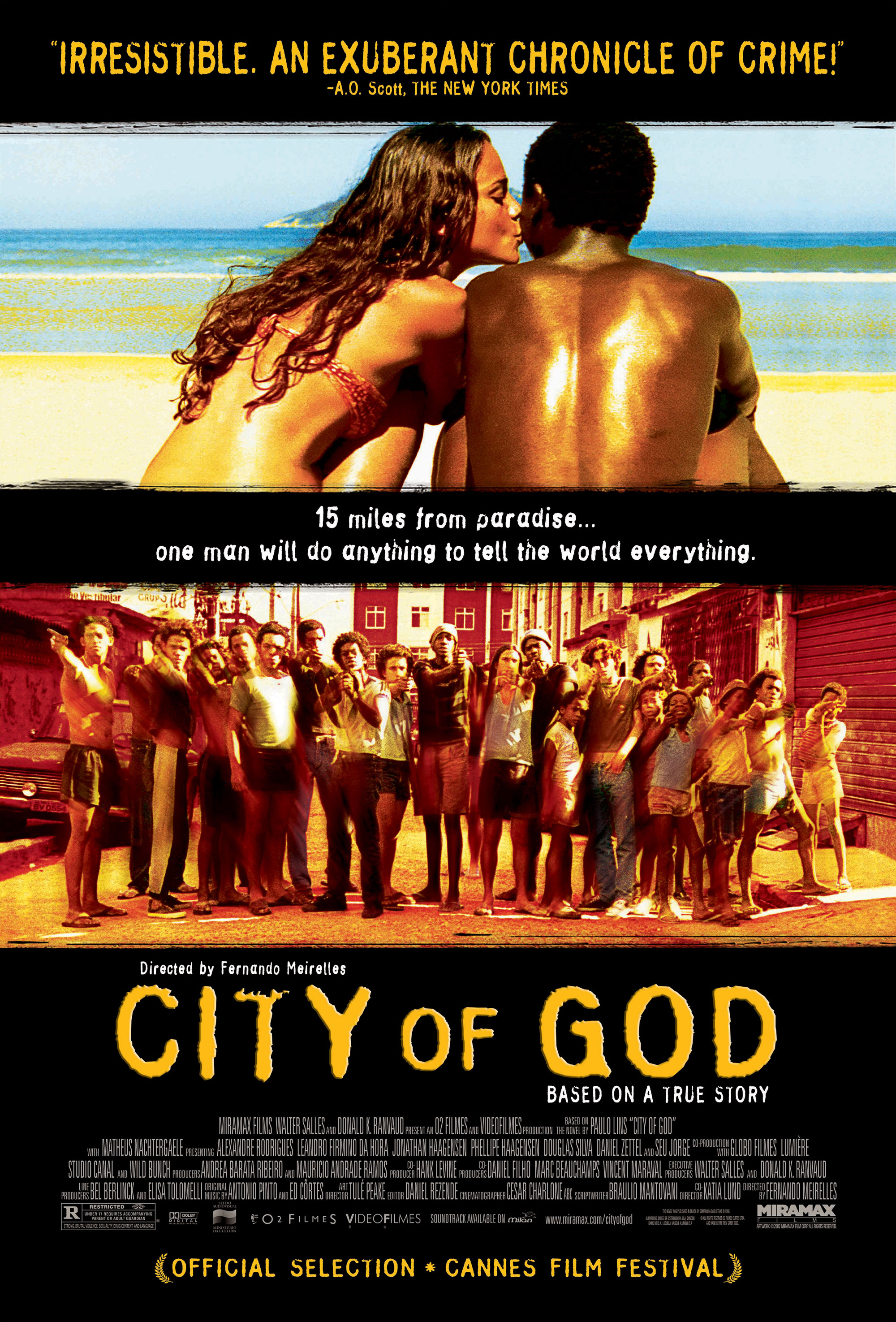
City of God
Celebrated with worldwide acclaim, this powerful true story of crime and redemption has won numerous prestigious awards around the globe! The streets of the world's most notorious slum, Rio de Janeiro's "City of God" are a place where combat photographers fear to tread, police rarely go and residents are lucky if they live to the age of 20. In the midst of the oppressive crime and violence, a frail and scared young boy will grow up to discover that he can view the harsh realities of his surroundings with a different eye, the eye of an artist. In the face of impossible odds, his brave ambition to become a professional photographer becomes a window into his world and ultimately his way out!
Oops! Is this show WOKE?
Only an account holder or member can file. Cite a scene, a line, or a pattern. Other account holders +1 or −1 that argument, once each. The show is not WOKE until enough of them have given a +1. Enough −1s remove the write-up, and it is no longer shown.
Sign in to file a woke label. One of each criterion per member.
Comments and reviews
Report a mistake
Same rule as woke labels: one report, a written reason, and the community +1 or −1 it — once per member. A net +5 applies the change. Editors can hold it for review, or apply it immediately.
No mistake reports yet.
Sign in to report a mistake. One report per field, per member.
Member review
June Pell Member
Oct 6, 2026
★★★★★★★★★★I gave City of God 4.5 stars the night I finished it and I still think that number holds. It is not a comfortable film and it does not try to be. I put it on expecting a crime story with some style, and what I got was something that sits in your chest for days afterward. The streets feel tight, the choices feel immediate, and the camera never looks away just to spare you.
What pulled me in was the way it tracks ordinary kids who grow up inside a place where the usual exits are blocked. Rocket is the one who notices things instead of grabbing for power, and that small difference becomes everything. He is not brave in the movie-hero sense. He is careful, a little soft, and smart enough to understand that a camera might get him farther than a gun. Watching him figure that out felt honest. I have known people who found a way out through some quiet skill nobody else valued, and the film gets the mix of luck and stubbornness right without turning it into a speech.
The violence arrives fast and without ceremony. One minute kids are running around, the next someone is on the ground and the group has already moved on. That rhythm is what makes it land. It never pauses to tell you how to feel about any of it. You just watch the cycle tighten. I took a short side path while watching and thought about how many American movies treat poverty like a temporary setback or a lesson waiting to be learned. Here it is simply the weather. People laugh, fall in love, play soccer, then plan the next score because that is the available path. My own childhood was nothing like the favelas, yet I recognized the gravity that pulls certain groups of young guys sideways when nothing stronger is pulling the other way. Different city, same physics.
The non-professional cast is a big reason it works. Faces look lived-in. Decisions look stupid in the moment and inevitable five minutes later. Nobody delivers clean explanations. They argue, boast, panic, and keep going. Li’l Zé’s rise and the shifting alliances around him feel like watching a storm form rather than a plot being constructed. I had to rewind once early on to lock the names and timelines in place, but after that the film carries its own momentum. The editing keeps you slightly off-balance in a good way, matching the sense that everything can flip in an afternoon.
I appreciated that the photography thread never becomes a tidy metaphor for hope. Rocket wants out and the camera is his tool, yet the movie does not pretend the tool is magic or that the rest of the neighborhood gets the same chance. Some people dig in deeper. Some disappear. The film lets that unevenness stand. That is rare. A lot of stories feel the need to balance the scales or assign clear villains and saints. City of God mostly refuses. The city itself keeps turning the same way after the credits.
A couple of the later set pieces lean a little hard into operatic intensity, which is why I stopped short of 5. They still work, but you can feel the movie flexing. Everything else stays grounded. The heat, the dust, the sudden quiet after a loud stretch—those details stay with me more than any single gunfight. I paused once just to sit with what I had seen, something I almost never do. Then I pressed play again because I needed to know where Rocket landed and whether the place would let him leave.
What lingers is the speed of the lives on screen. Softness gets corrected fast. Ambition is measured in whether you survive long enough to try a different door. Most of us talk about ambition in softer terms—better jobs, side projects, a nicer apartment. Here the stakes strip all that down. I found myself respecting the film’s refusal to soften the edges or hand out easy lessons. It trusts the audience to sit with the mess.
I would watch it again, though not lightly. It is the kind of movie that reminds you how thin the line can be between a regular afternoon and a life that closes early. The craft is sharp, the performances feel unforced, and the whole thing refuses to tidy itself up for comfort. Four and a half stars feels exact: excellent, occasionally overwhelming, and hard to shake once it is over. It earned the rating by treating its world as real instead of a backdrop for somebody else’s argument.