
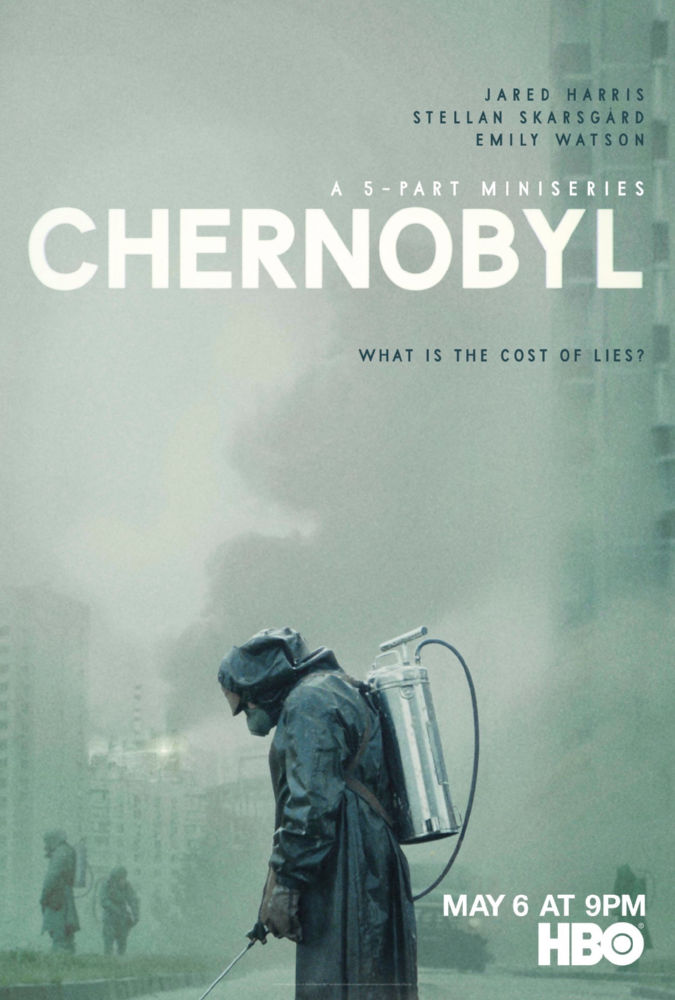



 TV · 2019
Chernobyl
Chernobyl dramatizes the 1986 reactor explosion and the scientists, officials, and workers who fought radiation and official lies to limit a continent-wide catastrophe.
Chernobyl follows Valery Legasov, a nuclear chemist summoned after Reactor 4 at the Chernobyl plant explodes. He arrives to find firefighters and plant staff already dying from acute radiation while local leaders insist the core is intact. Legasov clashes with deputy chairman Boris Shcherbina, who initially prioritizes Party optics over physics, and with plant managers who hid design flaws. Together they confront graphite fires, a threatened second explosion, and the need to evacuate Pripyat. Composite scientist Ulana Khomyuk presses for honest data as dosimeters max out and the true scale of the release becomes undeniable.
As the crisis widens, Legasov and Shcherbina organize helicopter drops, miners to dig under the reactor, and liquidators to clear radioactive debris from the roof. Khomyuk tracks the RBMK design defect that made the disaster possible and helps build the case against the culture of secrecy. Ordinary workers and soldiers absorb lethal doses while officials stage managed tours and delayed admissions. The series moves through the trial of plant personnel and Legasov’s later testimony about the cost of lies, closing on the human toll of containment and the long exclusion zone left behind.
Oops! Is this show WOKE?
Only an account holder or member can file. Cite a scene, a line, or a pattern. Other account holders +1 or −1 that argument, once each. The show is not WOKE until enough of them have given a +1. Enough −1s remove the write-up, and it is no longer shown.
Sign in to file a woke label. One of each criterion per member.
Comments and reviews
Report a mistake
Same rule as woke labels: one report, a written reason, and the community +1 or −1 it — once per member. A net +5 applies the change. Editors can hold it for review, or apply it immediately.
No mistake reports yet.
Sign in to report a mistake. One report per field, per member.
Member review
Ray Okonkwo Member
Oct 20, 2026
★★★★★★★★★★Chernobyl does not ease you in. It drops you into the night the reactor blew and lets the panic, the denial, and the physics do the rest. I liked that choice more than I expected. Some people want a long runway of Soviet history first; I already knew enough of that world that starting at the fire felt honest. You learn the system by watching what it does when the meters peg and nobody wants to say the word “graphite.”
The stretch that tested me was the crawl under the core to open those valves. The show stays down there with the men long enough that the dread turns physical. You feel the heat, the water, the knowledge that the dose is already fatal. It works, but it also overstays. I caught myself wanting to jump ahead once the point had landed. A couple of other sequences lean the same way—minutes spent on a single grim task when a tighter cut would have kept the same weight. That is the only real drag I felt across five episodes.
What stays with me is the slow collision between Legasov and Shcherbina. Legasov shows up already carrying the science and the dread. Shcherbina begins as the man sent to manage optics and Party comfort. Their first meetings are almost comic in how badly the language fails: one man talking radiation, the other talking reports that will look good in Moscow. Watching Shcherbina get converted by reality—by the graphite on the ground, by the numbers that keep climbing—is the spine of the thing. It never turns into a friendship montage. It just becomes two exhausted men who finally share the same problem and the same cost.
The composite scientist Khomyuk is a useful invention. She forces the questions the real system tried to bury, and she does it without turning into a speech machine. The plant managers who hid the design flaws land as something colder than cartoon villains; they are men who believed the lie had already been told so often it must be true. That is scarier than cartoon evil. You see the same pattern in the early refusal to evacuate Pripyat, in the cheerful broadcasts, in the way dosimeters that max out are treated as defective rather than as the only honest instruments left.
I kept thinking about the sound of those meters. The show does not need constant gore. The click rate and the quiet after a reading is enough. Firefighters with faces that will not look like faces tomorrow. Miners digging under the reactor with almost no protection because the alternative is worse. Helicopter drops that feel like both bravery and improvisation under a deadline no one fully understands. The second-explosion threat, the graphite fire, the scramble for boron and sand—these pieces stay mechanical and human at the same time. You are never allowed to forget that the continent is the scale, not just the plant fence.
The trial sequence near the end is where the earlier patience pays off. Legasov finally says out loud what the design and the culture of lying produced. It is not a victory lap. It is a man choosing the record over his own safety, knowing the system will still punish him. The show does not pretend that one testimony fixed anything. It just makes the cost visible.
There is a particular gravity to material this heavy when it refuses to wink or soften. It is terrifying and sobering without becoming a lecture. I have read enough about the USSR and the accident that I walked in with the broad outline already in my head. That can kill tension. Here it did not. The multiple angles—scientists, officials, plant workers, the people who lived downwind—keep the story moving even when you know the broad outcome. You still do not know, moment to moment, which small decision will make the difference between containment and something larger.
I am not interested in turning historical catastrophe into moral branding. Chernobyl mostly avoids that. It stays with competence, cowardice, bureaucracy, and radiation as facts. The Party’s need for good news is the real antagonist more than any single face. That lands cleanly.
A few scenes still feel longer than they need to be, and anyone hoping for a thick pre-disaster backstory section will leave hungry. Those are fair complaints. They did not sink it for me. The core of the series—the physics arguing with the politics, the men who paid in their bodies, the quiet way lies multiply—holds. I came away rattled in the right way, and I have not stopped thinking about the meters or the way Shcherbina’s face changes once he stops performing certainty. That is enough to put it at 4.5 and leave it there. It is exceptional television narrative without needing to shout about it. The weight does the work.