
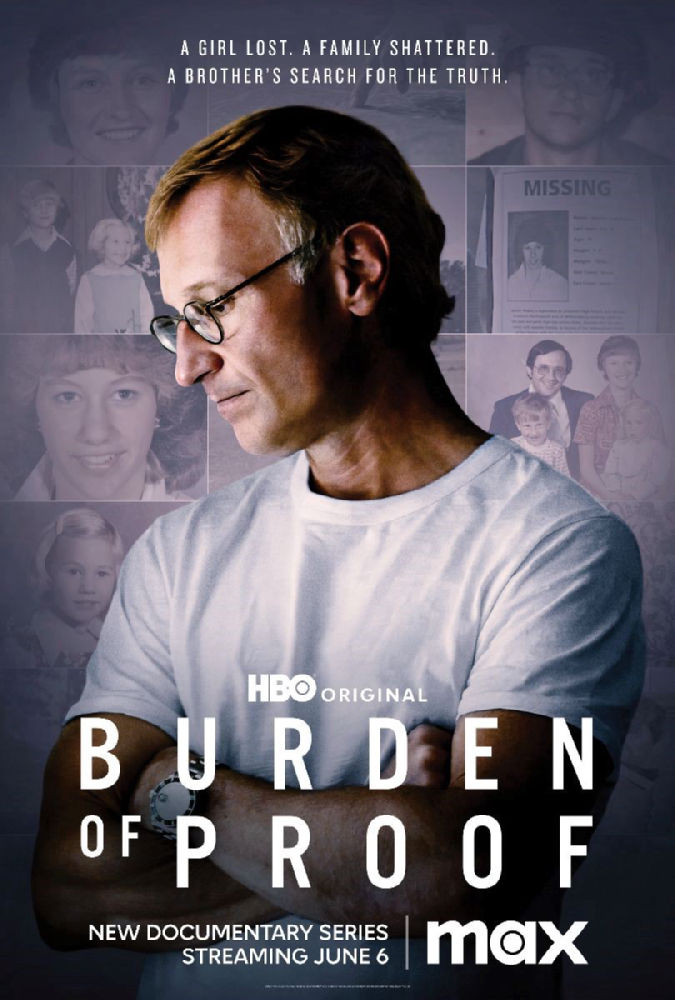



 TV · 2023
Burden of Proof
Stephen Pandos reopens the 1987 disappearance of his sister Jennifer and grows convinced his parents were involved, only to watch new evidence unravel everything he thought he knew.
Burden of Proof follows Stephen Pandos as he digs into the decades-old vanishing of his fifteen-year-old sister Jennifer from the family home in 1987. Their parents long maintained she had simply run away, yet Stephen’s mounting doubts drive him to reopen police files, interview relatives, and challenge the official story. The series tracks how each new lead places the entire family under scrutiny and forces long-buried inconsistencies into the open. Stephen’s pursuit steadily erodes trust among the people closest to him while he pieces together timelines, statements, and physical clues from the night she disappeared. Fresh details gradually surface that undercut the runaway narrative the family has repeated for years.
As the investigation deepens, Stephen’s certainty that both parents played a role begins to shift under contradictory accounts and newly examined evidence. Relatives offer conflicting memories while investigators revisit forensic possibilities and the original police response. The documentary captures the personal cost as Stephen weighs loyalty against the demand for answers and finds himself questioning the foundations of his own beliefs. Later developments introduce additional witnesses and overlooked threads that further complicate the case. By the end he is left reassessing not only the crime but every assumption he once held about those nearest to him.
Creator: Writer
Click any of the following icons below to rent or stream it!
Oops! Is this show WOKE?
Only an account holder or member can file. Cite a scene, a line, or a pattern. Other account holders +1 or −1 that argument, once each. The show is not WOKE until enough of them have given a +1. Enough −1s remove the write-up, and it is no longer shown.
Sign in to file a woke label. One of each criterion per member.
Comments and reviews
Report a mistake
Same rule as woke labels: one report, a written reason, and the community +1 or −1 it — once per member. A net +5 applies the change. Editors can hold it for review, or apply it immediately.
No mistake reports yet.
Sign in to report a mistake. One report per field, per member.
Member review
Peg Harlan Member
Oct 7, 2026
★★★★★★★★★★Burden of Proof sat with me longer than most of these true-crime series do. It’s not flashy and it doesn’t chase every wild theory just to keep the clock running. A brother spends years carrying the quiet weight of his sister vanishing when she was fifteen, back in 1987, after the family story settled on her running away. He finally forces the case open again and starts finding pieces that point uncomfortably close to home. That alone makes it heavier than the usual missing-person hour.
What worked for me was how ordinary the digging felt. He talks to people who knew the family, looks at old statements, sits with failed polygraphs and the kind of small inconsistencies that only matter once you’ve already lived with the official version for decades. You watch him go from lingering doubt to something sharper, and the show mostly lets that happen without a narrator telling you how to feel every five minutes. I appreciated that. Too many of these productions turn grief into a performance. Here the brother just keeps going, even when the answers start looking like they might destroy whatever is left of the family he still has.
I grew up in a time when a teenager leaving home was sometimes treated as the end of the story. Pack a bag, hitch a ride, and the adults move on. This series reminds you how thin that explanation can be when nothing else ever turns up. The parents’ version held for a long time. Watching someone pull at those threads is uncomfortable in a way that feels honest rather than staged. There are moments when the camera stays on faces a beat too long, and you can see the cost of asking the next question. That stayed with me more than any dramatic reenactment would have.
At the same time, the series stretches itself. Three or four episodes of careful work start to thin out once the main suspicions are on the table. Some interviews circle the same ground. A couple of side paths feel like they were included because the runtime needed filling rather than because they moved anything forward. I found myself checking how much was left more than once in the later stretches. The core is strong enough that it didn’t collapse, but it lost some of the quiet force it had early on. They used to make these tighter, or at least it felt that way when you only got one solid documentary instead of a whole limited run.
The family dynamic is the real center, and the show doesn’t flinch from how ugly that can get. Suspecting your own mother and father of something unthinkable isn’t a twist they spring for shock. It’s the slow result of looking at behavior that never quite added up and records that raise more questions than they settle. I don’t need every answer wrapped with a bow, and this one doesn’t pretend it has them all. Still, the open edges left me wanting a cleaner sense of where the investigation actually landed with authorities. The personal toll is clear. The official follow-through feels a little foggy by the end.
I rated it 3.5 because the honest parts outweigh the padding. It treats the brother’s determination with respect and doesn’t turn the parents into cartoon monsters or saints. You sit with the possibility that the people who raised him might have been involved or at least protected a version of events that kept everything buried. That is hard to watch without getting angry on his behalf, and the series earns that reaction instead of manufacturing it. I kept thinking about how long he carried the original story before he decided it wasn’t good enough. Most of us never push that hard on the things we were told as kids.
There is also a quiet point about how cold cases sit in drawers until someone with a personal stake refuses to leave them alone. Police resources, memory fading, witnesses moving or dying—all of that is real. The show shows the grind without turning it into a lecture. I liked that it stayed close to one family’s wreckage instead of zooming out into bigger cultural speeches. Not every disappearance needs to stand for something larger. Sometimes it is just one girl gone and one brother who can’t stop looking.
Would I watch it again straight through? Probably not. Parts of it feel longer than they need to be. But I would recommend the early episodes to anyone who has ever wondered what happens when the family story stops working. It is plain and stubborn in a way that fits the subject. No big stylistic flourishes, just a man turning over rocks he was told to leave alone. That kind of patience is rarer than it should be in this genre. The later episodes drop a little, and some of the supporting material could have been cut without losing anything important, which is why it lands at 3.5 for me instead of higher. Still worth the time if you can live with a few slow stretches and an ending that leaves more questions than neat resolution. It stuck with me after I finished, and that counts for something.