
Find a mistake?
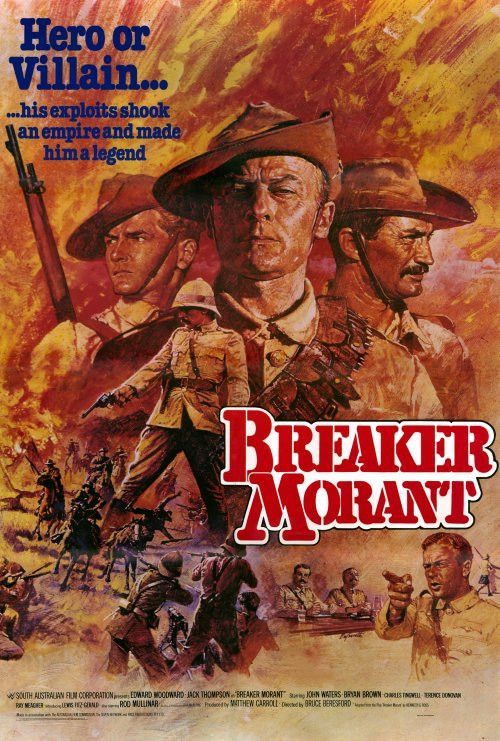



 MOVIE · 1980
Breaker Morant
8
8/10Community rating
Label it
IS WOKE
Three soldiers become scapegoats in a trial meant to draw attention from the crimes of their commanders.
Oops! Is this show WOKE?
Only an account holder or member can file. Cite a scene, a line, or a pattern. Other account holders +1 or −1 that argument, once each. The show is not WOKE until enough of them have given a +1. Enough −1s remove the write-up, and it is no longer shown.
Sign in to file a woke label. One of each criterion per member.
Comments and reviews
Report a mistake
Same rule as woke labels: one report, a written reason, and the community +1 or −1 it — once per member. A net +5 applies the change. Editors can hold it for review, or apply it immediately.
No mistake reports yet.
Sign in to report a mistake. One report per field, per member.
Member review
Dan Reilly Member
Oct 2, 2026
★★★★★★★★★★Breaker Morant is a film I put off longer than I should have, and when I finally sat down with it I kept waiting for the courtroom machinery to feel less stacked. That is the first thing that nags at me. The British military court is so obviously engineered against the three Australian lieutenants that the tension sometimes sits too far in one direction. You know almost from the jump that the outcome is fixed by politics higher up the chain, and once that settles in, a few of the procedural beats land with less force than they might have. Major Thomas, the small-town solicitor thrown into the deep end, has to claw for every scrap of fairness, and while Jack Thompson plays him with real grit, there are stretches where the deck feels so loaded that the drama risks becoming pure resignation rather than a fight.
The structure itself is built around the court martial and flashbacks to the killings in the Bushveldt, and that choice works more often than it doesn’t, but it does mean we spend a fair amount of time hearing testimony rather than living the irregular war as it happened. Some of the Boer War skirmishes come through hard and ugly, yet I wanted a tighter sense of the day-to-day pressure that turned ordinary soldiers into men willing to shoot prisoners. The film tells you the unwritten orders existed and that the rules had already broken down after their squadron commander’s death, but it can feel like argument more than immersion. That distance is probably deliberate—this is a story about scapegoats and the men who decide what justice looks like when empire needs a clean handshake at the peace table—but it left me colder in places than a war picture of this weight usually does.
Still, once you accept the frame, the film earns its keep. Edward Woodward as Harry “Breaker” Morant carries a dry, almost literary bitterness that never tips into self-pity. He is a poet and a horseman who has already half-accepted that the empire will use him and then discard him, and that quiet fatalism is more interesting than any speech about honor. Bryan Brown and Lewis Fitz-Gerald as Handcock and Witton give the other two men distinct edges so the trio never collapses into one interchangeable accused. What stuck with me is how little the movie bothers to dress the killings up as clean necessity. The prisoners die, the orders are murky, and the defense has to argue that the same ruthless practices were happening elsewhere in the campaign. That is not a comfortable position, and the film does not pretend it is. It simply shows the cost of irregular warfare when higher command needs someone to hang so the rest of the machine can keep running.
I kept thinking about how little has changed in the way large powers manage the dirty edges of a fight. You send men out to do the ugly work against guerrillas who will not stand still for parade-ground rules, then you act shocked when the same men stop taking prisoners. The current habit of talking about “rules of engagement” while quietly expecting results that those rules cannot deliver makes this 1980 picture feel less like a period piece and more like a warning that keeps getting ignored. The Australians here are not saints. They shot people under questionable authority. The film’s strength is that it refuses to turn them into pure martyrs or pure villains. They are soldiers who believed the chain of command had already sanctioned what they did, and the court exists mainly to protect the chain from having to admit it.
Jack Thompson’s performance as the defense counsel is the quiet engine. He is out of his depth, short on time, short on documents, and still refuses to roll over. Watching him chip away at the prosecution’s tidy narrative is more gripping than most of the flashback gunfire. The supporting British officers are written with the right mix of polish and cold calculation; they are not cartoon sadists, just men who understand that peace talks require a few bodies on the Australian side of the ledger. That kind of institutional cynicism is harder to watch than open cruelty, and the film gets it right.
Where it loses a little steam is in the final stretch. Once the verdict direction is clear, the emotional payoff feels slightly muted, as if the movie itself has accepted the fix and simply wants to record the injustice for the record. I would have traded a few of the later speeches for one more scene that showed the personal cost landing on the men in the dock without underlining it. Even so, the last images stay with you. These are not glorious last stands. They are the quiet aftermath of a system that needed examples and found three convenient ones.
I rated it four stars because the craft and the moral clarity outweigh the structural predictability. It is one of those war-courtroom pictures that understands both the battlefield and the courtroom are places where truth gets managed. It does not lecture. It just lays out how three men became the price of a cleaner story for the people writing the history. If you have been circling it on a “should watch someday” list the way I did, the wait is worth ending. The film is lean, angry in a controlled way, and still sharp about the gap between the orders men hear and the orders the record will later claim existed. That gap is the whole point, and Breaker Morant never lets you look away from it.