
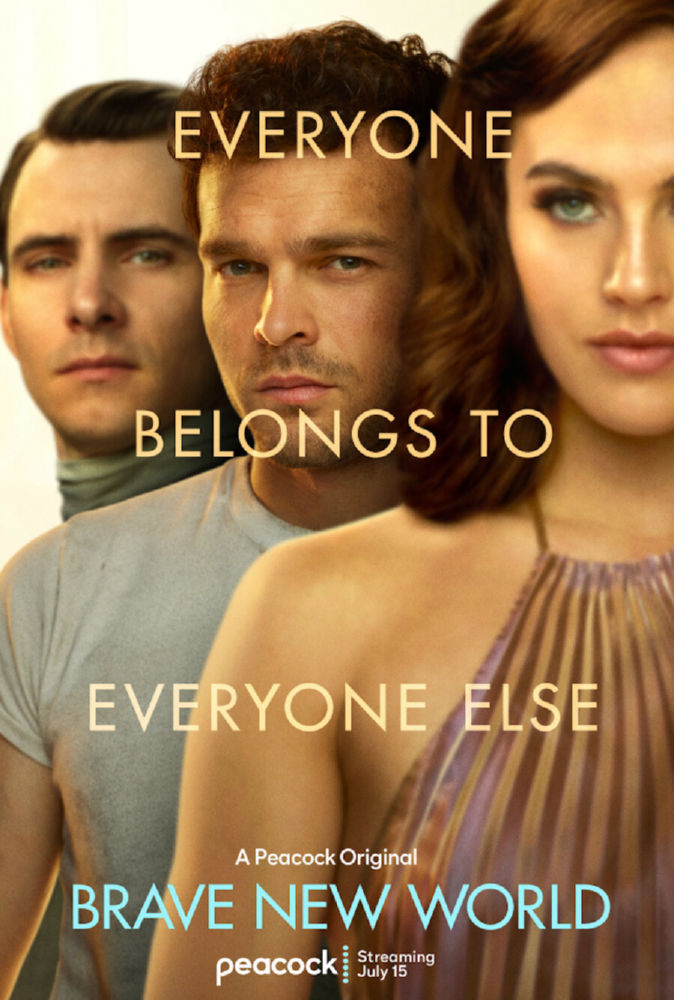



 TV · 2020
Brave New World
Brave New World follows citizens of a futuristic utopia who begin to question the state's total control over reproduction, emotion, and personal relationships. The nine-episode series adapts Aldous Huxley's novel and centers on the collision between the regimented World State and outsiders who value individuality.
Brave New World follows Bernard Marx, an Alpha-plus psychologist dissatisfied with his society's mandatory promiscuity and lack of privacy. Bernard travels to a Savage Reservation and brings back John, a young man raised on Shakespeare and traditional values, along with John's mother Linda. Lenina Crowne, Bernard's coworker and occasional partner, grows attached to John while struggling against her own conditioning that demands she belong to everyone. The arrival of these outsiders exposes cracks in the World State's stability as citizens encounter jealousy, grief, and exclusive attachment for the first time.
John's refusal to conform sparks wider unrest among the Alphas and Betas who interact with him. Mustapha Mond, the World Controller, debates the value of art, religion, and family with John while the government moves to suppress the spreading discontent. Lenina's growing feelings for John force her to confront the limits of her engineered existence. The series ends with the regime reasserting control through exile, reconditioning, and the removal of disruptive influences.
Oops! Is this show WOKE?
Only an account holder or member can file. Cite a scene, a line, or a pattern. Other account holders +1 or −1 that argument, once each. The show is not WOKE until enough of them have given a +1. Enough −1s remove the write-up, and it is no longer shown.
Sign in to file a woke label. One of each criterion per member.
Comments and reviews
Report a mistake
Same rule as woke labels: one report, a written reason, and the community +1 or −1 it — once per member. A net +5 applies the change. Editors can hold it for review, or apply it immediately.
No mistake reports yet.
Sign in to report a mistake. One report per field, per member.
Member review
Becky Soto Member
Oct 20, 2026
★★★★★★★★★★I sat down with Brave New World mostly curious about how they would handle the whole controlled-happiness setup on screen, and it held my attention more than I expected even when it drifted. The look of the World State is clean and a little cold in a way that makes the smiles feel practiced. What stuck with me was a quiet stretch where John is just walking through the city for the first time, taking in the brightness and the casual touching and the complete lack of anything private. You can almost see the Shakespeare he grew up with bouncing off the walls with nowhere to land. That beat did more for me than some of the bigger speeches.
Lenina’s side of it got under my skin in a good way. She is clearly drawn to John, and at the same time her conditioning keeps yanking her back toward the idea that she is supposed to belong to everyone. Watching her try to hold both of those impulses at once felt honest. It is not flashy. It is just a person realizing the rules she lives by do not cover what she is actually feeling. Bernard’s restlessness worked for me too. He is supposed to be the polished Alpha-plus type, yet you can tell the mandatory promiscuity and the constant group living are wearing thin. When he brings John and Linda back, the cracks start showing in ways that feel earned rather than forced.
I will say it plain: if you read the book first, this is going to feel pretty far from the actual book content. They turned it into more of a popcorn series, with extra relationship drama and a faster pace that keeps things moving for television. Some of the sharper edges of Huxley’s satire get sanded down so the show can linger on jealousy and grief and the shock of real attachment. I did not hate that choice. It let me sit with the characters longer. But anyone looking for a close page-to-screen match will walk away disappointed, and I understand why. The core collision still comes through—the regimented society running into people who value individuality and memory and even pain. That part lands.
There are stretches where the world-building does the heavy lifting. The way reproduction and emotion are managed sits in the background of almost every conversation, so when someone finally feels something unscripted it hits harder. I kept thinking about how little privacy anyone has and how that would wear a person down over years. The show does not lecture about it. It just lets you watch people bump into the limits of their own conditioning. John’s presence makes those limits obvious without him needing to shout about them every scene. Linda’s arrival carries its own weight; she has lived outside the system and the contrast is uncomfortable in the right way.
I rated it 3.5 because it entertained me and left a few images in my head, yet it never quite became something I would push hard on friends who love the novel. The nine episodes give it room to breathe, which helps. You get to see the outsiders settle in and the citizens start noticing their own empty spots. Some plot turns feel like they exist to keep the energy up rather than to deepen the idea, and that is where the popcorn side shows. Still, the attachment between Lenina and John stayed with me after I finished. It is messy and against the rules and more human than anything the World State wants to allow. That felt like the point arriving naturally instead of being announced.
I am glad I watched it. It is not a replacement for the book and it does not try very hard to be one. It is its own version, smoother and a little softer around the edges, with enough genuine unease to make the utopia feel off. If you can meet it on those terms, there is something worthwhile in the way it lets people wake up to their own feelings. The scenes that linger for me are the smaller ones—John taking in the city, Lenina catching herself mid-habit, Bernard realizing he wants a door that actually closes. Those moments carried the series for me more than any grand statement about freedom. I finished it feeling like I had spent time in a place that looked perfect and quietly was not, and that is enough to make the watch stick.