
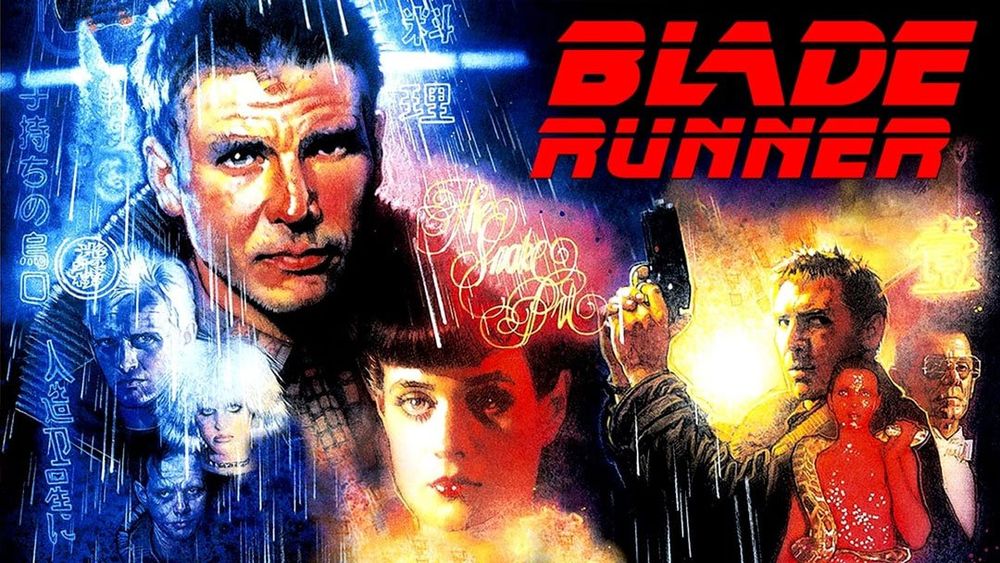



 MOVIE · 1982
Blade Runner (1982)
A blade runner must pursue and terminate four replicants who stole a ship in space and have returned to Earth to find their creator.
Oops! Is this show WOKE?
Only an account holder or member can file. Cite a scene, a line, or a pattern. Other account holders +1 or −1 that argument, once each. The show is not WOKE until enough of them have given a +1. Enough −1s remove the write-up, and it is no longer shown.
Sign in to file a woke label. One of each criterion per member.
Comments and reviews
Report a mistake
Same rule as woke labels: one report, a written reason, and the community +1 or −1 it — once per member. A net +5 applies the change. Editors can hold it for review, or apply it immediately.
No mistake reports yet.
Sign in to report a mistake. One report per field, per member.
Member review
Becky Soto Member
Oct 16, 2026
★★★★★★★★★★Blade Runner has this way of settling over you like the rain that never really stops in its Los Angeles. I keep coming back to it, and every time the city feels a little more solid, like it has streets and corners that exist even when the camera isn’t looking. Ridley Scott built something that doesn’t just look like a future; it feels lived-in and worn down, neon bouncing off wet pavement, advertisements looming over people who barely look up. That atmosphere is what pulls me in first, before the questions start stacking up.
I watched the Final Cut, and I’m glad I did. It drops the old voice-over and that brighter ending people used to complain about, and the whole thing sits quieter and heavier as a result. Deckard isn’t handed easy explanations. Harrison Ford plays him with this tired, half-gone quality, like a man who’s already seen too much and would rather not see more. He’s called back to handle four replicants who made it back to Earth looking for the one who made them, and the job never feels clean. You feel the weight of it in the way he moves through those cramped apartments and rainy rooftops.
What stays with me most is Roy Batty. Rutger Hauer gives the film its center of gravity. There’s a moment on the rooftop near the end that I can still picture clear as day—the rain, the stillness, the way he talks about things he’s seen that no one else will ever see. Some folks shrug the movie off as cult status and nothing more. I’d just say it has Rutger Hauer on that rooftop, and for me that’s plenty. He makes the big questions about memory and dying and what counts as real feel personal instead of abstract. The film never hurries to answer them, and I like that it doesn’t. It lets the questions hang in the air the same way the smoke and steam do.
The pacing is slow on purpose. It gives you room to notice the little things—the way light cuts through blinds, the clutter on a desk, the distance between people even when they’re standing close. Sean Young’s Rachael has this careful, almost fragile presence that somehow still feels strong, and Daryl Hannah’s Pris brings a sharp, unpredictable energy that keeps you uneasy in the best way. Edward James Olmos doesn’t need many lines; the way he watches everything says enough. The whole cast fits the world without forcing anything.
Vangelis’s music does something special here. It isn’t just background. It swells and pulls back and leaves you with this mix of melancholy and wonder that matches the city lights reflecting in puddles. I felt sentimental one minute and a little awed the next. The score and the visuals lock together so tightly that the movie becomes a place you sit inside rather than something you simply watch. Doug Trumbull’s effects and the production design still hold up because they were built with texture and shadow instead of trying to look shiny and new. You can almost smell the damp concrete.
I know it didn’t tear up the box office when it first landed. Movies like E.T. and the big adventure pictures were packing theaters then, and this one asked people to sit with something darker and more deliberate. It found its people later, the way some films do when the noise dies down and you can actually hear what they’re saying. Watching it now, the world it shows still feels close—crowded, corporate, a little lost—and the questions about who gets to count as human haven’t gotten any smaller.
There’s a scene early on where Deckard runs the Voight-Kampff test that always sticks with me. The tension isn’t in shouting or chasing; it’s in the tiny shifts of expression, the way a person might flinch at a question that shouldn’t matter. That careful attention to small human details runs through the whole film. Even the chase sequences feel grounded in the city’s weight rather than pure spectacle. When things finally break open, the emotion lands harder because the movie has earned the quiet first.
I wouldn’t call it perfect. Sometimes the deliberate pace can feel like it’s stretching a beat too long, and a couple of story turns left me wanting one more clear thread. Still, those are small things next to what it gets right. It treats identity and mortality like real weights instead of neat puzzles to solve before the credits. The replicants aren’t simple villains or simple victims; they’re people who know their time is short and want something true before it’s gone. That longing is what the movie keeps circling, and it’s why the ending—whatever cut you land on—stays with you after the screen goes dark.
Every time I revisit it I notice another corner of the city or another line reading differently. It’s the kind of science fiction that doesn’t date because it was never really about gadgets. It was about rain and memory and the thin line between made and born. I’m glad it stuck around long enough for people to catch up to what it was doing. Four stars feels right to me—strong, personal, and still humming years later.