
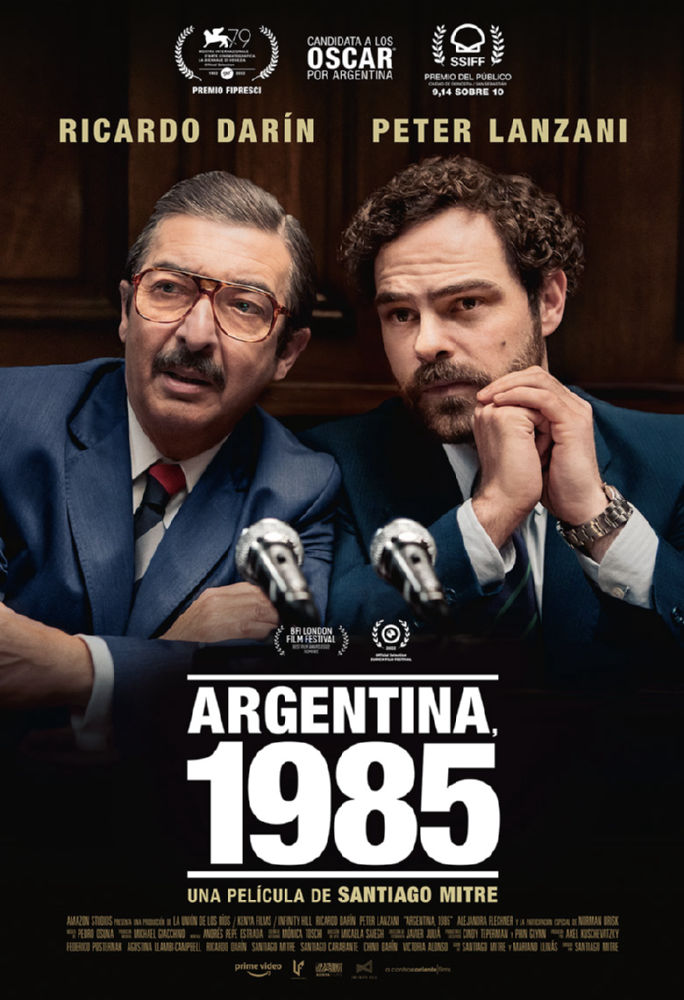




 MOVIE · 2022
Argentina, 1985 IS WOKE
A team of lawyers takes on the heads of Argentina's bloody military dictatorship during the 1980s in a battle against odds and a race against time.
'Argentina, 1985' is inspired by the true story of Julio Strassera, Luis Moreno Ocampo and their young legal team of unlikely heroes in their David-vs-Goliath battle to prosecute Argentina's bloodiest military dictatorship against all odds and in a race against time to bring justice to the victims of the Military Junta.
WHAT CRITERIA MAKES IT WOKE?

Oops! Is this show WOKE?
Only an account holder or member can file. Cite a scene, a line, or a pattern. Other account holders +1 or −1 that argument, once each. The show is not WOKE until enough of them have given a +1. Enough −1s remove the write-up, and it is no longer shown.
Sign in to file a woke label. One of each criterion per member.
Comments and reviews
Report a mistake
Same rule as woke labels: one report, a written reason, and the community +1 or −1 it — once per member. A net +5 applies the change. Editors can hold it for review, or apply it immediately.
No mistake reports yet.
Sign in to report a mistake. One report per field, per member.
Member review
Becky Soto Member
Sep 24, 2026
★★★★★★★★★★I put on Argentina, 1985 the other evening after it had been sitting in my queue for a while, and I ended up staying with it longer than I planned. Ricardo Darín plays Julio César Strassera with this steady, almost weary focus that never tips into showiness. He feels like a man who understands the size of the job and still shows up every day anyway. That quality carried a lot of the film for me. His deputy, played by Peter Lanzani, brings a different kind of energy—younger, a little more impatient—and the two of them bounce off each other in ways that feel practical rather than written for effect.
What stayed with me most was the stretch where the survivors begin to give their testimony. There is nothing ornamental about those scenes. People sit or stand and describe what was done to them or to people they loved, and the camera mostly just lets them. You can see the cost of speaking in the small pauses and the way some of them glance toward the exits. It is not presented as triumphant. It is presented as necessary and hard. I kept thinking about how much courage it takes to walk into a room still full of the old power structure and say the quiet parts out loud. That beat sat with me after the movie ended.
The film spends time on the ordinary friction of building the case: the thin resources, the late nights, the phone calls that go nowhere, the sense that parts of the judiciary are still loyal to the people who should be answering for the disappearances and the torture. Strassera’s family life gets enough space that you feel the pressure landing at home without turning every dinner scene into a lecture. Threats arrive the way they often do in real life—half-denied, half-believed, always there in the background. I appreciated that the movie did not need to invent cartoon villains. The institutional resistance and the lingering fear were enough.
I liked how it treated the work of prosecution as craft rather than destiny. They have to decide what charges can actually hold, how to order the evidence, which witnesses can withstand the scrutiny. It is not glamorous. It is methodical and sometimes frustrating, and that felt honest. Darín is especially good in the quieter moments when Strassera is calculating risk against duty. You get the sense of a man who knows the window for accountability can close, and he is trying not to let it.
There are places where the pacing settles into a groove that could have been tightened a little. A couple of the procedural stretches run long if you already know the broad outline of the history. I never felt lost, though, and I never felt talked down to. The film trusts you to sit with the weight of the material. It also trusts that the story itself—real people trying to pin responsibility on a military dictatorship for systematic murder and forced disappearances—is strong enough without dressing it up in extra speeches.
I kept coming back to how fragile the whole effort looks from the inside. A small team, limited support, public attention that can turn either way, and families who have already lost so much still having to decide whether to speak. That combination of determination and vulnerability is what makes the movie land for me. It is not a victory lap. It is a record of people refusing to look away while they still had the chance.
Stories like this matter because the slide into that kind of power does not always announce itself with trumpets. It can look like ordinary administrative decisions until the disappearances start and the rooms where people used to be able to speak go quiet. Watching Strassera and Ocampo pull the case together under those conditions left me with a simple, stubborn respect for the work. I rated it four stars because the performances hold, the central through-line stays clear, and those testimony scenes still sit in my head. It is a solid, serious film that earns its time without asking you to clap on cue. I would watch it again, mostly to sit with that courtroom atmosphere and Darín’s quiet insistence one more time.