



 TV · 2022
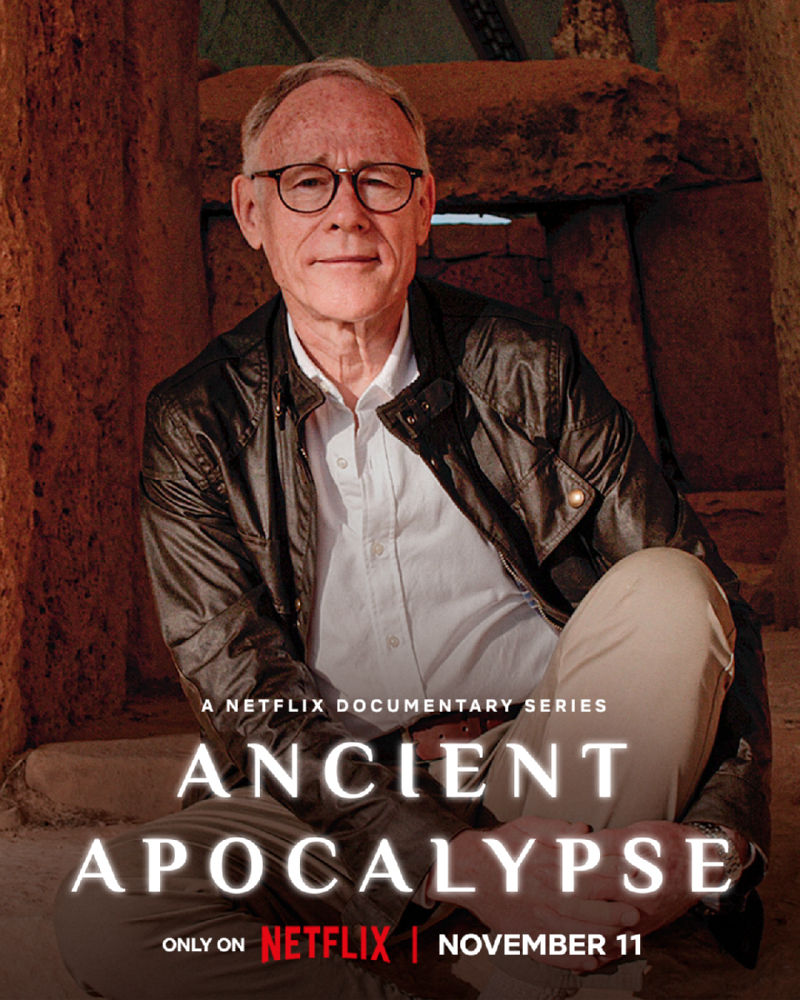
Ancient Apocalypse
Journalist Graham Hancock travels the world hunting megaliths, flood myths, and other clues he says prove a sophisticated Ice Age civilization was wiped out by global catastrophe.
Ancient Apocalypse follows journalist and writer Graham Hancock as he crisscrosses continents in search of physical and mythic evidence for a lost advanced culture at the end of the last Ice Age. Hancock inspects monumental stonework, underwater formations, and early temple complexes that he argues are older and more sophisticated than mainstream archaeology accepts. He interviews local researchers and guides while laying out a narrative of sudden cataclysm—comet impacts, floods, and climate upheaval—that he believes erased most traces of that society. Episodes move from well-known sites to less familiar ones, treating oral flood traditions and scattered artifacts as surviving memory of the same disaster. Hancock repeatedly contrasts his reading of the evidence with conventional academic timelines and methods.
Later stops deepen the same thesis as Hancock links distant monuments and shared catastrophe stories into one proposed global pattern. He revisits the idea that survivors of the disaster seeded later civilizations and that key knowledge was deliberately or accidentally lost. Field sequences show him climbing ruins, examining carvings, and arguing on camera that official histories have underplayed or dismissed inconvenient dates. The series keeps returning to the tension between his speculative reconstruction and the skepticism of established archaeology, ending each arc with another site he presents as unfinished business for the field. No separate fictional ensemble or romance subplot drives the narrative; the through-line remains Hancock’s on-location case for a forgotten Ice Age world.
Click any of the following icons below to rent or stream it!
Oops! Is this show WOKE?
Only an account holder or member can file. Cite a scene, a line, or a pattern. Other account holders +1 or −1 that argument, once each. The show is not WOKE until enough of them have given a +1. Enough −1s remove the write-up, and it is no longer shown.
Sign in to file a woke label. One of each criterion per member.
Comments and reviews
Report a mistake
Same rule as woke labels: one report, a written reason, and the community +1 or −1 it — once per member. A net +5 applies the change. Editors can hold it for review, or apply it immediately.
No mistake reports yet.
Sign in to report a mistake. One report per field, per member.
Member review
Peg Harlan Member
Oct 19, 2026
★★★★★★★★★★I put Ancient Apocalypse on because I’d heard Graham Hancock on long-form podcasts and figured the series might settle whether he was worth the time. When he sits with Rogan it can get pretty out there, and I still don’t know how much I want to take every claim at face value. That said, the show itself is not pure nonsense. It keeps circling real places and real problems with the standard timeline, and that is enough to keep me watching even when the presentation starts grating.
Göbekli Tepe is the obvious example that won’t leave you alone. Something was there before it “should” have been, organized and large enough that the old story of slow hunter-gatherers stumbling into farming no longer fits cleanly. The series leans on that site and others like it, walking through stonework and underwater formations that look more deliberate than accidental. Hancock treats flood myths and scattered artifacts as memory of one big wipeout near the end of the Ice Age. I don’t buy the whole package, but parts of what he wrote years ago in Fingerprints of the Gods still hold water. Geologists and archaeologists clash more than they admit; one side keeps getting forced to shove dates backward while the other works without that same choke collar. Watching him move from Turkey to Indonesia to the Americas, you can feel that tension even if you reject the comet-impact drama.
The production is where it loses me. Every sentence seems to need a stab of music, a deep bass rumble, or some cheap hit sound to announce that something Important Just Happened. After two episodes I was muting the effects and just listening to the talking. It’s a shame, because the sites are genuinely striking and do not need the carnival treatment. Hancock himself comes across more measured in long interviews than he does here, where the editing pushes him toward the cliff-hanger style. I kept wishing they had trusted the material enough to let a quiet shot of a carved pillar or a submerged wall sit for ten seconds without a soundtrack telling me how to feel.
Still, I finished the run. The series made me pull up old maps and read a couple of papers on Younger Dryas climate swings just to check the edges of his argument. That is more than most streaming history shows manage. He interviews local researchers who are not household names, and some of them raise solid points about dating methods and what “sophisticated” even means when you only have stone left. I never felt lectured at. The tone is more like a stubborn traveler who keeps finding anomalies and refuses to file them under “coincidence.” Whether a single lost civilization explains all of it is another matter. I land somewhere in the middle: the mainstream timeline has been too rigid for too long, yet Hancock’s grand narrative still asks for leaps that the physical record only half supports.
What stays with me is the simple fact that large, coordinated stone projects appear earlier than the textbooks once allowed. Once that door opens, you start noticing how many flood stories sit in the same rough window and how many coastal sites now lie underwater. The show does not prove a global culture with seafaring and advanced knowledge. It does force the question of how much we might have missed because we assumed everything important started in the Fertile Crescent at a convenient date. That alone is worth three and a half stars from me. I would rather watch something that overreaches and makes me dig than something that recites the same safe paragraphs with prettier drones.
If they ever strip out half the sound design and let the stones and the guides do more of the talking, I would rewatch it without the mute button. As it stands, it is uneven, occasionally silly, and still more interesting than most of what lands in the “ancient mysteries” bin. Hancock is not a careful scholar, but he is a useful irritant. Ancient Apocalypse left me less certain about the old story and more curious about the gaps. That is a fair return for eight episodes of travel and speculation.