



 TV · 2018
Altered Carbon
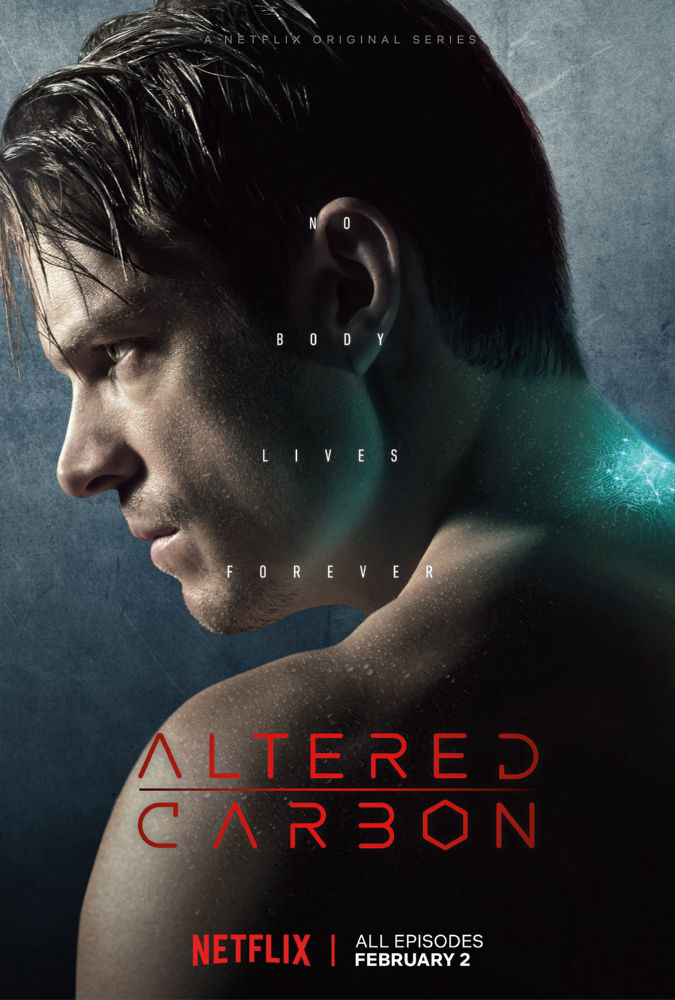
Society has been transformed by new technology: consciousness can be digitized; human bodies are interchangeable; death is no longer permanent. Takeshi Kovacs is the lone surviving soldier in a group of elite interstellar warriors who were defeated in an uprising against the new world order. His mind was imprisoned -- on ice -- for centuries until Laurens Bancroft, an impossibly wealthy, long-lived man, offers Kovacs the chance to live again. In exchange, Kovacs has to solve a murder … that of Bancroft himself.
Click any of the following icons below to rent or stream it!
Oops! Is this show WOKE?
Only an account holder or member can file. Cite a scene, a line, or a pattern. Other account holders +1 or −1 that argument, once each. The show is not WOKE until enough of them have given a +1. Enough −1s remove the write-up, and it is no longer shown.
Sign in to file a woke label. One of each criterion per member.
Comments and reviews
Report a mistake
Same rule as woke labels: one report, a written reason, and the community +1 or −1 it — once per member. A net +5 applies the change. Editors can hold it for review, or apply it immediately.
No mistake reports yet.
Sign in to report a mistake. One report per field, per member.
Member review
Stu Kline Member
Oct 19, 2026
★★★★★★★★★★Altered Carbon hooked me hard on the first season and never fully let go, even when the second one stumbled. I have gone back to it at least three times a year since it dropped. Part of that is pure cyberpunk appetite. The rest is the little details that keep surfacing and the way it keeps poking at what a person even is once you can dump a mind into a new body and call it life.
Takeshi Kovacs wakes up after two hundred and fifty years in someone else’s skin and has to solve a rich man’s murder if he wants to stay free. That setup is clean and mean. The world around him is Bay City, full of Meths who treat bodies like spare clothes while everyone else dies for real. You feel the gap immediately. The show never softens it. The rich buy continuity. The rest get one shot. That alone gives the story teeth.
Season one is a dense neo-noir cyberpunk run that plunges you into the mess without holding your hand. Kovacs partners with Kristin Ortega, digs through Bancroft’s family, brushes up against the yakuza, and keeps running into ghosts from his own past through Quellcrist Falconer. The conspiracy layers feel earned. You learn more about sleeves, stacks, and the Envoy training without sitting through lectures. The fights are solid. They serve the story instead of stopping it. I never wanted them cut. The money went where it counted: the ideas and the atmosphere.
I will not pretend this is some exhaustive breakdown. Years later I still just enjoy the majority of that first season if you like sci-fi that treats the human condition as something worth cracking open. Hopeless romantics get something too if they watch how attachment survives body swaps and centuries of ice. The show does not wink at you about it. It just lets the cost sit there.
The design choices bug some people and I get it. Curved screens and tablets that look a little too close to what we already own. You can wish they had spent harder on pure future flash. I still think the core idea carried harder than any extra chrome would have. Moving consciousness between sleeves, permanent death for the poor, the Meths floating above it all—that is the real engine. Once you lock onto that, the smaller visual shortcuts matter less.
Season two is where the air leaks out. It squanders a lot of what made the first run sharp. New sleeve, new planet, new problems, but the density thins and some of the edge dulls. I still finished it. I still go back sometimes for the leftover texture. The combined ride is frustrating and rewarding at once because that opening chapter is so strong it props the rest up. You feel the drop, but you do not throw the whole thing away.
What keeps me returning is the rewatch value baked into the premise. Every pass I catch another angle on how people cling to identity when flesh is optional. Kovacs carries history in his head that no new body can erase. Ortega’s stubbornness makes sense in a place where justice has price tags. Reileen’s long game across decades shows how twisted longevity can get when you stop fearing the end. None of it needs a speech. The show just puts you there and lets the weight accumulate.
I like stories that do not flinch from the ugly trade-offs. Immortality for the few turns into a cage for everyone else. Love gets complicated when the person you care about can walk out of a different face. Loyalty gets tested when your old enemies wear new skins. Altered Carbon leans into all of that without turning preachy. It stays a mystery first and a philosophy second, which is the right order.
The second season tries to expand the map and loses some of the street-level grit that made Bay City feel lived-in. Characters shift focus and the conspiracy feels less personal. Still, the bones of the concept hold. I never stopped caring what a stack really means once someone can be spun up again. That question alone is worth the time.
If you come for cyberpunk that treats body-swapping as both miracle and curse, the first season delivers the goods and then some. The rest is uneven but not empty. I rated it four because the high points stay high and the concept keeps paying off long after the credits. I will keep circling back. The details still reward it, and the human mess underneath never gets old.