



 TV · 2023
All the Light We Cannot See
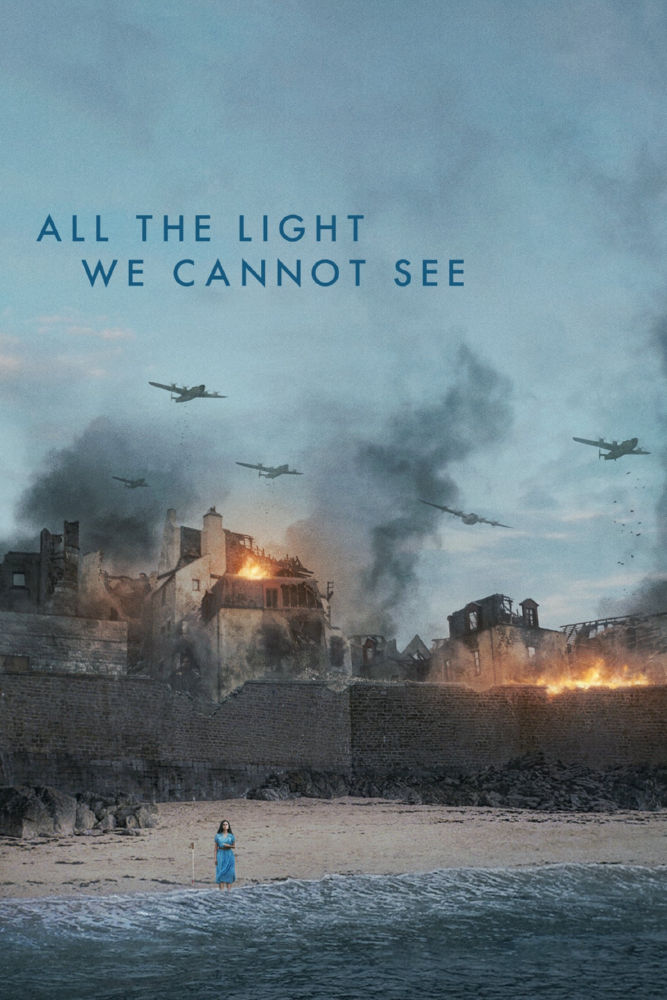
During the final days of World War II, the paths of a blind French teenager broadcasting resistance messages and a brilliant young German soldier tasked with tracking illegal radio signals converge in the heavily besieged coastal town of Saint-Malo.
The narrative centers on two young lives shaped by the devastation of the German occupation of France. A blind French girl lives in Paris with her devoted locksmith father, who builds a detailed miniature model of their neighborhood to help her navigate the world. When the Nazi regime invades, they are forced to flee to the walled seaside citadel of Saint-Malo, taking refuge with her reclusive, shell-shocked great-uncle. Unbeknownst to her, they also carry a legendary, allegedly cursed museum diamond that is being relentlessly hunted by a terminally ill and ruthless Gestapo officer. From her uncle's attic, she begins broadcasting illegal, coded shortwave radio transmissions to aid the Allied resistance.
Meanwhile, a brilliant German orphan with an extraordinary, self-taught aptitude for radio repair is forcefully drafted into a brutal military academy for Hitler Youth. His technical skills earn him a specialized assignment on the front lines to track and eliminate illicit resistance signals across Europe. Eventually deployed to Saint-Malo to silence the illegal radio operation, he becomes captivated by the girl's poetic, nightly broadcasts, which echo a radio program he secretly listened to during his impoverished childhood. As the city undergoes a destructive American artillery siege, his mission shifts from tracking an enemy to a desperate race to protect her from both the falling bombs and the advancing Gestapo, forging a profound connection that highlights human resilience amidst the horrors of war.
Click any of the following icons below to rent or stream it!
Oops! Is this show WOKE?
Only an account holder or member can file. Cite a scene, a line, or a pattern. Other account holders +1 or −1 that argument, once each. The show is not WOKE until enough of them have given a +1. Enough −1s remove the write-up, and it is no longer shown.
Sign in to file a woke label. One of each criterion per member.
Comments and reviews
Report a mistake
Same rule as woke labels: one report, a written reason, and the community +1 or −1 it — once per member. A net +5 applies the change. Editors can hold it for review, or apply it immediately.
No mistake reports yet.
Sign in to report a mistake. One report per field, per member.
Member review
Omar Quill Member
Oct 7, 2026
★★★★★★★★★★I put on All the Light We Cannot See mostly because the setup sounded like one of those slow-burn games where two characters are on opposite sides of the same map and you just know their paths are going to slam into each other. Blind French girl sending resistance messages over the radio, young German soldier whose whole job is hunting illegal signals, both stuck in that walled coastal town while the war is winding down and everything’s getting wrecked. Saint-Malo looks like a level designer went crazy with the siege damage. I ended up finishing the whole thing in a couple of long sessions the way I clear a campaign when the story actually hooks me.
What worked for me is how clean the two main threads stay. Marie-Laure and her dad building that detailed miniature of the neighborhood so she can move around without help is the kind of practical, quiet care that feels real instead of sentimental. When they have to run and end up with the great-uncle who is basically living inside his own head after earlier trauma, the attic radio setup becomes her way of still doing something. On the other side, Werner is this radio prodigy the German side pulls in because he can track stuff no one else can. You watch him get better at the technical side while the moral weight of what he’s actually enabling starts sitting heavier. I’m not usually into war dramas that lean hard on pure misery, but this one keeps the focus on what these two kids can still choose inside a situation that is already decided by adults and bombs.
The diamond subplot with the Gestapo guy hunting it could have turned cartoonish, but they keep him sick and desperate enough that his chase feels like a ticking clock instead of just evil for the scoreboard. I liked that the show doesn’t pause every five minutes to explain the history to you. You pick it up from the rooms people are stuck in and the way the radio static cuts through. The broadcasts themselves have this strange calm to them. Sitting in the dark listening for a voice that might get someone killed if it’s traced is the closest the series gets to pure tension, and it reminded me of those late-game stealth sections where one wrong move alerts everything. You feel the hours stretch the same way they do when you’re grinding a tough boss and the margin for error keeps shrinking.
Aria Mia Loberti as Marie-Laure is strong without the performance turning into a showcase of “look how much she can do while blind.” She just moves through the space like someone who has already mapped it in her head, which matches the miniature city her father built. Louis Hofmann as Werner has that quiet, almost apologetic intelligence that makes you understand why the army grabbed him and also why he starts cracking. Their eventual connection doesn’t feel forced; the radio has already done half the work. Supporting people around them—especially the uncle and the people helping or hindering in Saint-Malo—fill in the world without turning into speech-makers.
Where it loses a little steam is in the middle stretch when the parallel stories start repeating the same emotional beat. You already know both of them are trapped by larger forces, so some of the sequences feel like they are marking time until the siege tightens. A tighter cut probably would have helped. Also, a couple of the more dramatic set pieces land a little heavier than they need to, like the show momentarily forgets how effective the smaller moments already are. Still, those are pacing complaints more than story ones. The ending sticks the landing by staying with the characters instead of trying to summarize the whole war.
I keep thinking about the model city. In games I spend way too many hours on builds and layouts that only make sense once you’re inside them. That little wooden version of the streets is doing the same job for her that a good map does for me when I’m lost in some massive zone. It turns survival into something you can rehearse. The radio work feels similar: you learn the frequencies, you learn when to transmit, you learn what silence costs. None of that needed big speeches. The show trusts the props and the quiet competence.
I’m not the type who chases every prestige limited series, but this one earned the time. It treats the kids as people who still have private lives and private skills even while the world is on fire around them. No one is reduced to a single trait. The blindness is part of how Marie-Laure navigates, not a metaphor that gets waved around every episode. Werner’s talent is useful and also a trap. That balance is why I sat through it without checking my phone much, which is rare for me with anything that isn’t interactive. Four stars feels right. It isn’t perfect, the middle sags a bit, but the core idea of two young people linked by sound and geography while everything else collapses held up. I’ll probably think about that attic transmitter the next time I’m up late with headphones on, waiting for a signal that matters.