



 TV · 2022
All of Us Are Dead
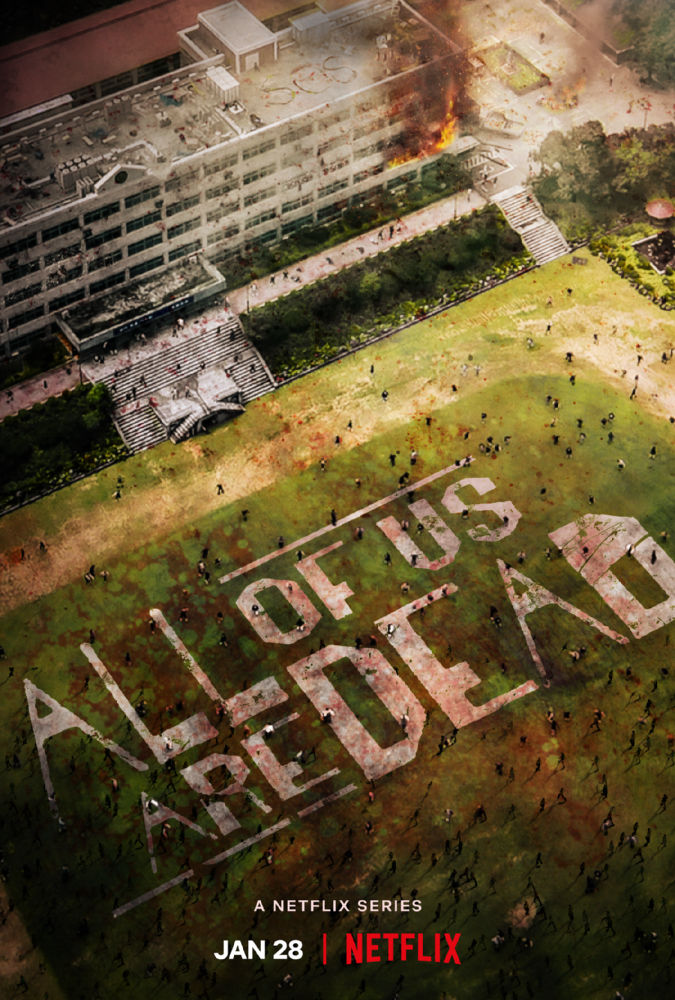
When a failed science experiment triggers a catastrophic zombie virus outbreak inside a local high school, a group of trapped students must fight together to survive with no food, no water, and no help from the outside world.
The harrowing ordeal unfolds at Hyosan High School, where a desperate science teacher accidentally engineers a highly contagious, rage-inducing virus in a misguided attempt to give his bullied son the biological strength to fight back. When a student is bitten by a lab mouse, the infection spreads with terrifying speed through the classrooms, hallways, and cafeteria, turning ordinary teenagers and faculty members into aggressive, flesh-eating monsters overnight. Cut off from all communication and abandoned by authorities who place the entire city under military martial law, a small faction of surviving classmates must band together. Transforming everyday school supplies like desks, archery equipment, and sports gear into makeshift weapons, they navigate claustrophobic corridors to outmaneuver their former friends.
As the physical environment becomes increasingly lethal, intense psychological warfare fractures the surviving group, forcing them to confront personal betrayals and the terrifying evolution of "half-zombies" who retain their human consciousness but possess supernatural predatory strength. The students battle extreme starvation, structural hazards from military airstrikes, and the devastating loss of close companions while making a desperate push toward the school's rooftop to signal for rescue. Their painful journey exposes deep societal issues regarding systemic bullying, parental sacrifice, and institutional negligence, culminating in a final, tragic escape through a desolate, infected quarantine zone.
Click any of the following icons below to rent or stream it!
Oops! Is this show WOKE?
Only an account holder or member can file. Cite a scene, a line, or a pattern. Other account holders +1 or −1 that argument, once each. The show is not WOKE until enough of them have given a +1. Enough −1s remove the write-up, and it is no longer shown.
Sign in to file a woke label. One of each criterion per member.
Comments and reviews
Report a mistake
Same rule as woke labels: one report, a written reason, and the community +1 or −1 it — once per member. A net +5 applies the change. Editors can hold it for review, or apply it immediately.
No mistake reports yet.
Sign in to report a mistake. One report per field, per member.
Member review
Dan Reilly Member
Oct 21, 2026
★★★★★★★★★★All of Us Are Dead starts with a premise that should have been tighter than it ended up. A science experiment gone wrong turns a high school into a pressure cooker of infected kids and teachers, and while the setup is straightforward enough, the early episodes lean too hard on the usual teenage hierarchy nonsense before the real chaos kicks in. You get the bullies, the loners, the overachievers, all drawn in broad strokes that feel familiar from every other school disaster story. I kept waiting for the virus to strip that away faster. Instead, the show spends a fair amount of time on personal grudges and crushes even as bodies start dropping, which undercuts the urgency in spots. Some of the character choices feel dumb in the way that makes you yell at the screen—splitting up, ignoring obvious warnings, lingering on old rivalries when the halls are filling with the infected. That part grated on me more than once.
The military response outside the school also lands unevenly. Martial law and abandonment are fine for isolation horror, but the show sometimes uses the adults as blunt instruments rather than people with their own stakes. It creates a few effective moments of hopelessness, yet it also pads runtime with radio silence and distant helicopters that don’t always pay off. And the science-teacher origin feels a little convenient, the kind of “misguided dad” shortcut that gets the plot moving without needing much deeper justification. I wanted less of that and more of the raw scramble once the infection is loose.
Still, once it settles into the trapped-students mode, the series finds its footing. The school itself becomes a character—locked classrooms, cafeteria barricades, stairwells that turn into death traps. The limited resources sell the dread better than any monologue could. No food, no clean water, no reliable way out, and the clock ticking on everyone still breathing. That basic survival pressure is handled with real bite. The infected move with a speed and aggression that keeps set pieces tense instead of turning into endless shambling. You feel the panic in the narrow hallways and the way a single mistake can cascade through a group that already barely trusts each other.
What works best is how the show lets the group dynamics shift under that pressure without forcing every beat into a speech. Alliances form out of necessity more than speeches about unity. Some kids step up because they have no other option; others fold and make things worse. The better performances sell the exhaustion and the short tempers after days of no sleep. There are stretches where the camera just stays with people trying to quiet their breathing or share a half-bottle of water, and those quieter beats land harder than the louder ones. The practical physicality of the fights helps too—doors that barely hold, improvised weapons that break, the constant risk of getting cornered. It doesn’t always look expensive, but it looks lived-in and desperate, which fits.
I also came around on a few of the supporting characters who started as pure types. Once the outbreak strips away the classroom roles, some of them get room to surprise you without turning into perfect heroes. The show doesn’t pretend every survivor is noble. People make selfish calls, hide information, or freeze at the wrong second, and the story usually lets those choices have consequences instead of walking them back for feel-good points. That honesty keeps it from sliding into pure power fantasy. At the same time, when the group does pull off something clever—using the building’s layout, timing a distraction, holding a line just long enough—it feels earned by the earlier failures rather than handed to them.
Pacing remains the biggest drag across the full run. Middle episodes repeat certain traps and arguments a little too often, and a couple of subplots about outside family members or authority figures stretch thin. I found myself checking how many episodes were left more than once. Yet the final stretch tightens again and remembers the core promise: a handful of kids with almost nothing left, trying not to turn on each other while the infected keep coming. The ending doesn’t wrap every thread into a neat bow, which I appreciated. Survival here still costs something.
Overall it’s a solid piece of zombie television that knows its setting and squeezes real tension out of it even when the teen-drama habits slow it down. I wouldn’t call it flawless or the deepest entry in the genre, but the parts that click—the school as a sealed nightmare, the resource desperation, the way ordinary kids crack or hold—are strong enough that I stuck with it and didn’t regret the time. It’s really a good one if you want that particular mix of high-school claustrophobia and infection horror without needing everything explained twice. Four stars feels right: plenty of problems, more than enough that works to recommend it, and a clear sense that the better instincts of the show win out more often than they lose.