



 TV · 2021
All Creatures Great and Small
A newly qualified vet joins a chaotic Yorkshire practice and learns animal medicine, village diplomacy, and the bonds of the household that takes him in.
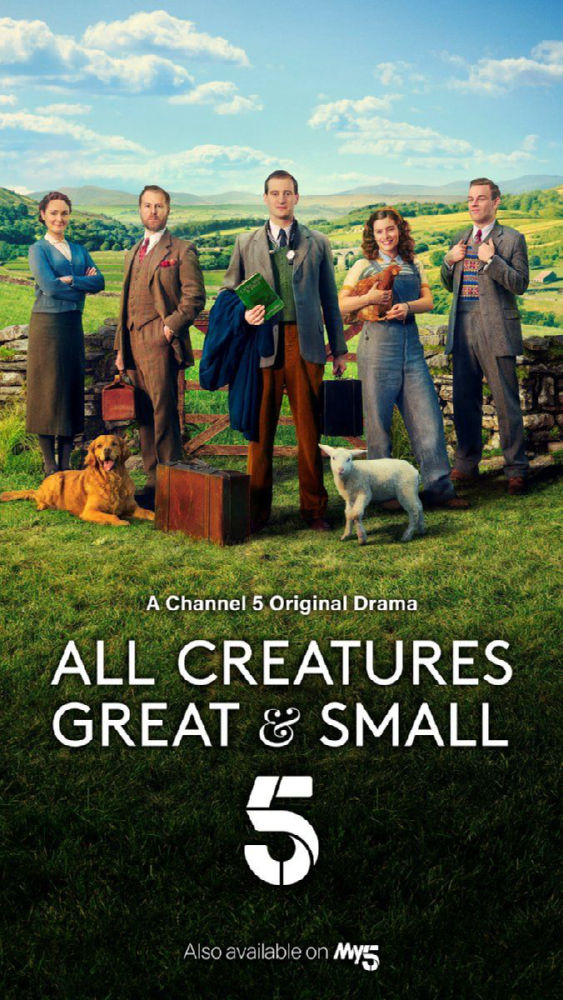
All Creatures Great and Small follows James Herriot, a young Scottish veterinary surgeon who arrives in the Dales town of Darrowby to take a post at Skeldale House. He must master difficult calvings, ailing pets, and skeptical farmers while answering to the brilliant but mercurial practice owner Siegfried Farnon. Siegfried’s younger brother Tristan supplies comic chaos between college terms and clinic duties. Housekeeper Mrs. Hall steadies the men with practical care and quiet judgment. James’s professional trials soon intertwine with his growing regard for farmer’s daughter Helen Alderson, whose own responsibilities on the land match the demands he faces in the surgery.
As seasons pass, James earns the trust of the local farming community through long nights and hard-won successes with livestock and companion animals. His courtship of Helen advances amid family pressures, rival suitors, and the daily emergencies that define rural practice. Tristan’s scrapes and Siegfried’s exacting standards continue to test the household, while Mrs. Hall’s own past and loyalties surface in quieter moments. The approach of wider historical change presses on the valley, yet the core remains the work of healing animals and the chosen family that forms around the surgery table and the kitchen at Skeldale House.
Oops! Is this show WOKE?
Only an account holder or member can file. Cite a scene, a line, or a pattern. Other account holders +1 or −1 that argument, once each. The show is not WOKE until enough of them have given a +1. Enough −1s remove the write-up, and it is no longer shown.
Sign in to file a woke label. One of each criterion per member.
Comments and reviews
Report a mistake
Same rule as woke labels: one report, a written reason, and the community +1 or −1 it — once per member. A net +5 applies the change. Editors can hold it for review, or apply it immediately.
No mistake reports yet.
Sign in to report a mistake. One report per field, per member.
Member review
Ray Okonkwo Member
Oct 20, 2026
★★★★★★★★★★All Creatures Great and Small settles into a rhythm that feels honest about the work instead of dressing it up for nostalgia alone. James arrives green, Scottish accent still sharp against the Dales, and the show never pretends the first calving or the first skeptical farmer is glamorous. One early stretch that stuck with me is the overnight lambing where everything that can go wrong does, the barn cold, the ewe thrashing, and Siegfried barking corrections that sound cruel until you realize he is teaching under pressure. James comes out of it shaking and filthy and quietly proud. That sequence does more for his character than any speech about calling or destiny.
Siegfried is the engine. He is brilliant with animals and a walking contradiction with people—generous one minute, slamming doors the next, then pouring whiskey and acting like nothing happened. The comedy lands because Tristan keeps poking the bear between college terms, turning the surgery into a low-stakes battlefield of missing instruments and half-finished jokes. Mrs. Hall is the only adult in the house most days. She does not lecture; she just sets the table, notices who has not eaten, and decides when the men have gone far enough. Her scenes with James are some of the quietest and best—tea, a raised eyebrow, the sense that the household will hold if everyone does their part.
Helen is not written as a prize. She has her own farm work, her own stubbornness, and the courtship moves at the speed of real rural life: delayed by sick cows, rain, and the fact that neither of them has much free time. I liked that the show lets awkward silences sit. James is decent and a little stiff; Helen is practical and not interested in being rescued. Their walks and the occasional dance feel earned rather than scheduled for a romantic beat. When the practice and the Alderson place start overlapping, you feel the weight of two sets of responsibilities instead of a simple love story grafted on.
The animal cases themselves are the real mechanics. You get enough detail on breech births, milk fever, and the odd pet that refuses to die on schedule without turning into a veterinary textbook. The farmers range from the ones who trust the new lad immediately to the ones who test him with impossible horses and worse manners. Watching James learn to read a room—when to push, when to shut up, when to accept a bottle of homemade something as payment—is more interesting than any big dramatic arc. The show trusts small victories: a cow that stands, a dog that eats again, a farmer who finally nods instead of scowling.
There is comedy in the chaos of Skeldale House that never feels forced. Tristan’s schemes usually collapse under their own weight, Siegfried’s temper flares and then softens, and Mrs. Hall’s dry comments cut through the noise. I laughed harder at a simple dinner-table argument over whose turn it was to fetch the next bottle than at most sitcom setups. The period details stay in the background—cars, clothes, the radio—without the production waving them at you. It feels like a place people actually live and work rather than a museum set.
What keeps it from being perfect is occasional soft focus on the harder edges. Some later stretches lean a little too comfortably into the found-family warmth and let the professional stakes ease off. A couple of guest farmers feel sketched rather than lived-in. Still, the core holds. The bonds form the way they do in real practices: through shared exhaustion, shared mistakes, and the stubborn refusal to leave a sick animal overnight. James earns his place slowly. That patience is the show’s real strength.
I came back to it because it respects the grind. Veterinary work in that setting is dirty, cold, and often unpaid in cash, yet the people keep showing up. The household at Skeldale is messy and loyal in equal measure. Helen’s world on the land is treated with the same seriousness as the surgery. Nothing is made into a statement; it just is. That restraint is rare enough that a 4.5 feels right—strong, steady, worth the evenings it asks for, without needing to be more than a good story about people who look after animals and each other in a hard beautiful place.