



 TV · 2021
Age of Samurai: Battle for Japan
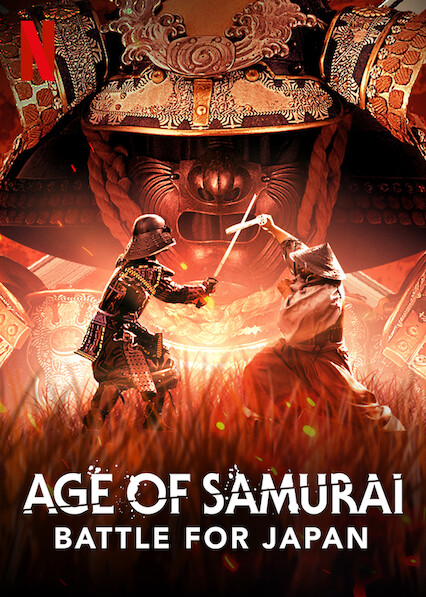
Reenactments and historians recount the Sengoku-era wars in which rival daimyo fought to unify 16th-century Japan. The series tracks the successive rises of Oda Nobunaga, Toyotomi Hideyoshi, and Tokugawa Ieyasu through conquest and political maneuvering.
Age of Samurai: Battle for Japan follows Oda Nobunaga, the ruthless daimyo who breaks from traditional warfare to seize control of central Japan in the mid-1500s. Nobunaga employs firearms, scorched-earth tactics, and calculated alliances to crush rival clans and Buddhist warrior-monks who oppose him. Dramatic reenactments show his forces storming fortresses and executing enemies after victories at places such as Okehazama. Expert commentators explain how his ambition and innovations destabilize the old feudal order. As his power expands, betrayal and overreach begin to threaten the coalition he has built. The narrative establishes the chaos of the Sengoku period through his relentless campaign for supremacy.
After Nobunaga’s death, the series shifts to Toyotomi Hideyoshi, the former peasant soldier who inherits and expands the unfinished conquest. Hideyoshi completes the military unification of the islands through sieges, diplomacy, and mass conscription while enforcing rigid social controls. Tokugawa Ieyasu then emerges as the patient survivor who outmaneuvers remaining rivals at Sekigahara and locks in lasting rule. Reenactments depict the final major battles, castle constructions, and political purges that end the century of civil war. Historians detail how each warlord’s choices reshape Japan’s map and hierarchy. The account closes on the Tokugawa settlement that brings relative peace after decades of bloodshed.
Oops! Is this show WOKE?
Only an account holder or member can file. Cite a scene, a line, or a pattern. Other account holders +1 or −1 that argument, once each. The show is not WOKE until enough of them have given a +1. Enough −1s remove the write-up, and it is no longer shown.
Sign in to file a woke label. One of each criterion per member.
Comments and reviews
Report a mistake
Same rule as woke labels: one report, a written reason, and the community +1 or −1 it — once per member. A net +5 applies the change. Editors can hold it for review, or apply it immediately.
No mistake reports yet.
Sign in to report a mistake. One report per field, per member.
Member review
Dan Reilly Member
Oct 20, 2026
★★★★★★★★★★Age of Samurai: Battle for Japan had me checking the runtime more than once, and not always for the right reasons. Six episodes try to cover the entire scramble of the Sengoku period, the rises and collapses of Oda Nobunaga, Toyotomi Hideyoshi, and Tokugawa Ieyasu, and it shows. The information comes at you dense and fast—intrigue, battles, turning points stacked end to end—so you get the shape of the story without much room to sit with any single campaign or decision. I kept wanting a slower look at how Nobunaga actually broke from the old rules of war, how the firearms and scorched-earth choices landed on the ground for the people who had to live through them, instead of the next fortress already falling. The talking-head historians are solid, but the cuts between them and the staged fights sometimes yank you out just when the tension should hold. Betrayal and overreach get mentioned, yet they feel more like checklist items than lived moments. That compression is the biggest drag for me. A longer run or tighter focus on two or three pivotal years would have helped the weight land.
Even so, the production side is hard to dismiss. The reenactments are filmed at a level that looks closer to a feature than most documentary filler. Armor, smoke, the press of bodies at places like Okehazama—those sequences have real scale and clarity. You can follow the tactics without a narrator spoon-feeding every move. Nobunaga’s willingness to use guns and burn what stood in his way comes through cleanly in the images, and the experts do a clean job explaining why that shook the older feudal habits. I didn’t need another polished samurai myth; what works here is the willingness to show calculation and ruthlessness without dressing it up as pure heroism. Hideyoshi and Ieyasu get their stretches too, and the political maneuvering after Nobunaga’s coalition starts fraying is sketched with enough detail that you understand the stakes even if you already knew the broad outline.
I went in half-expecting the usual glossy treatment that turns every warlord into a tragic genius. This one stays closer to the ground. The series doesn’t apologize for the blood or the opportunism, and it doesn’t pretend the Buddhist warrior-monks were simply obstacles to progress. That steadiness kept me watching past the spots where the pace felt rushed. You get successive rises through conquest and alliance, and the camera work makes the fortresses and open fields feel like places rather than sets. If the material interests you at all, the craft is high enough that the dense packing becomes more of a trade-off than a deal-breaker. I still wanted breathing room—more time on the cost of those scorched villages, more texture around the shifting loyalties—but I never felt talked down to or sold a simplified morality play.
There is a slight sameness to some of the battle staging after a while; once you’ve seen one storming of walls done well, the next one risks blending in. A couple of the expert segments lean toward summary when a sharper argument would have landed harder. Those are real limits. Yet the overall package stays surprisingly watchable for something trying to move through that much history in a short span. The reenactments carry a lot of the load and mostly earn it. I came away knowing the sequence of power more clearly than when I started, and without the sense that someone had sanded the edges off for modern comfort. That counts for something. It isn’t perfect television, and the squeeze of six episodes keeps it from being great, but it is a well-made look at a brutal, complicated stretch of Japanese history that doesn’t waste your time on empty spectacle. For a 3.5 it sits right where it should: worth the hours if the period already pulls you in, easy to skip if you need deeper character work or slower storytelling. I finished it, thought about the choices these men made, and didn’t feel cheated by the presentation. That is enough for me to recommend it with the caveats already listed, and not enough for me to pretend the pacing problems disappear just because the armor looks good on camera.