
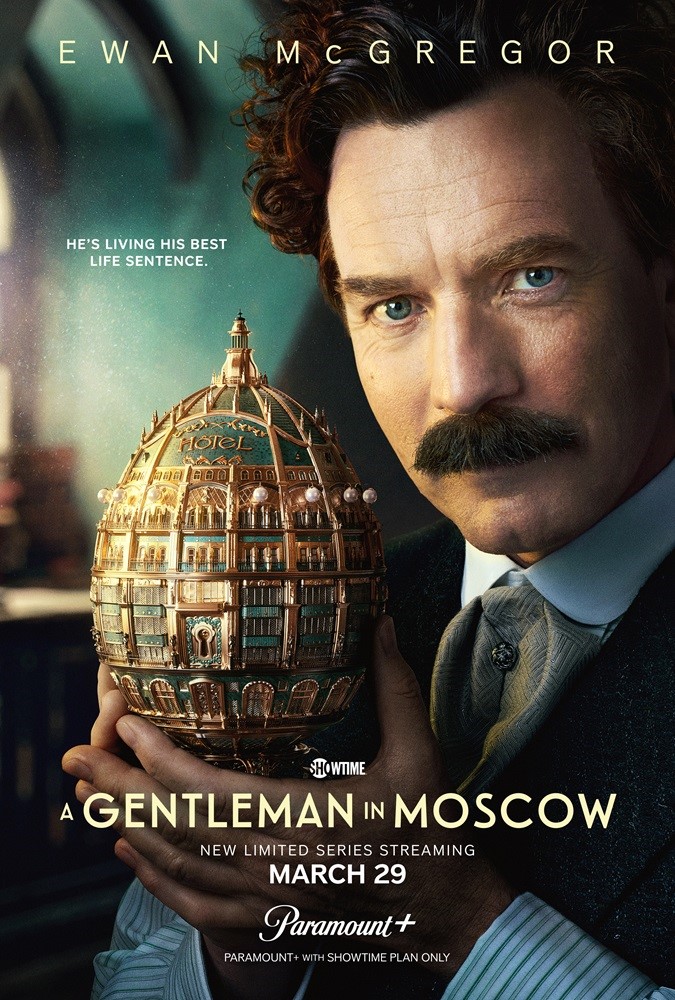



 TV · 2024
A Gentleman in Moscow
After the Bolshevik Revolution, Count Alexander Rostov is confined for life to Moscow’s Hotel Metropol, where friendships and quiet acts of defiance reshape what freedom and family mean to him.
A Gentleman in Moscow follows Count Alexander Rostov, a cultured Russian aristocrat who escapes a firing squad only to receive a life sentence of house arrest inside the elegant Hotel Metropol. Stripped of title and fortune, he is moved from a grand suite into a cramped attic room while the city outside transforms under Soviet rule. Rostov clings to courtesy and routine, befriending waiters, a seamstress, and other staff who still move freely through the building. A precocious young guest named Nina draws him into the hotel’s hidden passages, kitchens, and rooftop vantage points, teaching him how the Metropol truly operates. Through these daily encounters he begins to measure worth by loyalty and small kindnesses rather than estates or rank. The early years establish both the cage of his confinement and the unexpected community that forms around him.
As decades pass inside the same walls, Rostov’s bond with Nina deepens into a lasting responsibility when circumstances leave her daughter Sofia in his care. He raises the girl amid shifting political winds, protecting her education and spirit while Soviet officials and hotel managers watch his every move. A complicated romance with the glamorous actress Anna Urbanova offers intimacy and risk, pulling the count into the regime’s cultural and surveillance machinery. Rostov uses wit, old-world manners, and carefully chosen alliances to shield the people he loves from purges and suspicion. Later crises force him to weigh personal safety against the chance to secure Sofia’s future beyond the hotel. The series tracks how a man once defined by privilege discovers purpose through steadfast relationships forged under constant authoritarian pressure.
Click any of the following icons below to rent or stream it!
Oops! Is this show WOKE?
Only an account holder or member can file. Cite a scene, a line, or a pattern. Other account holders +1 or −1 that argument, once each. The show is not WOKE until enough of them have given a +1. Enough −1s remove the write-up, and it is no longer shown.
Sign in to file a woke label. One of each criterion per member.
Comments and reviews
Report a mistake
Same rule as woke labels: one report, a written reason, and the community +1 or −1 it — once per member. A net +5 applies the change. Editors can hold it for review, or apply it immediately.
No mistake reports yet.
Sign in to report a mistake. One report per field, per member.
Member review
Stu Kline Member
Oct 7, 2026
★★★★★★★★★★A Gentleman in Moscow earned a 4 from me without much internal debate. It does what it sets out to do and stays out of its own way most of the time.
The premise is clean. Count Alexander Rostov, Russian aristocrat, gets spared the firing squad in 1922 and locked inside the Hotel Metropol for life. He moves from a nice suite down to a cramped attic room. Outside the doors the Bolsheviks remake the country. Inside he has to figure out how to keep living like a man who still has standards. That tension is the whole engine, and the show mostly trusts it.
Ewan McGregor carries the thing. He plays Rostov as someone who refuses to collapse into bitterness or self-pity, even when the room gets smaller and the rules get stupider. You watch him learn the hotel from the inside—staff, routines, the quiet ways people survive under a system that hates what he used to be. He becomes head waiter later on. It should feel like a fall. Instead it feels like a man deciding dignity is portable. McGregor never sells it too hard. He just shows up every episode with the same quiet spine.
The supporting people around him make the confinement work. The staff aren’t props. They have their own reasons for staying and their own small rebellions. Guests come and go and leave marks. Over the decades you see how a single building can hold a whole miniature society when the one outside is busy eating itself. The show doesn’t rush the years. It lets the weight of time sit on Rostov’s shoulders without turning every scene into a history lecture.
I liked that it doesn’t apologize for the Count being who he is. He’s polished, educated, used to comfort, and the story never treats those things as original sins that need scrubbing. The Bolsheviks are the ones with the guns and the tribunals and the appetite for tearing everything down to the studs. The show lets that reality stand. Rostov adapts without becoming a convert. That choice matters. Too many stories these days would have sanded him down into some kind of eager student of the new order. This one doesn’t.
There are stretches where the pace dips. Thirty years inside one hotel means some episodes lean on conversation and small gestures more than big turns. If you need constant plot machinery you might get restless. I didn’t mind. The quieter hours are where you see how a man keeps himself intact when every external marker of his life has been stripped. The hotel becomes a character in its own right—grand public rooms downstairs, the attic up top, the kitchens and corridors in between. You start to know the geography the same way Rostov does.
Production looks expensive without flashing it in your face. Costumes, the hotel interiors, the slow shift in atmosphere as the decades move—it all feels considered. The writing trusts the audience to keep up with the history instead of stopping every five minutes to explain who Trotsky was this week. That respect is rare enough that I noticed it.
One thing that kept the score from going higher is a slight softness in the later stretches. Once Rostov finds his rhythm inside the hotel, some of the sharper edges dull a little. The community he builds is warm and the show enjoys that warmth, sometimes at the expense of the colder reality pressing against the walls. I still bought the relationships. I just wanted one or two more moments where the outside world punched harder through the doors and forced harder choices.
Still, the core holds. A man of manners and taste stuck in a system that sees both as enemies, refusing to become small. He works, he forms bonds, he raises a kind of family out of the people the revolution left him with. None of it feels like a lesson plan. It feels like watching someone decide that the four walls won’t get the last word.
I watched it over a couple of weeks, an episode or two at a time. It sits well that way. You leave each installment with the sense that Rostov is still the same man, only more so—thinned by circumstance, sharpened by it. That’s harder to pull off than it sounds. A lot of limited series burn their lead out by the midpoint. McGregor and the writers keep the center steady.
If you want explosions and constant forward motion, look elsewhere. If you want a story about remaining yourself when the world has decided you no longer get a vote, this one lands. The hotel never becomes a prison in the simple sense. It becomes the place where a gentleman proves the title still means something after the titles have been abolished. I respected that. Four stars feels right—solid, thoughtful, worth the time without needing to pretend it’s perfect.