
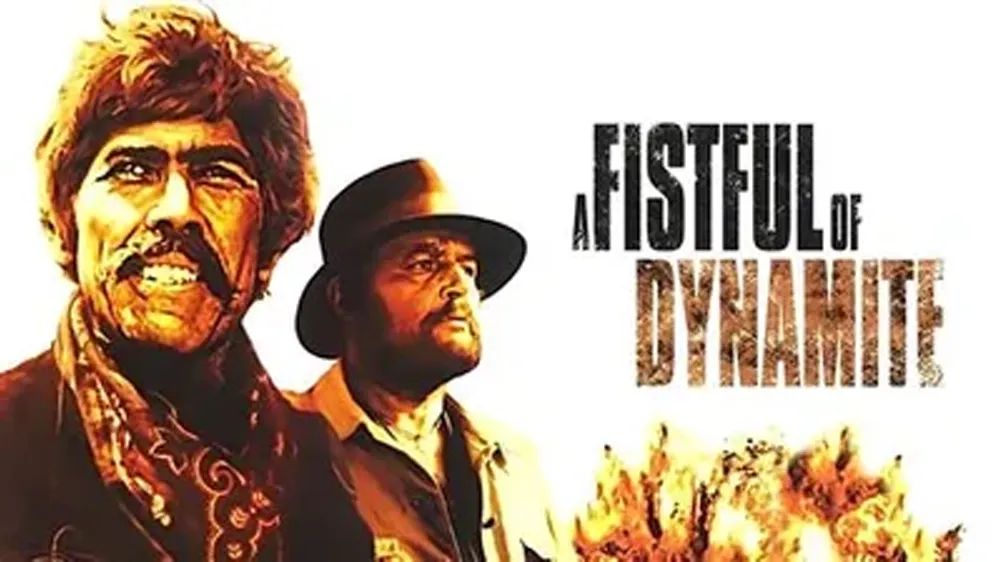



 MOVIE · 1971
A Fistful of Dynamite
A Mexican bandit and an Irish explosives expert turn a greedy bank job into revolutionary chaos and become unlikely figures in the Mexican Revolution.
A Fistful of Dynamite follows Juan Miranda, a coarse Mexican bandit who lives by robbing coaches with his many sons. He collides with John Mallory, an IRA dynamiter on the run, and strong-arms the Irishman into cracking a bank Juan thinks holds easy gold. The raid instead frees political prisoners, yanking both men into the Mexican Revolution against their narrower plans. Juan cares mainly for loot and his family’s survival, while John carries guilt and skill from earlier political violence in Ireland. Government troops and rebel factions close in as the pair’s uneasy deal hardens into a working partnership. Greed, loyalty, and sudden fame among the poor pull them deeper than either expected.
As fighting spreads, Juan and John keep hitting targets with dynamite while Juan still resists any cause larger than himself. John’s past and methods shape how they fight, and Juan’s family becomes entangled in the danger they create. A relentless army officer hunts them, raising the price of every score and every escape. Shared losses and betrayals force Juan to weigh pure self-interest against the people now looking to him. The two men push through larger battles and personal reckonings toward a violent climax that tests what their alliance is worth. Their path ends marked by the revolution’s cost rather than simple victory or spoils.
Creator: Sergio Leone · IMDb
Oops! Is this show WOKE?
Only an account holder or member can file. Cite a scene, a line, or a pattern. Other account holders +1 or −1 that argument, once each. The show is not WOKE until enough of them have given a +1. Enough −1s remove the write-up, and it is no longer shown.
Sign in to file a woke label. One of each criterion per member.
Comments and reviews
Report a mistake
Same rule as woke labels: one report, a written reason, and the community +1 or −1 it — once per member. A net +5 applies the change. Editors can hold it for review, or apply it immediately.
No mistake reports yet.
Sign in to report a mistake. One report per field, per member.
Member review
Dan Reilly Member
Oct 16, 2026
★★★★★★★★★★A Fistful of Dynamite never quite settles into the clean rhythm I wanted from a Leone picture, and that is the first thing that sticks with me. The two timelines keep cutting across each other in a way that feels more like a structural experiment than a necessity, and for long stretches the film seems more interested in showing you how clever the flashbacks are than in letting the present-tense partnership breathe. Rod Steiger’s Juan starts so broad and loud that I nearly checked out; the peasant-bandit act lands with a theatricality that can tip into cartoon, and early on it fights the dry precision Coburn brings to Sean. When the movie leans hard into the revolutionary set pieces, it also risks turning the Mexican struggle into a series of explosive set-dressings rather than something that feels lived-in. Those are real friction points, and they keep the whole thing from feeling airtight.
Once you accept the messiness, though, the film earns its keep. The relationship between the two men is the real engine, and it develops without speeches. Coburn’s Sean arrives already half-broken by whatever he left behind in Ireland, carrying that quiet IRA explosives skill like a private wound, and Steiger’s Juan gradually stops performing for the camera and starts reacting to another person who will not be bullied or charmed in the usual ways. Their shift from would-be bank robbers to something more entangled and necessary feels earned precisely because neither man softens on cue. Leone lets the distrust and the reluctant reliance pile up through action and small gestures instead of dialogue that explains everything. When Sean finally drops the famous “Duck, you sucker!” line at the right moment, it lands because the film has already shown you why that cry matters between them.
The violence and the humor sit side by side in a way that still feels slightly off-kilter in the best sense. Explosions are frequent and often played for a grim joke, yet the aftermath is never brushed aside as pure comedy. The prison job that Juan expects to be a simple bank score turns into a liberation of revolutionaries, and his disgust is funny and ugly at once. Leone does not ask you to cheer the cause without noticing the bodies or the dirt under the idealism. Morricone’s score helps hold that tone; it is memorable without constantly announcing itself, giving the bigger set pieces a lift while still leaving room for the quieter, more sour stretches between Juan and Sean. I kept noticing how the music refuses to make either man a pure hero or pure clown.
What keeps me at a solid four rather than higher is the uneven texture. Some sequences feel ground-breaking in the same restless way Leone’s better-known westerns do—the scale, the sudden shifts from farce to brutality, the way the Mexican Revolution becomes both backdrop and pressure cooker. Other stretches drag or over-explain through the flashbacks. Coburn is excellent throughout; he carries the weight of a man who has already lost one fight and is trying not to lose another. Steiger eventually matches him, but it takes longer than it should, and there are scenes where the low-life bandit bit still feels one size too large. The film is vibrant and violent and occasionally tongue-in-cheek, yet it never fully decides whether it wants to be a buddy adventure with dynamite or a darker meditation on how revolutions chew up the people who stumble into them.
I like that it refuses the tidy moral ledger. Juan is not ennobled just because he ends up on the side of the rebels for a while, and Sean is not purified by his explosives expertise. Their alliance is practical, then personal, then something closer to loyalty under fire, and the government troops hunting them feel like a real consequence rather than a plot device. When Juan is captured and facing execution, the rescue does not play as pure triumph; it plays as two damaged men refusing to let the other die alone. That is more interesting than a clean victory lap. Leone’s camera still finds beauty in dust and heat and sudden motion, but it also keeps the cost visible.
For a 1971 film that is trying to do more than recycle the spaghetti-western formula, it mostly succeeds by staying a little awkward and a little ambitious. I would not call it seamless, and I would not pretend every joke or every timeline cut works. But the core of it—the strange, deepening reliance between a loud Mexican bandit and a quiet Irish explosives man on the run—holds up. The humor, the action, the Morricone cues, and the willingness to let both men remain complicated keep it well above the average revolutionary adventure. It is the kind of movie that improves once you stop expecting it to behave like the cleaner Leone entries and just let the grit and the dynamite do their work. Four stars feels right: plenty of real strength, enough friction to keep it honest, and a partnership that stays with you after the last explosion fades.