
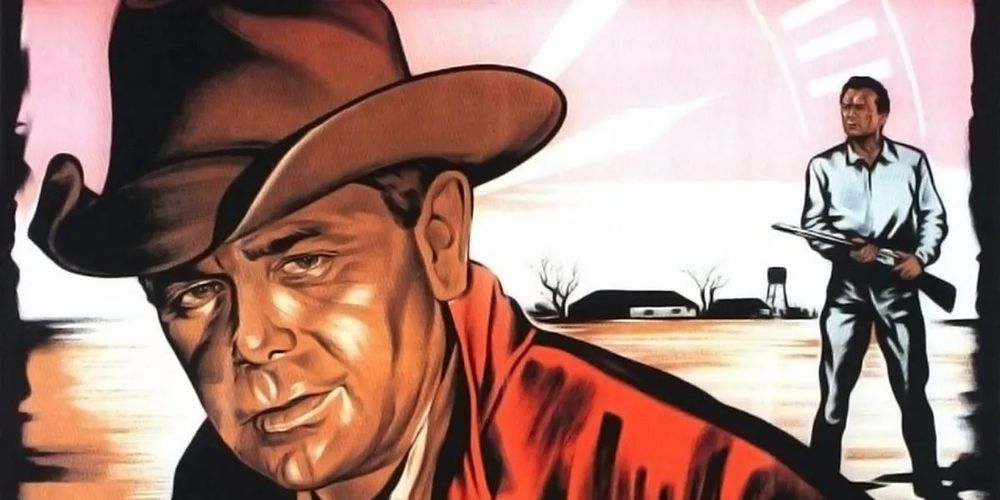



 MOVIE · 1957
3:10 to Yuma (1957)
Broke small-time rancher Dan Evans is hired by the stagecoach line to put big-time captured outlaw leader Ben Wade on the 3:10 train to Yuma but Wade's gang tries to free him.
After outlaw leader Ben Wade is captured in a small town, his gang continues to threaten. Small-time rancher Dan Evans is persuaded to take Wade (in secret) to the nearest town with a railway station to await the train to the court in Yuma. Once the two are holed up in the hotel to wait, it becomes apparent the secret is out and a battle of wills starts.
Oops! Is this show WOKE?
Only an account holder or member can file. Cite a scene, a line, or a pattern. Other account holders +1 or −1 that argument, once each. The show is not WOKE until enough of them have given a +1. Enough −1s remove the write-up, and it is no longer shown.
Sign in to file a woke label. One of each criterion per member.
Comments and reviews
Report a mistake
Same rule as woke labels: one report, a written reason, and the community +1 or −1 it — once per member. A net +5 applies the change. Editors can hold it for review, or apply it immediately.
No mistake reports yet.
Sign in to report a mistake. One report per field, per member.
Member review
Wes Calder Member
Oct 16, 2026
★★★★★★★★★★I put 3:10 to Yuma on again last week mostly because the house was quiet and I remembered the hotel room more than the riding. The 1957 one, Delmer Daves, black and white, the version that doesn’t try to shout. It still works. Not in a flashy way. In the way a clean job of carpentry works: the joints hold and you don’t spend the whole time noticing the nails.
Dan Evans is a rancher who has had a dry spell and a worse one in his pride. He takes the money to get Ben Wade onto the train that leaves at three-ten for Yuma. That is the whole contract. Wade’s men are still out there, and everybody in the town knows it by the time the two of them are upstairs waiting. The movie understands that once the secret is gone the real problem is not the posse outside but the hours inside. Glenn Ford plays Wade with a kind of polite amusement that never quite turns into swagger. He talks like a man who has already won most of the arguments he has ever had and is curious whether this one will be different. Van Heflin’s Evans does not answer every line. He just sits there looking like a man who has calculated the cost of walking away and decided he cannot afford it. That is enough. You do not need speeches about honor when the face already carries the arithmetic.
I like how little the picture inflates itself. The town feels small because it is small. The hotel room is just a room with a window and a door that will not hold forever. Time is the pressure, not some speech about destiny. You watch the light change a little and you hear the talk downstairs and you know the gang is buying drinks and waiting for the right moment. Wade keeps offering Evans ways out that sound reasonable. Money, safety, the chance to go home without a hole in him. Evans keeps declining in the same flat tone he used when he took the job. It is not noble in the stained-glass sense. It is stubborn in the way a man gets when he has already lost enough and does not want to add one more item to the list.
There are weaker patches. A couple of the townsmen feel like they wandered in from a lesser script, and the final stretch at the station has to compress what the hotel room expanded so carefully. I never mind that much. The center holds. Ford and Heflin keep the temperature even when the plot has to hurry. You believe both men could still change their minds right up until they don’t. That uncertainty is rarer than people admit in westerns of this period. Most of them decide early who is pure and who is damned and then march toward the inevitable. This one lets the minutes do the deciding.
I have seen the later version. It has its own virtues and a different kind of noise. The older one stays with me because it trusts silence and a closed door. No big declarations about the West or the law. Just two men in a room and a clock and the knowledge that the train will come whether they are ready or not. Evans needs the money for his family and the ground that will not grow anything. Wade needs to get free and keep the legend he has built around himself. Neither one gets exactly what he wanted at the start, and the movie does not pretend otherwise.
Watching it now I notice how little it leans on scenery or score to tell you what to feel. The black and white helps. Faces matter more. Dust and sweat and the tired set of Heflin’s shoulders do the work that color and wide lenses sometimes paper over. I am not saying every frame is perfect. A few exterior bits feel staged in the old studio way. But the hotel scenes are the reason the picture earned its keep, and they still do. You sit with them the way you sit with a long wait in real life: half hoping something breaks the tension, half knowing the break will be worse than the waiting.
I gave it four. That feels honest. It is not the loudest western I own and it is not trying to be a monument. It is a tight, adult piece of work about a man who takes a bad job for good enough reasons and then discovers he cannot quit it without becoming someone he refuses to be. Wade is charming enough that you understand the pull. Evans is plain enough that you understand the cost. The rest is the clock and the men outside and the simple fact that three-ten comes once. I will probably put it on again the next time the house is quiet. Not because it demands reverence. Because it still holds the room without raising its voice.