
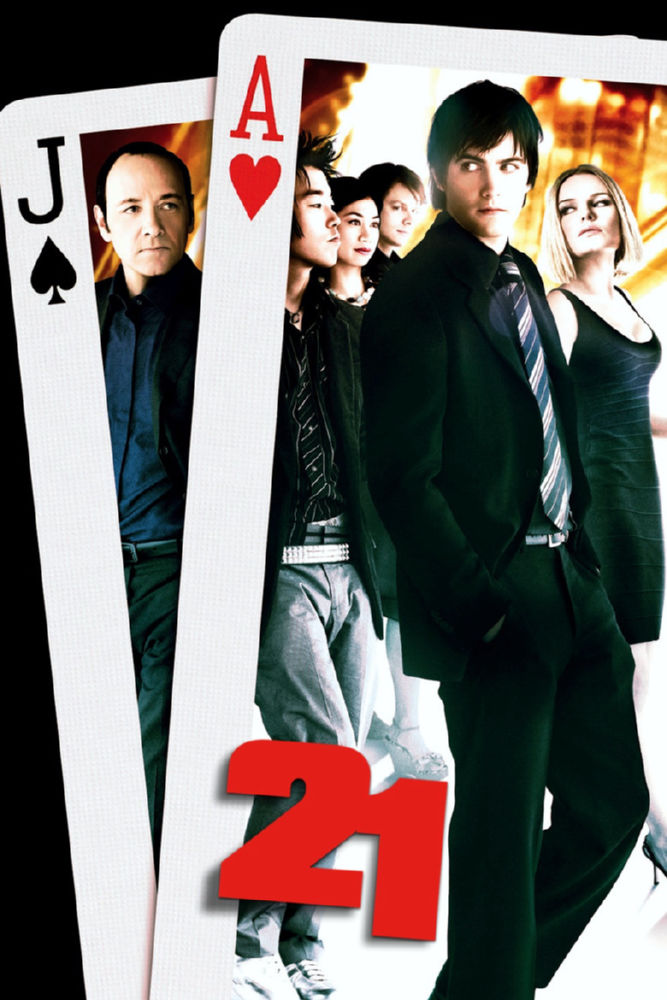



 MOVIE · 2008
21
An ambitious MIT math prodigy risks everything by joining an elite underground squad that systematically beats casino blackjack to bankroll his medical-school future.
21 follows facing crushing tuition costs that his working-class family cannot cover, the gifted undergraduate seizes an unexpected invitation from a charismatic professor. He enters a tightly knit circle of fellow students who have mastered advanced probability techniques for table games. Intensive drills transform abstract equations into real-time decisions under pressure. Bonds form quickly amid late-night strategy sessions and shared secrecy. The group’s disciplined approach promises life-changing winnings if they can stay undetected. Early successes fuel both excitement and the first hints of internal tension.
High-stakes weekends in glittering casino floors deliver adrenaline and rapidly mounting fortunes. Romantic sparks and shifting loyalties complicate the carefully maintained cover identities. Casino surveillance grows sharper, turning every hand into a potential catastrophe. Personal ethics clash with the lure of easy money as the operation scales up. Betrayals and close calls force painful choices about trust and ambition. Ultimately the young players confront whether the payoff justifies the mounting personal and legal dangers.
Oops! Is this show WOKE?
Only an account holder or member can file. Cite a scene, a line, or a pattern. Other account holders +1 or −1 that argument, once each. The show is not WOKE until enough of them have given a +1. Enough −1s remove the write-up, and it is no longer shown.
Sign in to file a woke label. One of each criterion per member.
Comments and reviews
Report a mistake
Same rule as woke labels: one report, a written reason, and the community +1 or −1 it — once per member. A net +5 applies the change. Editors can hold it for review, or apply it immediately.
No mistake reports yet.
Sign in to report a mistake. One report per field, per member.
Member review
Ray Okonkwo Member
Oct 22, 2026
★★★★★★★★★★I sat down with 21 again last week mostly because the blackjack math still sticks in my head longer than most heist setups. You watch Ben Campbell get pulled into that MIT team and the counting system itself becomes the real engine. Not magic tricks or gadgets. Just running tallies, team signals, and the way a table starts to tilt when the remaining deck gets rich in tens. The scenes where they practice in the back room with the cards flying and someone calling out the count feel tighter than half the actual Vegas floor work. You start wanting to try the basic strategy yourself, which is the kind of pull a movie like this should have.
Kevin Spacey’s professor character runs the show with that mix of charm and quiet pressure that makes you believe these kids would risk their scholarships for weekend cash. Jim Sturgess plays Ben as the kid who is smart enough to know better but hungry enough to ignore it, and that lands. Kate Bosworth’s character adds the romantic tension without turning every conversation into a lecture. The group dynamic works because they feel like students first: arguing over splits, celebrating small wins, then realizing the money changes how they look at each other. I liked that the film never pretends card counting is some grand criminal masterstroke. It is legal. The danger comes from the casino side, the guys who protect the house with more than cameras. Laurence Fishburne’s enforcer presence makes that clear without needing endless chase sequences. One quiet hallway confrontation does more work than a dozen shootouts would have.
The pace keeps things moving. You get the training montages, the first big scores, the lifestyle creep that follows, and then the moment the house starts closing ranks. It intrigues with a fascinating true story, fast pace, and fun characters, and that combination carries a lot of the runtime. There is a solid twist near the end that reorients what you thought you knew about loyalty inside the team, and it lands cleanly enough. At the same time the movie never quite digs past the surface of what that kind of pressure does to a person long-term. Ben’s academic life fades into the background once the chips stack up, and the film treats that fade as inevitable rather than something worth sitting with. A couple of the supporting players stay thin. You get their types more than their reasons.
What keeps it at a solid middle rating for me is how cleanly it stays inside its own lane. It wants to be a fun ride built on a real scheme, and it mostly is. The Vegas sequences have energy without drowning in neon clichés. You feel the heat of the rooms, the way a good shoe can shift the whole mood at a table, and the sudden drop when security takes an interest. The education angle never becomes preachy; the math is shown enough that you understand why it works without needing a classroom sequence every ten minutes. I appreciated that restraint. Too many films in this space either over-explain or treat the audience like they cannot follow a simple plus-minus system.
There are moments that feel slightly packaged, like the film knows exactly which emotional beat comes next and hits it on schedule. The rise-and-fall shape is familiar. Still, the specific flavor of college kids outthinking casinos gives it a fresher texture than a standard crew-of-thieves story. You root for them because the method is clever rather than brutal, and you wince when the consequences arrive because those consequences feel personal instead of abstract. The casino boss protecting his profits is not cartoon evil; he is a businessman who has seen this pattern before and knows exactly how far to go.
I came away entertained and a little more curious about the real MIT team stories than I was going in. That is a fair result for a Friday night watch. It does not reinvent anything, and it does not need to. The mechanics hold interest, the central performances stay likable, and the tension between smart kids and a system built to grind them down never fully lets go. If you have ever sat at a blackjack table and wondered whether the math could actually move the needle, this one scratches that itch without overstaying. Three and a half stars feels right: enjoyable, sharp in places, a touch too smooth in others, and worth the time if the premise already appeals. I might even pull it out again the next time someone starts arguing about whether counting cards is “cheating” or just paying attention.