



 TV · 2002
¡Mucha Lucha!
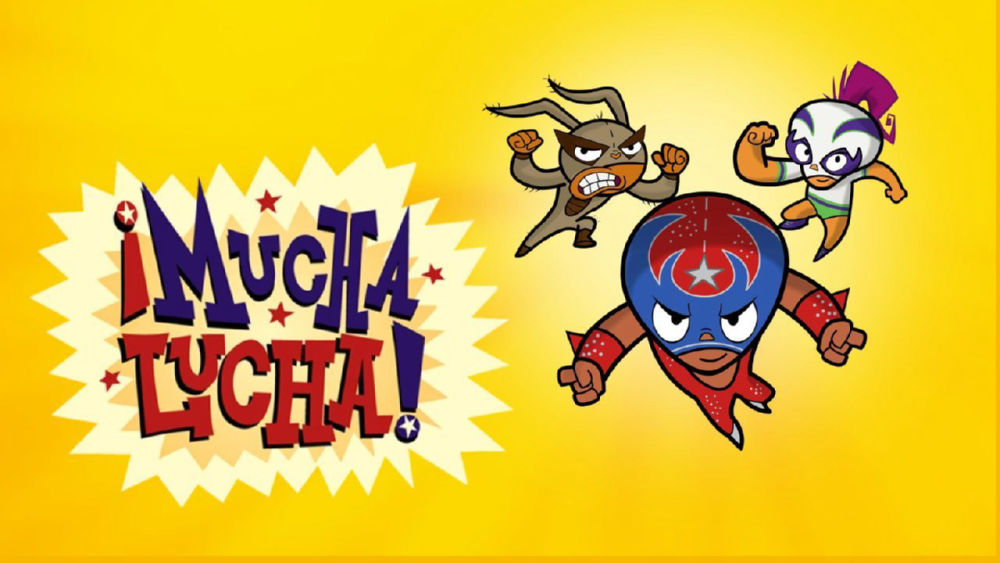
Three masked kids train at a lucha libre school in Luchaville, where costumes stay on and every signature move has a name and a punchline. Rikochet, Buena Girl, and the Flea chase wrestling glory through slapstick lessons and friendship.
¡Mucha Lucha! follows Rikochet, an eager young luchador who enrolls at the Foremost World-Renowned International School of Lucha with his closest friends Buena Girl and the Flea. They live in Luchaville, a Southern California town built around Mexican-style wrestling, where almost everyone wears a mask full-time and is known by a costume and a trademark move. Classes, rivalries, and daily errands all turn into exaggerated wrestling gags as the trio practices holds that can literally reshape a scene to match the move’s name. Rikochet charges in with heart, Buena Girl balances skill and rules, and the Flea brings chaotic energy and oddball tactics. Together they stumble through assignments, mask etiquette, and school hierarchy while trying to prove they belong among future champions. The early stretch stays focused on friendship, training mishaps, and the colorful code of the ring.
As the seasons continue, Rikochet, Buena Girl, and the Flea face tougher opponents, oddball teachers, and town-wide tournaments that test loyalty as much as technique. Their bond is strained by pride, secret moves, and the pressure to live up to legendary luchadores, yet they keep covering for one another when plans backfire. Side characters fill Luchaville with competing schools, family expectations, and over-the-top villains who still settle scores inside the ropes. A later direct-to-video story sends the same core trio against a larger threat tied to the return of El Maléfico, pushing their teamwork past classroom drills. Through it all the show stays on masks, moves, and kid-scale adventure rather than lectures, keeping the focus on how the three friends grow as partners in the ring.
Creator: Kimberly Brooks, Candi Milo
Click any of the following icons below to rent or stream it!
Oops! Is this show WOKE?
Only an account holder or member can file. Cite a scene, a line, or a pattern. Other account holders +1 or −1 that argument, once each. The show is not IS WOKE until enough of them have given a +1. Enough −1s remove the write-up, and it is no longer shown.
Sign in to file a woke label. One of each criterion per member.
Comments and reviews
Report a mistake
Same rule as woke labels: one report, a written reason, and the community +1 or −1 it — once per member. A net +5 applies the change. Editors can hold it for review, or apply it immediately.
No mistake reports yet.
Sign in to report a mistake. One report per field, per member.
Member review
Toni Briggs Member
Oct 20, 2026
★★★★★★★★★★¡Mucha Lucha! showed up on my radar the way a lot of early-2000s kids’ cartoons did—somebody left it on and the masks caught my eye before the story did. Three kids at a wrestling school in a town where almost nobody takes the mask off and every signature move has a name that sounds like it could rearrange your whole day. Rikochet, Buena Girl, and the Flea grind through the Foremost World-Renowned International School of Lucha trying to figure out who they are under the spandex. That premise still works on paper. Lucha libre already comes with built-in drama, honor codes, and ridiculous physical comedy, so hanging a series on kids learning the craft inside a place that treats the mask like a second skin felt like a smart hook.
I landed at three stars because the show never quite decides how seriously it wants to take its own world. Some episodes lean into the school structure and the friendships with real warmth; you get the sense these three actually care about each other and about getting better. Other stretches turn into pure gag reels where the move names do the heavy lifting and the character work stalls. The transformation gags tied to the moves are clever the first few times—someone hits a finisher and suddenly the whole dynamic flips—but they start to feel like a reset button instead of progress. After a while you can feel the writers reaching for the next loud set piece rather than letting a quieter win land.
What I liked most was the texture of Luchaville itself. Southern California filtered through Mexican wrestling culture, everybody costumed, everybody known by their move. It never felt like a lecture on heritage; it just lived there. The school hierarchy, the rivalries, the way a good mask and a clean technique still mattered more than raw power—that stuff held my attention longer than the slapstick. Buena Girl’s focus and the Flea’s underdog energy gave the trio some actual texture instead of three interchangeable punchlines. Rikochet’s big heart and bigger mistakes kept him from turning into a pure golden-boy lead. When the show stayed with their training and the small stakes of looking foolish in front of the class, it felt grounded in a way a lot of louder cartoons never bother with.
The weaker side is how often it drifts into formula. Challenge appears, signature move gets namedropped, chaos ensues, lesson is half-learned, end credits. You can clock the pattern early, and once you do the surprise drains out. The animation style is bold and clean for its time, but the facial expressions under the masks sometimes freeze into the same few shapes, which undercuts the emotion the writing is aiming for. And while the show is aimed at kids, it occasionally talks down instead of talking straight. I never needed the moral stamped on the forehead; the better episodes already showed it through the matches and the locker-room talk.
I kept watching because the core trio still felt like friends who would cover for each other when a move went wrong. That loyalty is rarer than it should be in this kind of series. The supporting roster of teachers and rivals had just enough personality to make the school feel populated rather than empty sets waiting for the next gag. Nobody is trying to reinvent the wheel here; they’re just running a wrestling school where the students take the craft seriously even when the results are ridiculous. That balance is harder than it looks, and ¡Mucha Lucha! hits it more often than it misses, which is why I didn’t drop lower than three.
Still, three is the honest number. The concept deserved tighter plotting and fewer episodes that exist only to showcase a new move name. When it trusts the characters and the culture it borrowed from, it has real charm. When it panics and piles on noise, it becomes background noise itself. I would put it on again for the good stretches—the training montages, the quiet talks about what the mask means, the moments when one of them finally lands a move clean—but I wouldn’t call it essential. It’s a solid afternoon watch that knows its lane and mostly stays in it, even if it occasionally wanders into the cheap seats for an easy cheer. The masks stay on, the friendships hold, and the school keeps its doors open. That was enough for me to finish the run without resentment, and not quite enough to push it higher. If you already like lucha libre or just want a kids’ show that treats costumes as identity instead of costume-party props, it’s worth the time. Just don’t expect every episode to stick the landing the way a good top-rope dive should.